
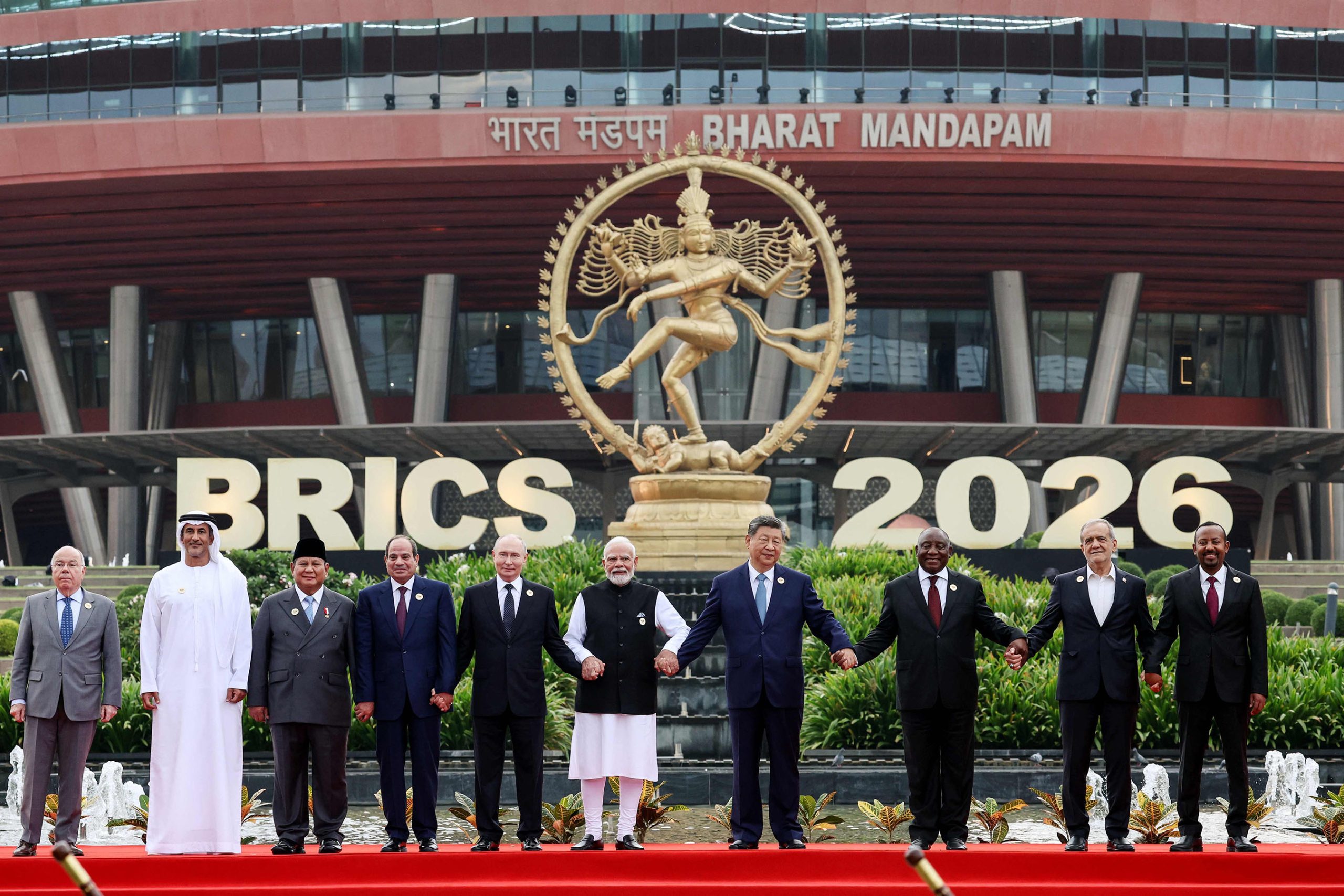
In this pool photograph distributed by the Russian state agency Sputnik, (L-R) Brazil's Foreign Minister Mauro Vieira, UAE's Supreme Council for National Security Secretary-General Ali Mohamed Hammad Al Shamsi, Indonesia's President Prabowo Subianto, Egypt's President Abdel Fattah al-Sisi, Russia's President Vladimir Putin, India's Prime Minister Narendra Modi, China's President Xi Jinping, South Africa's President Cyril Ramaphosa, Iran's President Masoud Pezeshkian and Ethiopia's Prime Minister Abiy Ahmed pose for a family photo during the 18th BRICS Summit in New Delhi. (Photo by Alexander KAZAKOV / POOL / AFP)
Kathmandu, September 13: The conclusion of the 18th BRICS Summit at Bharat Mandapam in New Delhi marks a definitive milestone in contemporary international relations.
Hosted under India’s chairship with the theme building for resilience, innovation, cooperation, and sustainability, the two-day gathering of emerging economies served as a major laboratory for designing a post-Western global architecture.
Representing roughly 45 percent of the global population and over a third of global GDP, the expanded 11-member bloc demonstrated that the gravity of global commerce and strategic thought is shifting decisively toward the Global South.
Yet, beyond the polished rhetoric of mutual development and multilateralism, the New Delhi summit delivered sharp geopolitical signals.
These signals include a deliberate challenge to dollar hegemony, an institutional embrace of Artificial Intelligence governance from a non-Western perspective, and a calculated geopolitical shield around Tehran.
For immediate neighbors like Nepal, the event became a stark reminder of the costs of diplomatic insularity and poor political judgment.
The Multipolar World Order and the De-Dollarization Imperative
For decades, the architecture of global trade and finance has been anchored in Washington and Western European capitals.
The New Delhi summit underscored that this unipolar comfort zone is eroding. While avoiding the immediate creation of a single, unified BRICS currency, the summit heavily emphasized financial sovereignty through local-currency settlements and alternative payment systems.
International analysts note that the systemic weaponization of Western financial networks has accelerated a quiet migration of trade away from the greenback.
By backing the expansion of the New Development Bank and promoting localized currency financing, BRICS is building a parallel plumbing system. This shift provides emerging economies with structural insurance against external shocks and sanctions, laying the bedrock for a polycentric century.
Xi Jinping’s Five Initiatives: Institutionalizing the Digital and Technological Future
A defining moment of the summit came on its second day, when Chinese President Xi Jinping laid down a concrete roadmap for greater BRICS cooperation.
Xi proposed five strategic initiatives targeting areas critical to future economic survival. These areas cover artificial intelligence governance, trade and investment facilitation, the digital industry, smart manufacturing, and talent development.
Xi’s blueprint addressed a core vulnerability of the Global South, which is the danger of being relegated to mere consumers of technology.
By emphasizing innovation incubators and resilient supply chains, China and its partners are attempting to anchor future technological value chains within the developing world. International coverage frames these proposals as an effort to transform BRICS into a practical, integrated economic bloc.
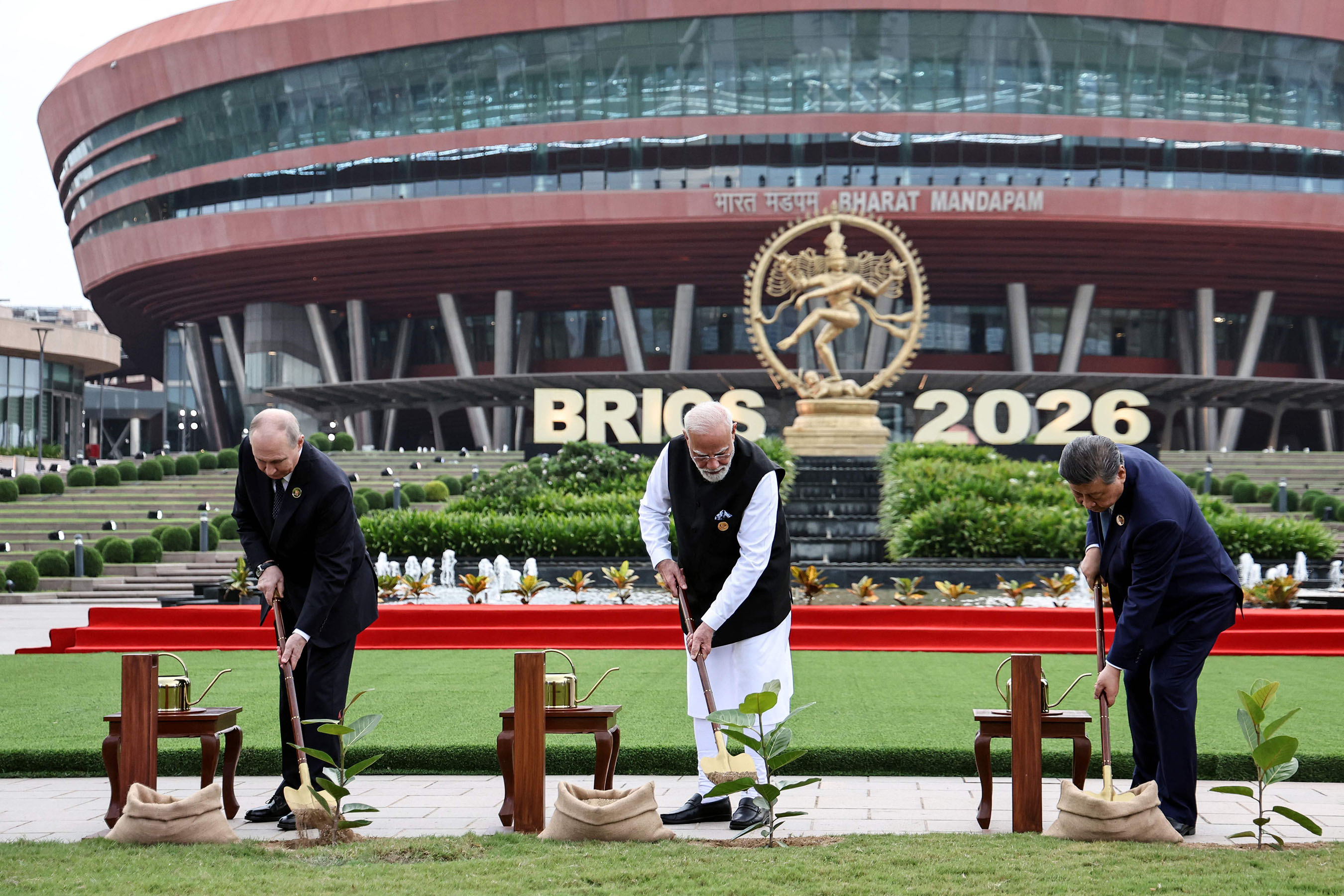
The Geopolitical Prism of Iran: A Unified Embrace by India, China, and Russia
Perhaps the most geopolitically charged subtext of the New Delhi summit was the prominent presence and treatment of Iran. Amid volatile tensions in the Middle East, the collective welcoming of Iranian leadership by New Delhi, Beijing, and Moscow carried profound symbolism.
For Russia and China, Iran represents a crucial axis in defying Western isolation. For India, engaging Tehran at a high level demonstrates that New Delhi’s commitment to the Global South overrides external pressures. It sends a clear message that attempts to isolate sovereign states through unilateral fiat will find a robust counterweight in BRICS.
The Nepal Paradox: Absence, Indifference, and Long-Term Implications
While the rest of the developing world looked to New Delhi as the epicenter of a new global paradigm, Nepal’s response ignited sharp domestic concern. Taking place right at its doorstep, the summit offered a historic platform representing nearly half of humanity, yet Kathmandu remained conspicuously absent.
The Contrast in Diplomatic Engagement
No leaders, bureaucrats, or representatives from Nepal received any invitations or priority from the summit organizers. This total absence highlights a sharp contrast with recent history. Earlier, political figures like Rabi Lamichhane received warm welcomes and high-level attention during visits to India. The complete shut-out of the Nepali state apparatus this time signals a severe cooling of diplomatic goodwill.
The Cost of Political Immaturity
Nepal is now facing diplomatic isolation. Part of this trouble comes directly from the reckless behavior of Nepal’s own leaders. The Prime Minister recently made careless remarks in parliament regarding India. Lawmakers and regional observers correctly called these statements a sign of profound political immaturity. Shouting matches and populist rhetoric in domestic politics do little to build international trust.
Long-Term Risks for Kathmandu
Failing to act with maturity has real and lasting risks for Nepal.
- Bypassed Infrastructure: As BRICS nations and their partners reshape trade corridors and digital infrastructure, Nepal risks being left completely outside these vital regional networks.
- Loss of Alternative Finance: Missing out on platforms like the New Development Bank means Nepal will struggle to access non-conditional capital for its massive developmental needs.
- Diplomatic Irrelevance: In a rapidly consolidating multipolar world, small nations that rely on offensive rhetoric instead of smart diplomacy risk becoming irrelevant spectators.
Way Forward
The 18th BRICS Summit in New Delhi proved that the bloc is evolving into a durable vehicle for alternative global governance.
From Xi Jinping’s technology initiatives to the pushback against dollar dominance and the embrace of Iran, the message is unmistakable.
The rules of the 21st-century global order will increasingly be written by the Global South. For a country like Nepal, the lesson is clear. Surviving and thriving in a multipolar world requires mature leadership, strategic foresight, and active, respectful regional diplomacy rather than populist posturing.