

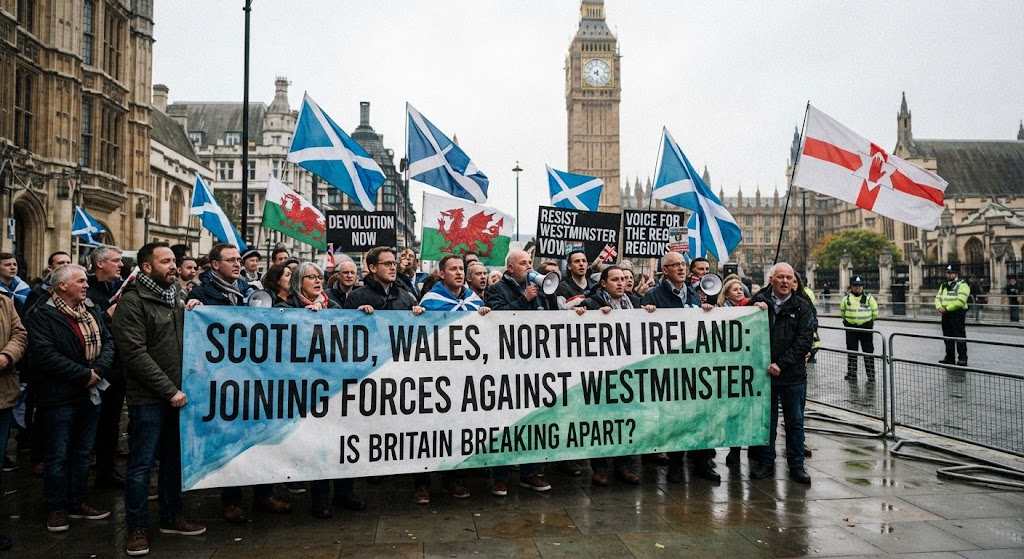
London, Sept. 16: The political foundations of the United Kingdom are facing a fresh challenge after the leaders of Scotland, Wales and Northern Ireland joined forces to demand greater constitutional self-determination, raising renewed questions about whether the United Kingdom can remain intact in its present form.
The leaders met in Cardiff this week and signed a joint political agreement calling for constitutional change and asserting the right of their nations to determine their own futures. The meeting brought together the leadership of Scotland’s Scottish National Party, Wales’ Plaid Cymru and Northern Ireland’s Sinn Féin.
The development does not mean that Scotland, Wales or Northern Ireland has declared independence. Nor has the United Kingdom formally begun a process of dissolution. Rather, the agreement represents a coordinated political demand for Westminster to recognize the right of the constituent nations to determine their constitutional arrangements.
But the symbolism is significant.
For decades, demands for Scottish independence, Welsh independence and Irish reunification have largely developed along separate political tracks. Their leaders are now increasingly presenting the question as part of a broader debate over the future structure of the United Kingdom.
Scotland at the centre of the dispute
Scotland remains the most developed independence movement within Britain.
Scotland rejected independence in the 2014 referendum, when voters chose to remain in the UK. Since then, however, Brexit has altered the political environment. Scotland voted overwhelmingly to remain in the European Union in the 2016 Brexit referendum, while the UK as a whole voted to leave.
The Scottish National Party continues to demand another independence referendum. The Institute for Government notes that the SNP won a fifth consecutive Scottish Parliament election in 2026, although it did not secure the 65 seats required for an outright majority.
Public opinion, however, remains divided. Recent polling cited by the Financial Times and Reuters places Scottish independence support around the 50-percent level, illustrating a closely divided electorate rather than an established mandate for separation.
Wales also moves into the constitutional debate
Wales has traditionally had a weaker independence movement than Scotland, but the issue has gained greater political visibility.
Plaid Cymru, the principal Welsh nationalist party, is now part of the wider constitutional campaign. Recent polling has nevertheless shown that support for Welsh independence remains substantially below a majority. A YouGov/BarnCymru survey conducted in January 2026 found 26 percent support for independence against 54 percent opposition.
That means the Welsh position is politically important, but public opinion does not currently demonstrate a clear majority for leaving the United Kingdom.
Northern Ireland is different
Northern Ireland presents a fundamentally different constitutional question because its future relationship with the United Kingdom is explicitly addressed by the 1998 Good Friday Agreement.
Under that settlement, a referendum on Irish unity can be held if the UK government’s Northern Ireland Secretary considers that it is likely that a majority would vote for Northern Ireland to cease being part of the United Kingdom and join a united Ireland.
The issue has gained fresh international attention following U.S. President Donald Trump’s recent comments supporting Irish reunification. Reuters reported that the British government subsequently reiterated that its position had not changed and that any border poll would require a clear shift in public opinion.
Thus, unlike Scotland and Wales, Northern Ireland has an established legal mechanism through which its constitutional status could eventually change.
Westminster rejects the idea of an imminent breakup
The new alliance does not mean that Westminster has accepted independence referendums.
The British government continues to oppose an immediate process leading to the breakup of the United Kingdom and has emphasized the need for clear public support before major constitutional changes are considered.
This creates the central constitutional confrontation: nationalist leaders argue that the constituent nations should have the democratic right to determine their own futures, while Westminster maintains that constitutional change must occur within the existing UK framework.
A united kingdom facing three different questions
The phrase “breakup of Britain” can therefore be misleading.
Scotland is debating independence from the UK.
Wales is debating whether it should eventually become independent, although support remains considerably lower.
Northern Ireland is debating whether it should remain in the UK or ultimately become part of a united Ireland.
These are not identical constitutional processes.
The Financial Times has highlighted the different legal and political circumstances facing the three territories. Northern Ireland has a defined route toward a unity referendum under the Good Friday Agreement, while Scotland and Wales do not have an equivalent automatic mechanism for holding independence referendums.
Is the United Kingdom actually breaking apart?
Not yet.
There has been no declaration of independence by Scotland or Wales, and Northern Ireland has not voted to leave the United Kingdom. The current development is better understood as a coordinated escalation of constitutional demands rather than the actual dissolution of the UK.
Nevertheless, the political significance should not be underestimated.
For the first time in this current phase of the debate, nationalist leaders from Scotland, Wales and Northern Ireland have publicly coordinated their constitutional demands. The move places renewed pressure on Westminster to address questions that Brexit, devolution and changing national identities have made increasingly difficult to contain within the traditional British union.
The question is therefore no longer simply whether Scotland wants another referendum.
It is increasingly whether the United Kingdom can maintain its existing constitutional structure when political forces in all three devolved nations are demanding a greater say over their own futures.
For now, Britain remains united legally and constitutionally.
But the debate over whether it should remain that way has entered a new and more coordinated phase.
(This news analysis is prepared on the basis of the information obtained from various international media).