

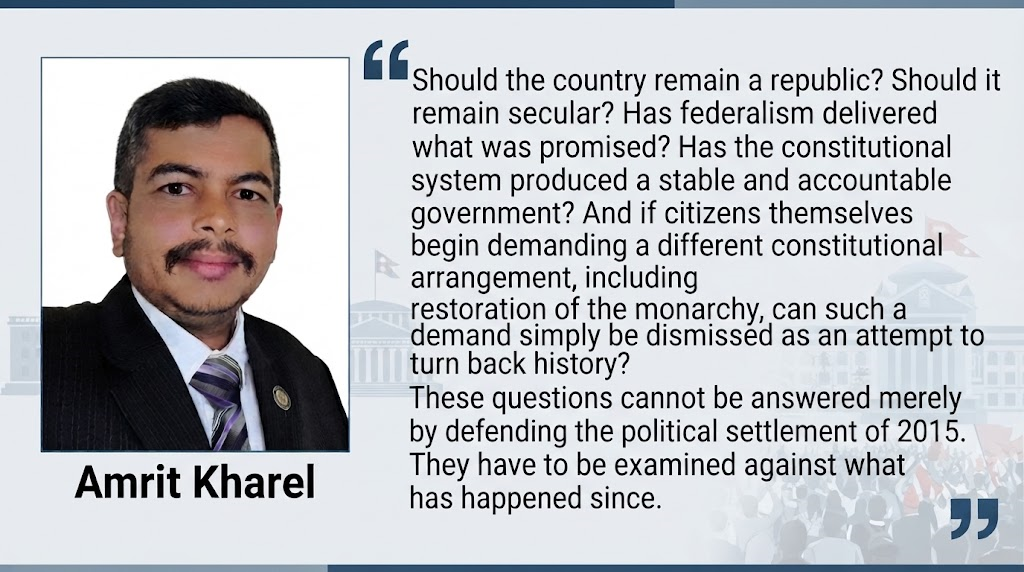
Amrit Kharel
Nepal’s Constitution was promulgated on September 20, 2015, after a long political transition that abolished the traditional monarchy, established a republic and attempted to restructure the state through federalism, inclusion and fundamental rights.
Its opening proposition was ambitious. Sovereignty and state authority, it declared, would belong to the Nepali people.
That sentence carries greater significance today than it did when the Constitution was promulgated.
Eleven years later, Nepal is again debating some of the fundamental questions that the Constitution was expected to settle permanently.
Should the country remain a republic? Should it remain secular? Has federalism delivered what was promised? Has the constitutional system produced a stable and accountable government? And if citizens themselves begin demanding a different constitutional arrangement, including restoration of the monarchy, can such a demand simply be dismissed as an attempt to turn back history?
These questions cannot be answered merely by defending the political settlement of 2015. They have to be examined against what has happened since.
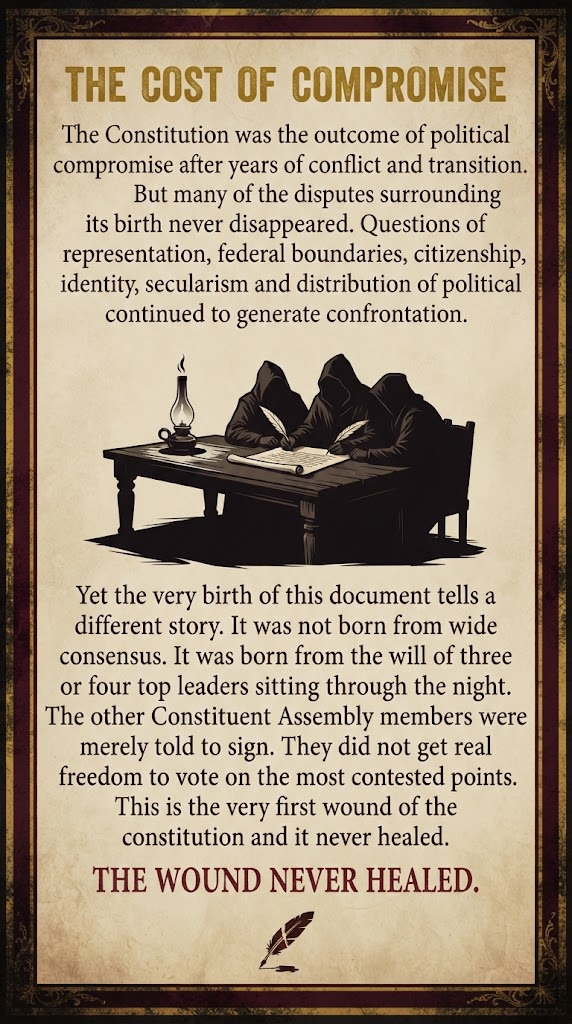
Contradictions, unsettled since the birth of the constitution
The Constitution was the outcome of political compromise after years of conflict and transition. But many of the disputes surrounding its birth never disappeared. Questions of representation, federal boundaries, citizenship, identity, secularism and distribution of political power continued to generate confrontation.
Yet the very birth of this document tells a different story. It was not born from wide consensus. It was born from the will of three or four top leaders sitting through the night. The other Constituent Assembly members were merely told to sign. They did not get real freedom to vote on the most contested points. This is the very first wound of the constitution and it never healed.
Soon after promulgation, the Madhesh movement brought large parts of the southern plains into prolonged unrest. The Tharuhat movement raised similar questions about representation and identity. The political dispute over federal boundaries became sufficiently intense to produce demands for fundamental changes to the constitutional settlement.
The Constitution survived those conflicts, but survival is not the same thing as resolution.
Its promises are extensive. Articles 16 to 46 establish a broad catalogue of fundamental rights covering dignity, freedom, equality, education, health, employment, social justice and other matters. On paper, it is an impressive statement of what the state owes its citizens.
The difficulty begins when those promises encounter ordinary life.
What does a constitutional right to employment mean to a young Nepali who sees foreign employment as the only realistic economic option. What does the constitutional promise of health mean to a woman who cannot receive treatment when she needs it. What does social justice mean to a citizen who spends years moving from one government office to another without finding an institution willing to listen.
The distance between constitutional language and lived reality has occasionally produced extraordinary forms of protest.
In January 2023, businessman Prem Prasad Acharya set himself on fire outside the Federal Parliament building in New Baneshwor. He later died during treatment. Before the incident, he had published a lengthy account describing his financial difficulties, business failures, debts and grievances concerning government policies and the economic environment.
In 2026, another disturbing incident brought the issue back into public attention. Ganesh Nepali, a 25 year old man from Soru Rural Municipality of Mugu, set himself on fire in front of the Department of Passports at Tripureshwor after his motorcycle was locked by authorities. He suffered burns over much of his body and later died during treatment.
The circumstances of the two incidents were different. They should not be mechanically treated as identical political events. Yet their existence raises a larger question about the relationship between citizens and the state.
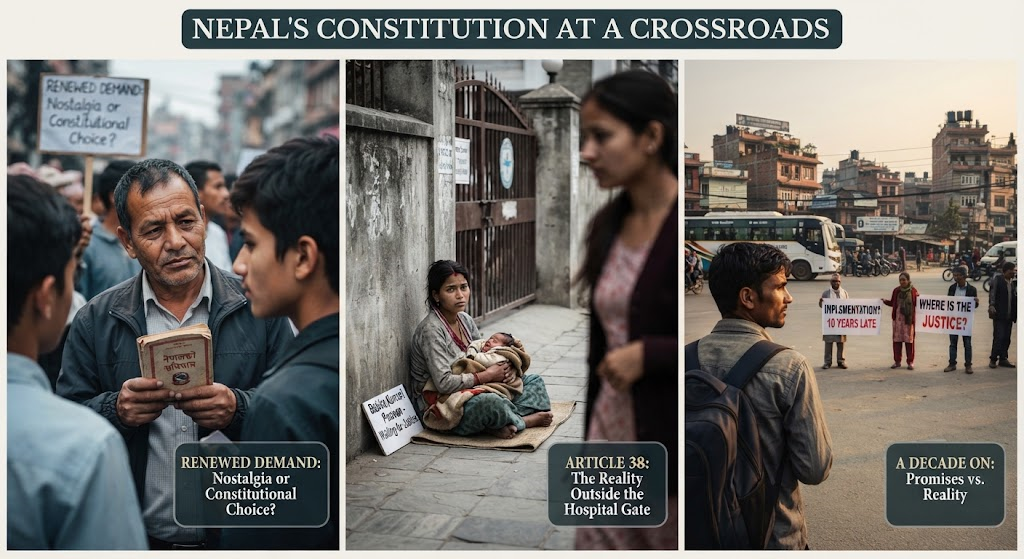
Social justice or merely paper justice?
The distance between constitutional language and lived reality becomes even more disturbing when measured against the Constitution’s promise to women.
Article 38(2) does not merely recognise women as equal citizens. It specifically guarantees every woman the right to safe motherhood and reproductive health. The commitment goes further in the Safe Motherhood and Reproductive Health Rights Act, 2018. The law provides women with rights to reproductive health information and services, safe motherhood, pregnancy and childbirth services, postpartum care and emergency obstetric services. It places a corresponding responsibility on the health system to make such services available.
Yet in September 2026, a 30 year old woman, Babita Kumari Paswan of Saptari, gave birth on a pavement outside Gajendra Narayan Singh Hospital in Rajbiraj. She had arrived at the government hospital in labour at around 1 am. According to reports, hospital staff sought Rs 3,200 for tests before treatment could proceed. Her husband had only Rs 2,000 and could not immediately arrange the remaining amount. After waiting for hours, she delivered her baby outside the hospital, lying near a roadside drain. The Health Ministry and Nepal Medical Council subsequently sent teams to investigate the incident.
The significance of this incident goes beyond the particular hospital or the individual officials involved. The question is what constitutional rights mean when a woman reaches a government hospital in labour but still ends up giving birth on the pavement outside it.
A right to reproductive health cannot have meaning only when circumstances are convenient. Safe motherhood is most important precisely when a woman is vulnerable, in pain and in need of immediate medical assistance. A constitutional promise that cannot reliably reach a woman at the hospital door raises a fundamental question about the distance between law and the state’s actual capacity to protect rights.
This is where the Constitution’s impressive catalogue of rights encounters an uncomfortable reality. The document promises safe motherhood. The law promises emergency obstetric services. The state maintains hospitals and announces free maternity care. Yet a poor woman can still find herself delivering a child on the pavement because her family cannot immediately arrange the money demanded for medical tests.
The issue is therefore not whether Nepal has written the right words into its Constitution. It clearly has. The issue is whether the state has built institutions capable of making those words real.
The same contradiction appears in other areas of social protection. The Constitution promises employment rights, health rights, social justice and protection for vulnerable citizens. But unemployment, migration, poverty and administrative exclusion continue to shape the lives of millions.
This is why constitutional evaluation cannot stop at the text of the document. The real test of a constitution is the experience of the citizen standing at its furthest edge.
For a woman giving birth outside a government hospital, Article 38 is not an abstract constitutional provision. It is a question of whether the state was there when she needed it.
For a young person leaving Nepal because employment opportunities are unavailable, the constitutional promise of employment is not a theoretical right. It is a question of whether the country can provide a future at home.
And for a citizen driven to an extreme form of protest because institutions appear unable or unwilling to hear his grievances, constitutional democracy is no longer an academic concept. It becomes a test of whether the state listens before desperation becomes irreversible.
Golden words do not guarantee constitutionalism
A constitutional democracy is ultimately judged not only by the elegance of its legal text but by whether citizens believe that institutions hear them before their grievances become desperate.
That is also why the federal experiment deserves closer examination.
Nepal now has one federal government, seven provincial governments and 753 local governments. Federalism was intended to decentralise authority and bring government closer to citizens. Yet implementation has remained incomplete. The World Bank has identified continuing problems involving the division of responsibilities, legislation, institutional capacity and the functioning of provincial governments.
The constitutional structure has therefore become considerably larger without always becoming proportionately more effective.
This is not an argument against decentralisation itself. It is an argument for asking whether Nepal’s institutional expansion has produced sufficient public value.
The same scrutiny must apply to the political system at the centre.
Nepal has experienced repeated changes of government since becoming a republic. Coalition arrangements have frequently determined political stability, while parties that compete against each other during elections have repeatedly found themselves sharing power afterwards.
The result has been a peculiar form of democratic instability. Elections occur, governments change, coalitions are rearranged and political offices are redistributed, but many citizens continue to experience the same unemployment, migration, administrative delay and economic insecurity.
The constitutional system cannot be blamed for every failure of government. Political parties and individual governments must carry responsibility for their own decisions. Yet after eleven years, it is legitimate to ask whether some weaknesses are institutional rather than merely personal.
This brings the monarchy debate back into the constitutional discussion.
Constitutional questions regarding monarchy
Nepal abolished the monarchy in 2008 after King Gyanendra’s direct rule had generated substantial political opposition. The history of that period cannot simply be erased. Restrictions on political freedoms and the concentration of power under the royal government remain part of the record.
At the same time, criticism of republican performance cannot reasonably be dismissed merely by referring to the failures of the monarchy.
The two questions are separate.
A citizen can acknowledge the failures of the former monarchy and still question the performance of the republic. Similarly, someone can support republicanism while recognising that the present system has produced serious institutional problems.
The monarchy question therefore deserves to be considered as a constitutional question rather than merely a question of nostalgia.
Pro monarchy demonstrations have returned to Kathmandu in recent years. In March 2025, a major demonstration demanding restoration of a constitutional Hindu monarchy became violent. Two people died and more than one hundred were injured. The events demonstrated both the strength of the demand among its supporters and the serious risks that accompany political confrontation outside established constitutional processes.
There is, however, a deeper constitutional principle involved.
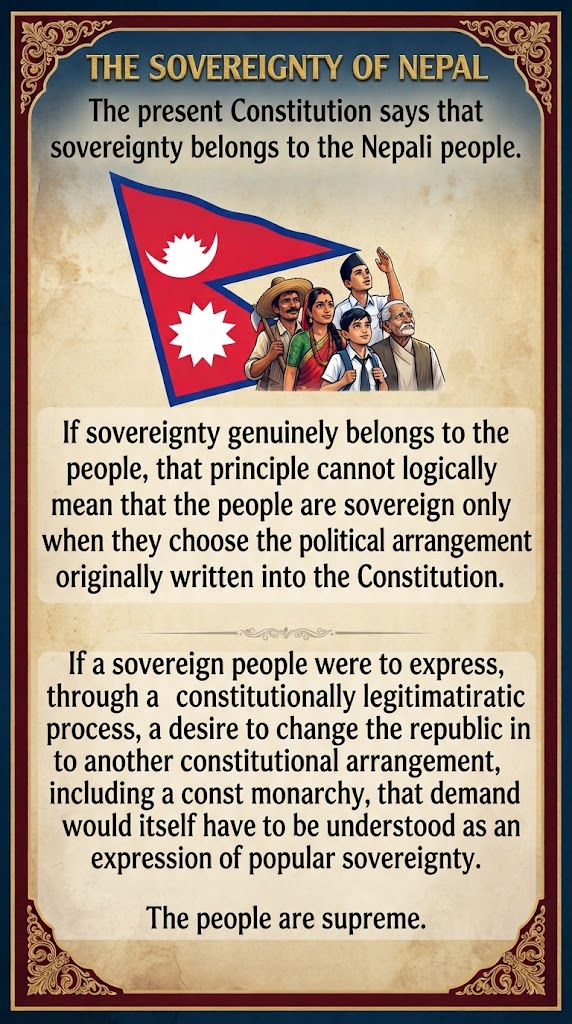
The present Constitution says that sovereignty belongs to the Nepali people. If sovereignty genuinely belongs to the people, that principle cannot logically mean that the people are sovereign only when they choose the political arrangement originally written into the Constitution.
If a sovereign people were to express, through a constitutionally legitimate democratic process, a desire to change the republic into another constitutional arrangement, including a constitutional monarchy, that demand would itself have to be understood as an expression of popular sovereignty.
That would not automatically make the proposed change desirable, nor would it establish that a majority currently supports it. It would simply mean that no constitutional arrangement should be treated as permanently beyond democratic reconsideration when the Constitution itself locates sovereignty in the people.
There is an important distinction here between restoring absolute monarchy and considering a constitutional monarchy.
A constitutional monarchy would require an entirely different question from a return to royal executive power. Under such an arrangement, the monarch could be a constitutional head of state while elected institutions retained governmental authority. Whether such a model would suit Nepal is a matter for citizens and constitutional debate, not something that can be settled by nostalgia or fear.
Debates on secularism
The same principle applies to secularism.
Article 4 defines Nepal as a secular federal democratic republican state. Yet secularism remains politically contested. Supporters of a Hindu state argue that Nepal’s civilisational history and demographic character justify reconsideration. Opponents argue that the historical Hindu state was associated with caste exclusion and that secularism provides stronger protection for religious minorities.
The disagreement is real. It should be debated through evidence rather than slogans.
Ultimately, the Constitution’s greatest test is not whether it can defend itself against criticism. It is whether it can accommodate criticism and constitutional change without treating every demand for change as an attack on democracy.
A constitution is supposed to organise political power, protect citizens and provide legitimate methods for resolving fundamental disagreements. If citizens conclude that the existing arrangement no longer serves those purposes, their dissatisfaction deserves institutional attention.
The answer may be constitutional reform or even rewriting of the constitution. It may be stronger implementation. It may be restructuring federalism. It may be changes to the electoral system. It may be preservation of the present republican framework with substantial reforms. Or, if a constitutionally legitimate democratic majority eventually demands it, it could involve a fundamental change in the form of the state, secularism and other institutional issues.
None of these possibilities should be declared impossible merely because the Constitution was written eleven years ago.
The central issue is therefore not whether Nepal should be trapped between monarchy and republic, past and present, or tradition and modernity.
The central issue is whether the people remain genuinely sovereign and whether the perpetuality of the Nepali as a sovereign state from prehistoric age shall continue.
If they are, their constitutional preferences cannot be permanently predetermined by political leaders, parties or institutions. The Constitution derives its legitimacy from the people. Any future constitutional order would have to do the same.
That is perhaps the most consequential question Nepal enters its second decade with.
Not whether the Constitution can survive.
But whether it can continue to command the confidence of the people in whose name it was written.
Author is a practicing advocate at Supreme Court of Nepal and he is an expert in international law.
Very analytical and thoughtful article. It is the duty of elites and sincere citizens,who loved the nation,shout think sincerely. I convey my sincere thanks to learned Advocate Mr Amrit Khrel
An article with critical analysis of current constitution. Analysis has rightly pointed out the critical issues with clear explanation with suitable conclusion too. Enjoyed the reading.