
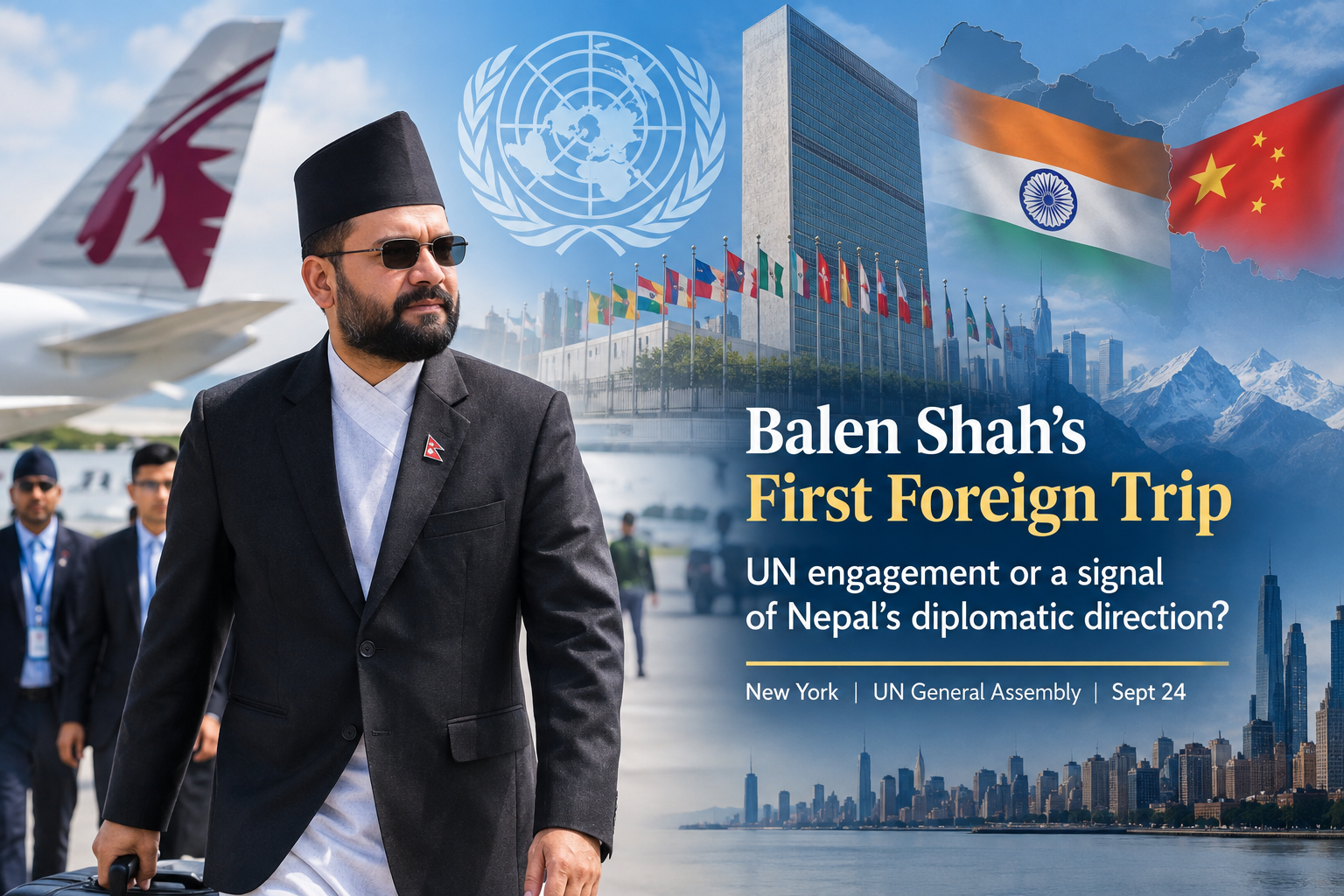
Kathmandu, Sept. 22: Prime Minister Balendra Shah is leaving for the United States today on his first foreign trip since taking office, choosing New York and the United Nations as the destination at a time when Nepal’s foreign policy is being closely watched by its immediate neighbours and major international partners.
Shah is travelling to New York to lead Nepal’s delegation to the 81st session of the United Nations General Assembly. He is scheduled to address the UN General Debate on September 24 and meet UN Secretary-General Antonio Guterres before returning to Kathmandu on September 26.
The visit is formally a multilateral engagement rather than a bilateral state visit to the United States. Yet its significance extends beyond the UN calendar because it is Shah’s first international trip after becoming prime minister in March.
That makes the destination diplomatically notable.
Unlike many South Asian leaders who traditionally prioritise neighbouring countries for their first bilateral engagements, Shah’s first trip abroad is taking him to the United States for a global diplomatic forum. The question now is how Kathmandu’s neighbours, particularly India and China, will read the sequence of Nepal’s external engagement.
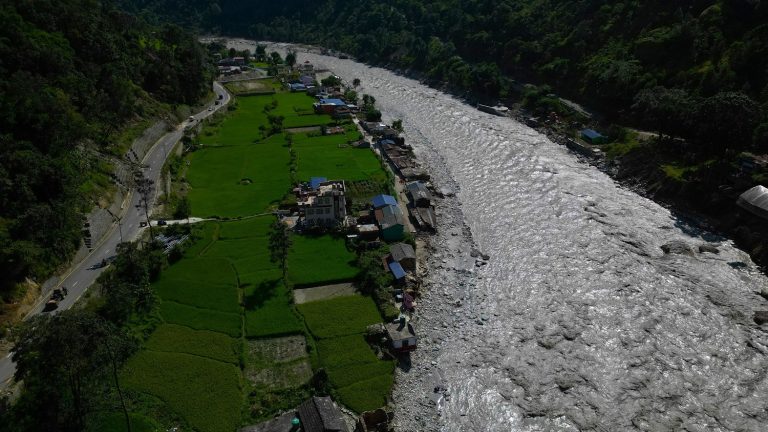
For India, the immediate issue may not be the UN visit itself. Nepal has regularly sent prime ministers to the UN General Assembly, and Shah’s participation is directly linked to Nepal’s effort to draw international attention to climate change, disaster losses and reconstruction following the devastating August floods. The government has also made climate diplomacy a major foreign-policy priority.
The diplomatic question is therefore more about sequencing than destination, will Shah’s New York trip be viewed simply as a ritual multilateral appearance, or as the opening move of a foreign policy that places greater emphasis on global powers and multilateral institutions before bilateral engagement with Nepal’s immediate neighbourhood?
There is no evidence so far that India has officially interpreted the trip as a snub or a bypass. In fact, New Delhi and Kathmandu are reportedly preparing for a possible Shah visit to India in November. Finance Minister Swarnim Wagle has also recently visited New Delhi and held talks with senior Indian officials on economic cooperation, connectivity, clean energy and post-flood assistance.
This means the sequence could ultimately prove less dramatic than it appears: New York for multilateral diplomacy first, followed by bilateral engagement with neighbours.
Still, the timing gives Shah an opportunity to define the character of his government’s diplomacy.
His UN appearance comes as Nepal seeks international support for reconstruction after the August 26 disaster. The government is preparing to highlight climate justice, loss and damage, adaptation, disaster preparedness and the special vulnerabilities of mountain countries.
Shah’s delegation includes Foreign Minister Shisir Khanal, Chief Adviser Kumar Byanjankar, Foreign Secretary Amrit Bahadur Rai and other officials. Khanal has already been in New York for high-level meetings and bilateral engagements ahead of the prime minister’s arrival.
The trip therefore presents Shah with two parallel diplomatic tasks: to use the UN platform to internationalise Nepal’s climate and reconstruction concerns, and to reassure Nepal’s neighbours that stronger global engagement does not come at the expense of regional relations.
For India, the coming months may offer a clearer indication than the New York visit itself. If Shah follows the UN trip with substantive engagement with New Delhi and Beijing, the US-bound first trip could remain primarily a multilateral choice. If Nepal’s diplomatic calendar instead shows sustained emphasis on Washington and other Western partners while regional engagement remains limited, the sequencing could acquire a broader strategic interpretation.
For now, Shah’s first foreign trip sends one clear message: his government is beginning its external engagement on the global stage, with the United Nations—and not a bilateral visit to a neighbouring country—as its first destination.