
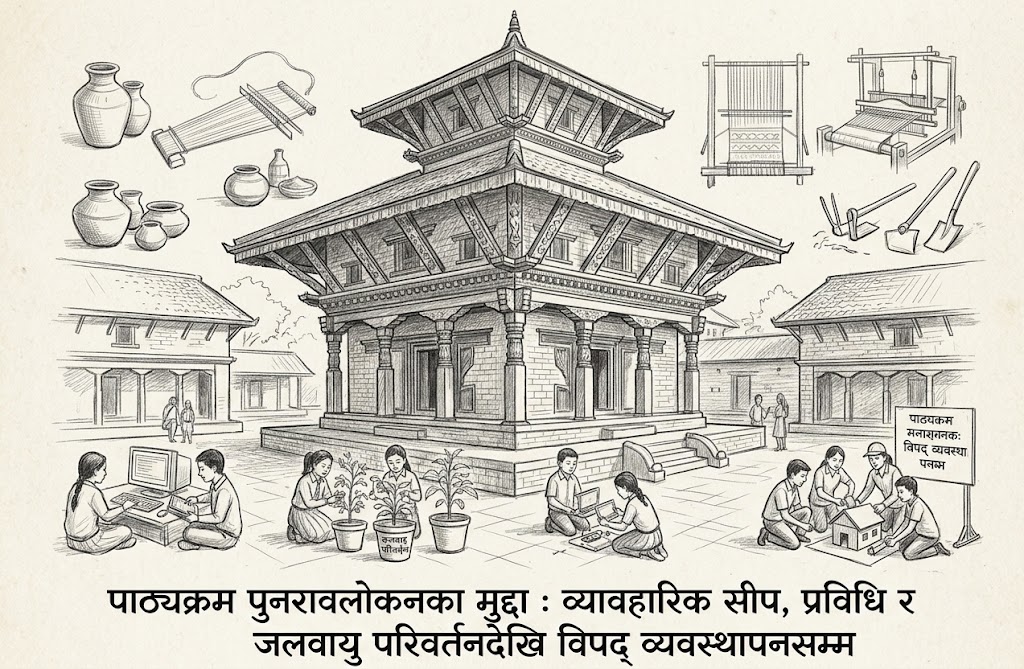
पाठ्यक्रम पुनरावलोकनका मुद्दा : व्यावहारिक सीप, प्रविधि र जलवायु परिवर्तनदेखि विपद् व्यवस्थापनसम्म
Kathmandu, September 28
Intense discussions are underway among stakeholders to adapt the school curriculum to the changing social, economic, and technological landscape. Following the government’s formation of a task force to review the ‘National Curriculum Framework (NCF) 2076 for School Education’, feedback and suggestions have been flowing in through various channels from citizens and key stakeholders.
At the 98th meeting of the National Curriculum Development and Assessment Council held on April 23 under the chairmanship of Minister for Education, Science, and Technology, Sasmita Pokharel, a task force was formed under the coordination of Prof. Dr. Bal Chandra Luitel, former Dean of Kathmandu University’s School of Education, to review the curriculum framework.
The revision process was initiated as the five-year cycle of the National Curriculum Framework 2076 ended with the academic year 2023. Based on the guidelines of the task force’s recommendation report, new curricula will be drafted for levels spanning Early Childhood Development to Grade 12. Task force coordinator Dr. Luitel stated that under a plan to gather feedback from around 50,000 citizens, approximately 25,000 suggestions have already been received in the first phase, with the final report expected to be submitted by January/February after collecting further input.
Emphasizing that curriculum development is a movement in itself, Dr. Luitel noted that citizen participation fosters community ownership. He added that maximizing community engagement in the review process would ensure effective curriculum design and smoother implementation.
The task force continues to receive suggestions primarily on competence-based learning, vocational and technical education, indigenous knowledge, human values and ethics, arts, sports, health, inclusion, disaster management, medium of instruction and mother-tongue teaching methodologies, evaluation systems, and curriculum implementation.
Mahendra Parajuli, Member Secretary of the task force and Director General of the Curriculum Development Centre, shared that suggestions were gathered by directly visiting classrooms to understand implementation realities alongside key stakeholders, children, and teachers.
Director General Parajuli informed that the revision work will move forward by integrating 12 thematic papers prepared by experts, research report recommendations, and stakeholder input. Key suggestions received include moral and value-based education, climate change adaptation, disaster management, information technology, AI, coding, and making the curriculum agile and practical. Although the task force established key policy foundations—such as integrating Early Childhood Development through Grade 12 into a single structure, creating a single-track model, and incorporating mother-tongue and local knowledge through local curricula—it has been urged to address the practical challenges faced during implementation.
Stakeholders emphasized that 21st-century education should focus on “what a student can do” and their critical thinking and problem-solving abilities rather than merely “what to teach.” In its submission, the Institutional Schools’ Teachers’ Association / Headmasters’ Association Nepal (PAN) urged a comprehensive overhaul of the curriculum to make school education life-oriented, skill-focused, tech-friendly, and tied to production.
PAN President Sudam Gautam informed that a concept paper was prepared and handed over to the Education Minister based on structured dialogues with school leadership, educationists, subject experts, teachers, parents, and local stakeholders nationwide, alongside conclusions drawn from 12 subject-specific working papers. He stated that the review of the National Curriculum Framework should not be limited to a technical exercise of adding or removing content, but viewed as an opportunity to align Nepal’s education system with the evolving socio-economic and technological context.
President Gautam highlighted that before implementing a new curriculum, teachers must receive at least six months of practical training on new learning methodologies, AI, digital technology, and evaluation systems. He also recommended developing headteachers into ‘chief educational leaders’ rather than mere administrative heads, granting them necessary legal, policy, and managerial autonomy to ensure the quality of curriculum implementation, teacher mentoring, and internal assessment. He added that curriculum revision must serve as the foundation for educational transformation—producing skilled, self-reliant, and responsible citizens capable of finding opportunities within the country.
Educational campaigner Abhishek Ghimire suggested that the subject structure must move beyond traditional theoretical knowledge to connect students with social awareness, technology, skills, entrepreneurship, environment, moral conduct, and language proficiency.
Ghimire proposed integrating sociology, civic awareness, local problem identification, social justice, collaboration, disaster management, and community service under ‘Community and Social Development Studies’. Under ‘Innovation, Technology, and Tech Startups’, he emphasized integrating science, computer studies, and applied mathematics to foster new technologies, design thinking, and innovative mindsets.
Under the ‘Skill Development and Entrepreneurship’ domain, he proposed combining practical technical skills—such as agriculture, woodwork, tailoring, electrical, and mechanical skills—with financial literacy, business planning, and the ‘Earn While You Learn’ program. Prioritizing modern IT, coding, robotics, digital literacy, and 21st-century technical competencies under ‘Robotics and Artificial Intelligence (AI)’ was also recommended.
For ‘Nature and Environment’, topics such as geography, environmental conservation, local biodiversity, medicinal herbs, astronomy/universal studies, and sustainable development were urged. Under ‘Moral and Behavioral Education (Scientific Values)’, human values, Eastern philosophy, yoga, meditation, social discipline, character building, empathy, compassion, and sense of duty should be covered. In ‘Language Studies’, balanced and practical language proficiency across mother tongues, the national language (Nepali), and the international link language (English) was requested.
From Practical and Digital Skills to AI
Suggestions recommend making computational thinking an integral part of the curriculum from the primary level, and coding, AI literacy, cybersecurity, and data ethics at the secondary level. For primary schools (Grades 1–5) lacking computer labs, ‘unplugged’ methods should be used to teach problem decomposition, pattern recognition, abstraction, and logical algorithm construction.
For Grades 6–8, block coding, internet safety, and personal data privacy should be introduced. For Grades 9–12, foundational knowledge of AI, prompt engineering, machine learning principles, and data analysis is proposed. Additionally, general stream students from Grade 6 onwards should be taught at least two market-relevant practical skills, chosen based on local needs and potential—such as modern agriculture, hydroponics, plumbing, house wiring, computer/mobile repair, woodwork, tailoring, or baking/cooking. Secondary-level education should mandate financial literacy covering personal budgeting, digital banking, QR payments, taxation, insurance, and stock market basics, alongside establishing ‘Innovation and Enterprise Labs’ in schools to market student-produced goods.
Project-Based and Interdisciplinary Learning
Integrated STEM (Science, Technology, Engineering, Arts, and Mathematics) education should form a core component of the curriculum. It is proposed that at least 30% of each subject’s annual credit hours be allocated to field research and problem-solving projects. Connecting real-world issues—such as local river water testing, data analysis, awareness campaigns, and waste management—to various subjects will make learning timely and relevant.
The Context of ‘Book-Free Day’
Suggestions from almost all provinces advocate integrating extracurricular activities into formal learning by running a weekly ‘Book-Free Day’ or ‘Bookless Day’ tied to the national credit-hour framework. Spearheaded by Kathmandu Metropolitan City, this initiative is seen as effective for showcasing student talent and fostering multi-dimensional development.
On ‘Book-Free Days’, practical activities such as public speaking, communication skills, teamwork, leadership development, robotics, art, music, woodwork, basic electronics, first aid, yoga, meditation, disaster drills, tree plantation, and local heritage conservation can be conducted.
Emphasis on Competency Assessment over Examinations
Assessment systems must also become competency-based. Test papers should be designed to evaluate real-world problem solving, higher-order thinking, creativity, and practical skills. Suggestions include establishing clear rubrics for internal assessment, creating digital student portfolios, and introducing inter-school ‘portfolio audits’ to ensure fairness in internal evaluation.
Climate Change and Disaster Education
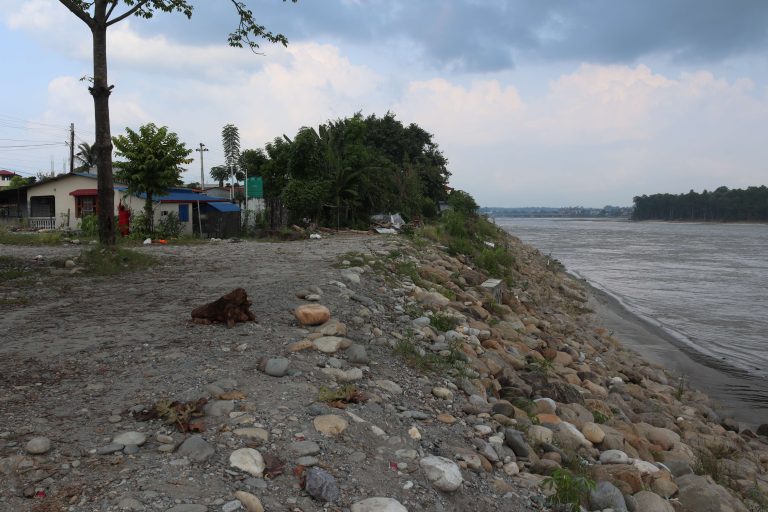
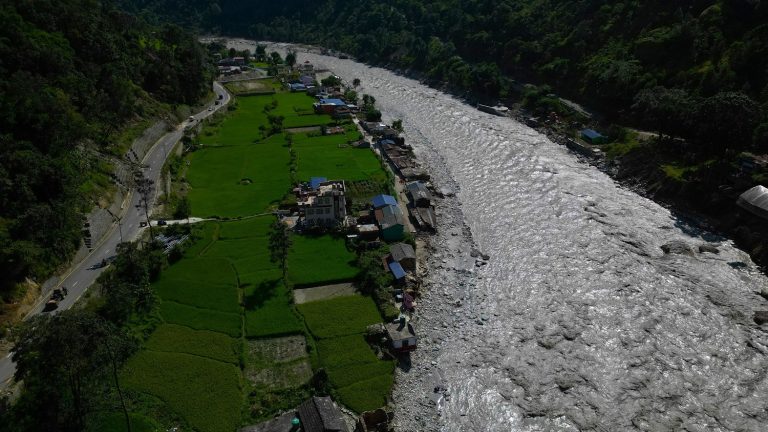
Given Nepal’s geographical and climate vulnerabilities, practical education on disaster preparedness and climate change must begin at the school level. Lessons from recent catastrophic events, such as the Bhote Koshi floods, highlight the need to instill awareness and new perspectives on human settlement planning starting from student life.
The curriculum should mandate practical drills at least twice a year covering earthquake, flood, landslide, and fire safety, basic search and rescue skills, and first aid.
Values, Mental Health, and Local Knowledge
Social-emotional learning must be made a compulsory component of the curriculum, integrating self-awareness, stress management, emotional balance, empathy, and relationship management into learning. Respect for teachers, parents, and senior citizens, national pride, social harmony, and integrity should be tied to performance-based evaluation. Finally, local curricula should move beyond textbooks to focus on direct observation and research into local geography, indigenous knowledge, traditional occupations, medicinal herbs, history, and culture.
The Curriculum Revision Task Force includes coordinator Dr. Luitel, along with members Dr. Lekhnath Paudel, Dr. Dahal, Dr. Amina Singh, Pabitrabahadur Gautam, Dr. Pramod Bhatta, Gyanendra Malla, Sagendra Shrestha, Richa Nyaupane, Rewati Karki, and Member Secretary Mahendra Parajuli. National Campaign for Education (NCE) Nepal has also previously provided inputs through an interaction program titled ‘School Level Curriculum Revision: Stakeholder Perspectives and Suggestions’.