
UN
KATHMANDU, September 28
Prominent historians, archaeologists, and sociologists have articulated profound and explanatory perspectives regarding the structure, composition, and evolution of Kirat society, which is considered the cornerstone of Nepal’s prehistory and ancient civilization.
Through exhaustive interpretations of non-Sanskrit terminology found in ancient Sanskrit literature, Kautilya’s Arthashastra, Buddhist scriptures, Chinese travelogues, and Licchavi-era inscriptions in the Kathmandu Valley, these scholars have established that Kirat society was not merely primitive or barbaric, but rather a human community endowed with a high order of political, economic, religious, and cultural consciousness.
Regarding geographical orientation and ethnic identity, Indian linguist Suniti Kumar Chatterji and anthropologist D.N. Majumdar defined the Kirats primarily as people of Mongoloid stock spread across the northeastern Himalayan region, who made the hilly terrain of Nepal and the Kathmandu Valley their primary domain of activity. Itihas Shiromani Baburam Acharya argued that the Kirats were the true indigenous inhabitants of Nepal who ended the nomadic era and established the first organized and permanent state in the Kathmandu Valley.
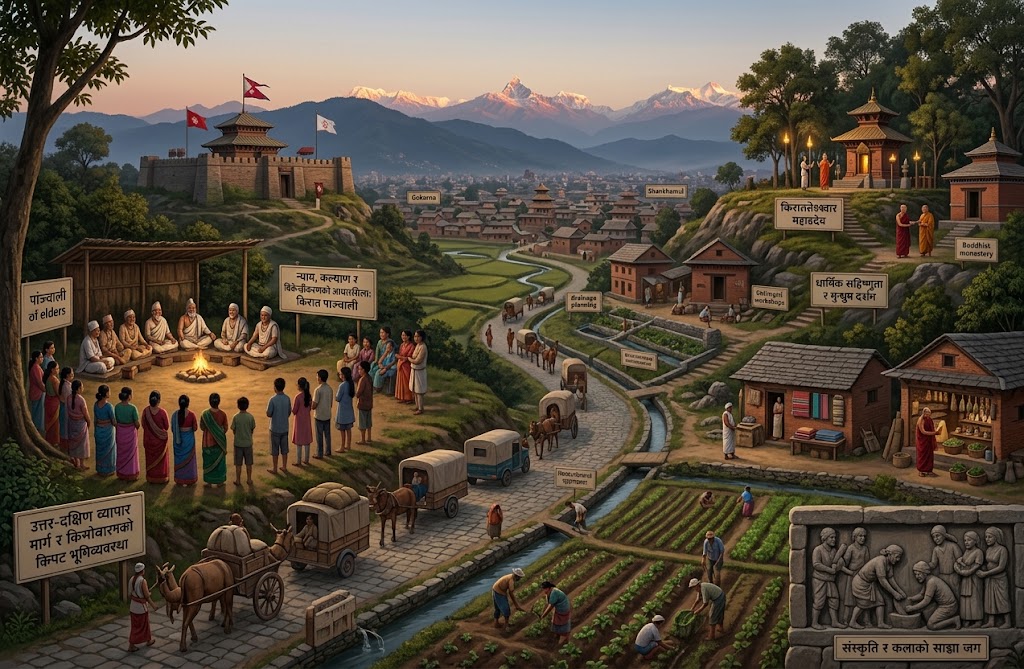
According to historians Jagadish Chandra Regmi and Chet Nath Acharya, although ancient mythological texts describe the Kirats as forest and mountain dwellers, they had become remarkably adept in urban and rural management by the time they entered the historical era. Historians such as Haraprasad Shastri from India and Bhesh Bahadur Thapa from Nepal regard areas like Gokarna, Shankhamul, and Chyasal in Kathmandu as the political and administrative centers of the Kirats, characterizing this period as the foundational pillar of the valley’s first urbanization. Linguist Kamal Prakash Malla noted that tracing the linguistic roots of ancient valley places—such as Khopring, Sanga, and Chyasal—to the Kirat language demonstrates the expanse and prosperity of the society at the time.
From a political and administrative standpoint, Kirat society was exceptionally well-governed and built on a decentralized system. Historians Surya Bikram Gyawali and Dhan Bahadur Chhetri explained that while the Kirat governance system was monarchical in form, it was democratic and welfare-oriented in practice, honoring the public sentiment. Indian Indologist Kashi Prasad Jayaswal attributed the strength of Kirat political organization to a unique blend of military skill and republican consciousness, while Vincent Smith compared the political independence of Nepal’s Kirats to the ancient Licchavi and Shakya republics of India.
Elaborating on administrative bodies, Ram Niwas Pandey and Shankar Man Rajbanshi clarified that the technical foundations for judicial, revenue, and development offices used during the Licchavi period—such as Kuther, Mapchok, Lingwal, and Shulli—were already established during the Kirat era. Historians Surendra KC, Manik Lal Shrestha, and Tulsi Ram Vaidya provided comprehensive analyses of district-level divisions like Panchali and Thum, highlighting how conscious Kirat rulers were regarding decentralization and the delivery of justice at the grassroots level, which kept the society peaceful and free from internal conflict.
Historians contend that in terms of social structure, family life, and gender relations, Kirat society was markedly distinct and more advanced than the Hindu society of northern India. According to sociological analyses by sociologists Chaitanya Mishra and Ganesh Man Gurung, labor, skill, and professions were held in high esteem, and rigid caste systems or varna hierarchies based on birth did not exist.
Historians Gyan Mani Nepal and culture expert Iman Singh Chemjong noted that although it was a transitional society shifting from matriarchy to patriarchy, women held an exceptionally high, respected, and decisive position within the family and society. Indian historian Romila Thapar explained that the joint family system was prevalent among ancient Himalayan Kirat communities, with collective ownership of property being practiced far more than individual ownership.
Historians Premanand Mishra, Krishna Bahadur Thapa, and various anthropologists have emphasized that the structure of Kirat society was remarkably flexible, open, and tolerant, enabling it to seamlessly integrate people from other cultures or communities. Their rituals surrounding marriage, feasts, and death were simple, community-building, and inexpensive, preventing class divisions from emerging.
In economic life, agriculture, and commerce, Kirat society had risen above mere self-sufficiency to engage in international trade. Economic historian Mahesh Chandra Regmi explained the Kipat land tenure system, noting that communal rights over land ensured the absence of homelessness and extreme economic exploitation. With agriculture and animal husbandry forming the backbone of the economy, Bhuwan Lal Pradhan highlighted that the Kirats initiated the development of specialized canal irrigation technology in the fertile Kathmandu Valley.
Citing Kautilya’s Arthashastra and ancient Buddhist texts, Indian archaeological and economic historians Radhakumud Mookerji and B.C. Law explained that Nepal-produced eight-piece woven wool blankets known as Bhingisi, alongside medicinal herbs, musk, and fine leather goods, were highly popular and fetched premium prices in the markets of Magadha and Pataliputra. According to Indian scholar A.L. Basham, Bijay Kumar Karna, and Baburam Khati, the Kirat kingdom served as a major trade hub connecting Tibet to the north and India to the south, driving vibrant internal and external commerce; revenue sources like Bhaga, Bhoga, and Kara were justly determined without burdening the populace.
In religious, spiritual, and cultural life, Kirat society is depicted as a harmonious synthesis of natural and human-centered philosophies. Culture experts Satya Mohan Joshi and Veena Poudel noted that the Kirats were fundamentally nature worshippers who venerated water, land, forests, mountains, and ancestors according to the precepts of the Mundhum. Their festivals, such as Udhauli and Ubhauli, were closely aligned with seasonal shifts and agricultural cycles, making their way of life scientific and eco-friendly.
Indian philosopher and historian Dr. Sarvepalli Radhakrishnan explained that this foundational consciousness of nature and spirit (Prakriti and Purusha) embraced by the Himalayan Kirats later became the primary source for the Sankhya philosophy and the Shiva-Shakti concept in Eastern thought. Historian Dr. Raja Ram Subedi posited that Nepal’s national deity, Pashupatinath, was originally Kirateshwar Mahadev of the Kirat era, later refined and adopted as a primary deity by subsequent Licchavi, Malla, and Shah rulers.
Archaeologist Babu Krishna Rijal and historian Dr. Triratna Manandhar highlighted that during the era of Gautama Buddha and the subsequent arrival of Maurya Emperor Ashoka in Nepal, the pacifist philosophy of Buddhism deeply influenced Kirat society; however, rather than sparking religious conflict, Mundhum, Sanatana, and Buddhist philosophies flourished side by side in exemplary harmony.
The contributions of Kirat society to art, script, literature, and technology were equally distinguished and enduring. Historian and artist Lain Singh Bangdel demonstrated that ancient stone sculptures of Yaksha, Yakshini, and ancestral figures discovered across the Kathmandu Valley are original masterpieces of Kirat art, reflecting grounded realism that earned praise from Indian art critic Ananda Coomaraswamy.
Playwright and historian Bal Krishna Sama noted that the ancient roots of Nepalese music and dance are found in Kirat folk traditions such as Chyabrung and Sakela. Indian epigraphist D.C. Sircar observed that towards the latter part of the Kirat era, early Brahmi script came into use for commercial and administrative purposes, steering society toward literacy and record-keeping.
Archaeologist Janak Lal Sharma and Indian scholar N.R. Banerjee credited Kirat society with leading Nepal’s transition from the Neolithic to the Metal Age—crafting copper and iron weapons and agricultural tools, and laying the initial plans for settlement drainage systems.
Overall, synthesis of historical findings confirms that the Kirat era stands as a glorious and sophisticated epoch in Nepal’s history. It represents not merely an ancient epoch, but the true origin of modern Nepalese values: social equality, inter-ethnic harmony, gender balance, human alignment with nature, religious tolerance, and sovereign political consciousness. Historians broadly agree that the grand cultural and architectural achievements of the subsequent Licchavi and Malla eras were built upon the solid social, economic, and cultural foundation laid by Kirat society.
Unified Nepal