
कुचबधिया समुदाय
Ranjha (Banke), October 1
The traditional livelihood of the endangered Kuchbadhiya community is facing an existential crisis due to the rapid expansion of modern technology and appliances.
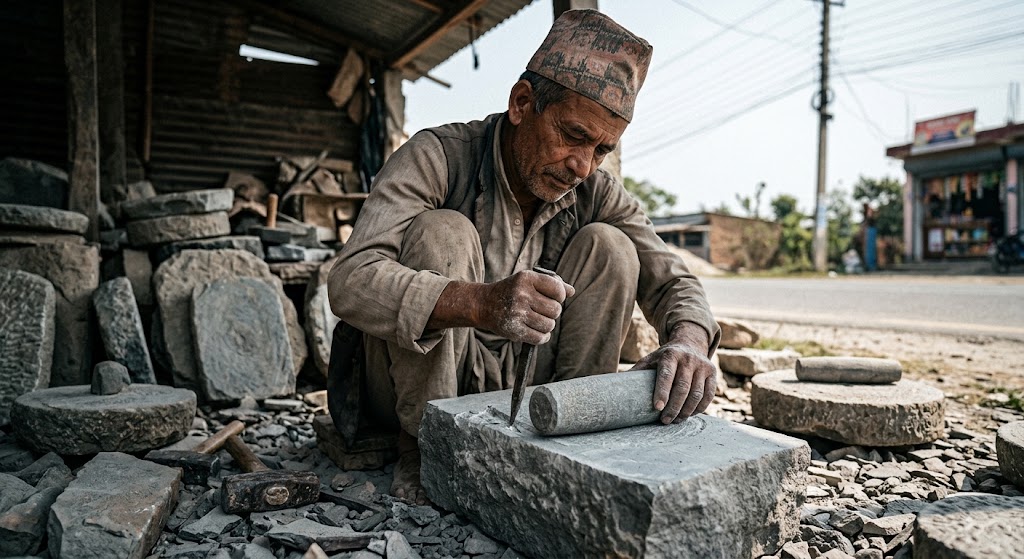
Arjun Kuchbadhiya, a resident of Indrapur in Janaki Rural Municipality–3, Banke, shared that their ancestral occupation of carving and selling traditional stone grinding tools—such as silauto (grinding stone) and jaanto (quern)—has plummeted as electric mixers and blenders become household staples in both urban and rural areas.
“Our traditional trade was selling silauto, jaanto, and jute ropes, but now there are hardly any buyers,” he said. “Everyone uses electric mixers at home now.”
The community also faces severe challenges sourcing raw materials. The stones required for making silauto and jaanto are not available locally in Nepal and must be imported from Bahraich, India. Importing these raw materials through customs poses significant hurdles. Combined with raw material shortages and falling market demand, the younger generation is increasingly forced to migrate to urban centers in search of alternative wage labor.
Meena Kuchbadhiya, another resident, explained that while men craft and sell new stone items, women traditionally visit households to re-groove (khopne) older grinding stones. However, earnings from this door-to-door service—often paid in small quantities of rice and lentils—are no longer sufficient to secure daily meals.
Patwari Kuchbadhiya, a community leader, noted: “Mills have replaced jaanto, mixers have replaced silauto, and plastic ropes have replaced natural fiber ones. No one values our manual craft anymore, and our profession is dying.” He added that a single raw stone imported from India costs around INR 150, yet selling a fully carved silauto for NPR 400 to 500 has become nearly impossible.
With their traditional trade endangered, community members increasingly rely on government social security allowances for survival. Recognized as an endangered indigenous group, members of the Kuchbadhiya (also known as Patharkatta) community receive a monthly state allowance of NPR 4,000 per person. According to Lal Bahadur Rana, Secretary of Janaki Rural Municipality–3, 275 individuals in the Indrapur settlement currently draw this allowance.
The Kuchbadhiya community mainly resides in Indrapur (Janaki Rural Municipality–3), Phultekhra (Nepalgunj Sub-Metropolitan City–6), and Gayatrinagar (Nepalgunj–20). According to the 2021 (2078 BS) national census, the total population of the Kuchbadhiya/Patharkatta community stands at 3,343.
— RSS