
Zurich, October 1:
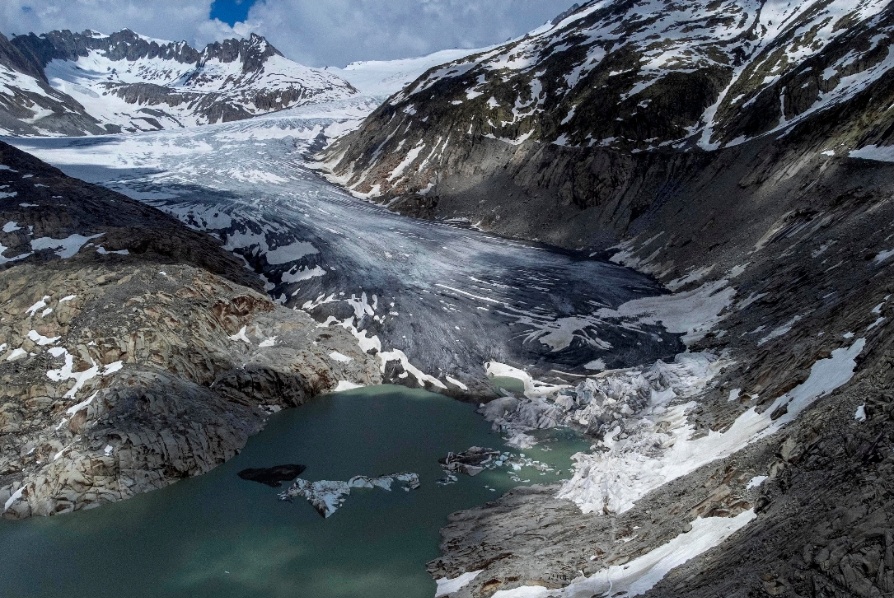
Switzerland’s glaciers have lost 5.5 percent of their total ice this year. Experts say the loss is the second-largest annual decline on record, as melting has accelerated due to extreme heat and low winter snowfall.
The amount of ice in Switzerland’s glaciers has decreased by about a fifth in the last five years alone, according to a report released on Thursday by the Glamos Swiss Glacier Monitoring Service and the Swiss Academy of Sciences. Matthias Huss, head of Glamos and professor of glaciology, said Alpine glaciers cannot survive in their current state for long.
According to him, the current temperature increase is entirely related to human-induced climate change. He said that the current temperature increase would not have occurred if it were not for human emissions and the use of fossil fuels.
He said that the lack of sufficient snow in winter is a particular concern for glaciers. Snow protects old ice from melting and also provides the foundation for new ice to form at higher altitudes. In 2022, Swiss glaciers suffered their fastest ice loss ever, driven by extreme heat, low snowfall and red dust from the Sahara Desert.
It is estimated that about 2.2 trillion liters of water equivalent was lost from Switzerland’s glaciers between July and September this year. That’s four times the annual water consumption of Switzerland, which has a population of about 9.1 million. Since Switzerland generates more than half of its electricity from hydroelectric power, the changes in glaciers are also linked to water resources and energy production.
Although the amount of ice lost from Swiss glaciers this year was less than in 2003, experts say the percentage loss is higher compared to the total ice loss. In 2003, the total ice volume was reduced by 3.5 percent, and now the amount of ice remaining in the glaciers is only about a third of what it was 23 years ago.
This year, the average thickness of some glaciers has decreased by 2.5 to 4 meters, and the thickness of the ice at the front of some glaciers has decreased by up to 10 meters. The largest glaciers in the Allalin, Clarident, Rhône and Alps regions are among the glaciers that are losing ice rapidly.
According to experts, the impact of melting glaciers is not limited to Switzerland. Switzerland is considered the “water tower” of Europe and contributes to the water resources of important rivers such as the Danube, Po, Rhine and Rhône. Due to global warming, major changes in ice and glaciers have also been seen in regions including the Himalayas, Greenland and Antarctica. (RSS / AP)