

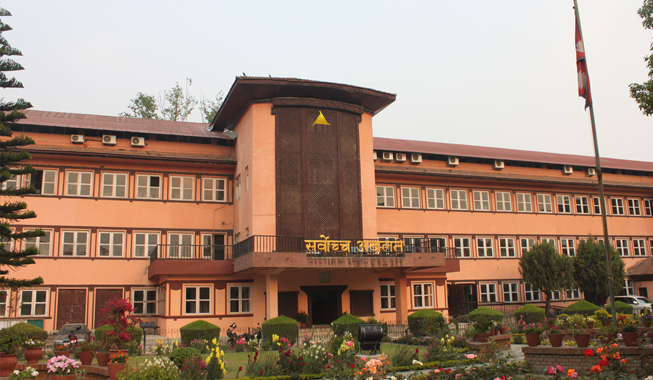
Kathmandu, Sept. 17: The Supreme Court has barred the implementation of provisions in the House of Representatives Regulations, 2083 that could allow a constitutional amendment to proceed by combining votes from the House of Representatives and the National Assembly, rather than requiring the constitutionally prescribed two-thirds majority in each chamber.
A Constitutional Bench led by Chief Justice Dr. Manoj Kumar Sharma issued an interim order on Wednesday staying the implementation of Rules 140(11) and 259 of the House of Representatives Regulations.
The order has brought into question whether Parliament can alter or reinterpret the constitutional procedure for amending the Constitution through its own parliamentary regulations.
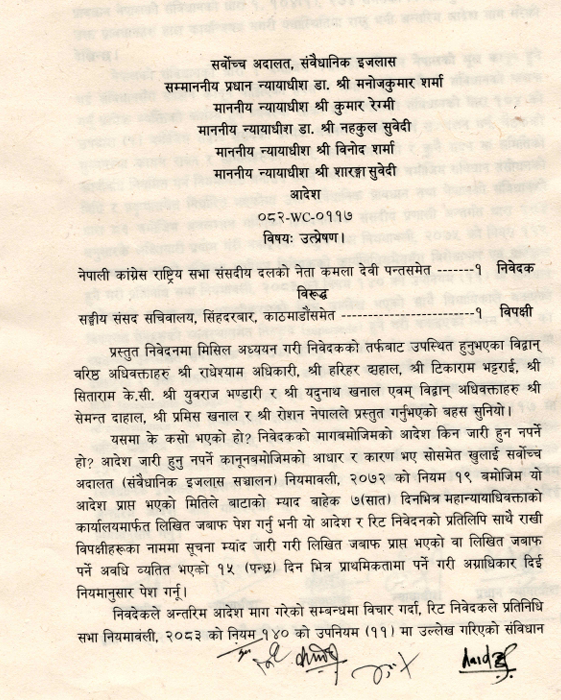
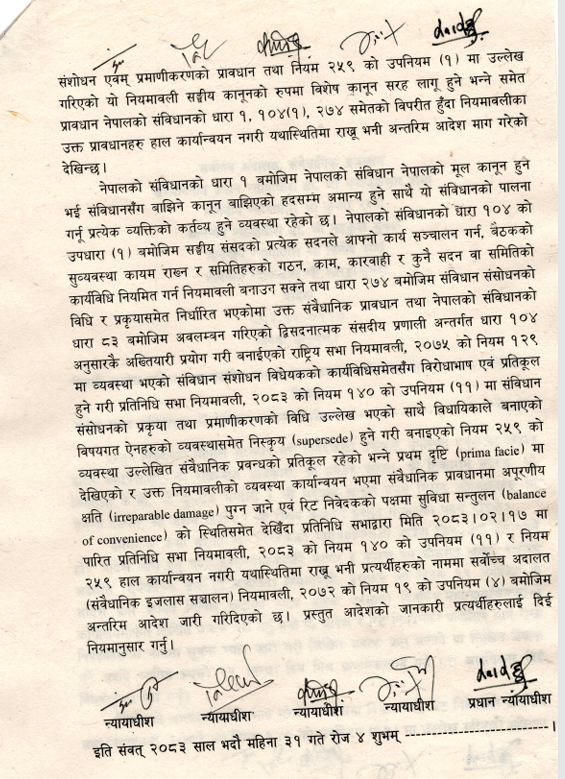
The disputed Rule 140(11) reportedly provided a mechanism under which votes secured in both chambers of the Federal Parliament could be combined to determine whether the required two-thirds majority had been achieved.
The provision has been challenged on the ground that it conflicts with Article 274(8) of the Constitution, which requires a constitutional amendment bill to be passed by at least a two-thirds majority of the total number of members currently in office in both the House of Representatives and the National Assembly.
The constitutional distinction is significant. While ordinary legislation can be passed through the parliamentary process prescribed by law, constitutional amendments are subject to a special procedure directly established by the Constitution.
The Supreme Court’s interim order therefore raises a broader question: can parliamentary regulations, which are subordinate to the Constitution, effectively modify a procedure that the Constitution itself has expressly prescribed?
The petitioners had argued that Parliament has the authority to formulate rules for conducting its business, but that authority does not extend to changing the constitutional requirements for amending the Constitution.
The challenge also concerns Rule 259, which sought to give the House regulations a special legal status in relation to other laws. The Constitutional Bench has stayed that provision as well.
The case has particular significance for Nepal’s bicameral parliamentary system. Under the Constitution, the Federal Parliament consists of two chambers, and the constitutional amendment process requires the participation of both.
If the disputed provision had remained operative, a numerical majority in one chamber could potentially be combined with votes from the other chamber to meet the two-thirds threshold. Critics argued that such an arrangement could dilute the separate constitutional role of the National Assembly in the amendment process.
The House of Representatives Regulations, 2083 had earlier faced opposition from several lawmakers when they were adopted. The subsequent constitutional challenge has now placed the disputed provisions under direct judicial scrutiny.
However, Wednesday’s order is an interim order and should not be treated as the Supreme Court’s final interpretation of the Constitution. The court will still have to hear the substantive arguments before determining whether the challenged provisions are constitutionally valid.
The immediate effect of the order, however, is clear: the disputed mechanism cannot currently be used to establish the two-thirds majority required for constitutional amendment.
Beyond the specific provisions under challenge, the case could become an important constitutional test of the limits of parliamentary rule-making power. It asks a fundamental question about Nepal’s constitutional order: where the Constitution has expressly prescribed a procedure, how far can Parliament go in changing that procedure through its own rules?