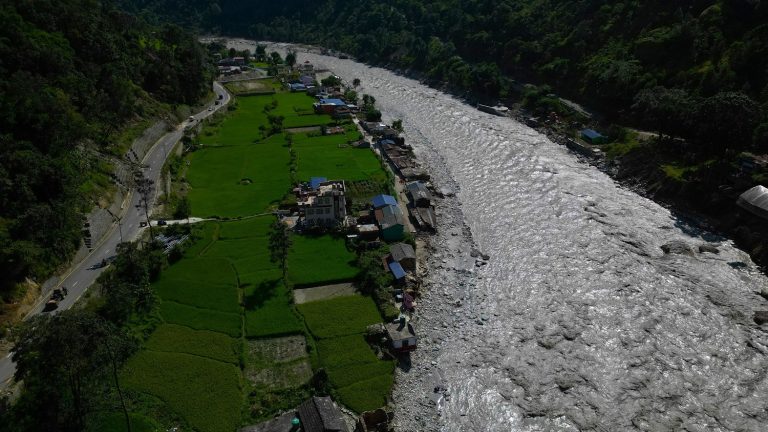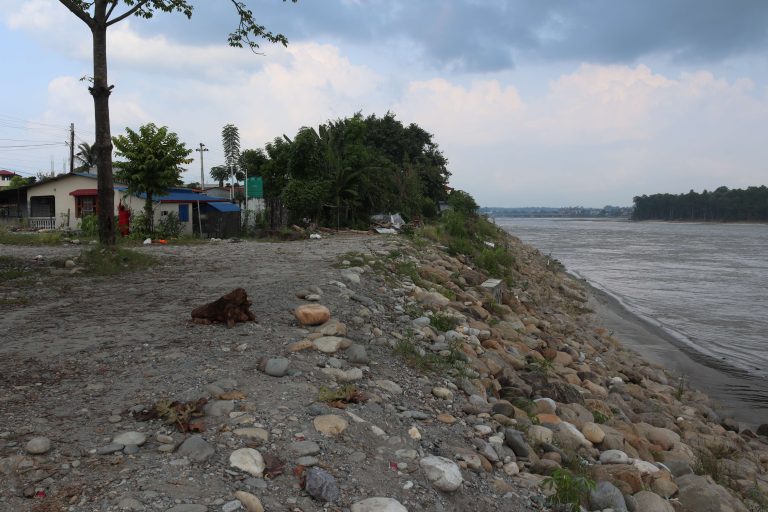

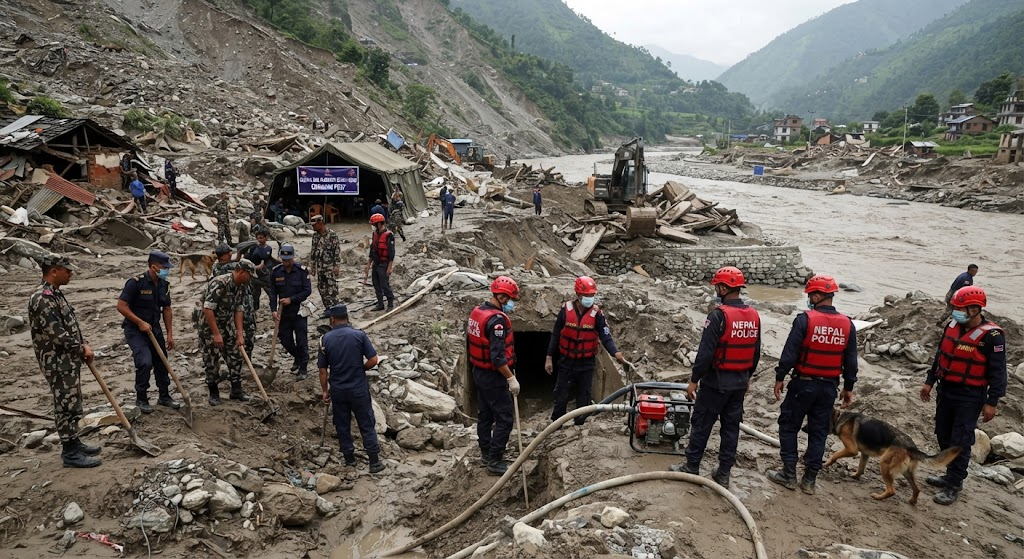
Kathmandu, Sept. 30: As families across Nepal prepare to celebrate Dashain, thousands of families affected by the devastating Bhotekoshi floods are still waiting for answers about their missing loved ones. With the possibility of finding survivors diminishing, the government has decided to shift its focus towards search and recovery, while working to ensure that families are not left without relief because of legal complications.
The government’s decision to advance search and recovery operations was made at the 37th executive committee meeting of the National Disaster Risk Reduction and Management Authority (NDRRMA), held at the Ministry of Home Affairs in Singha Durbar on Tuesday.
The meeting reviewed ongoing search and rescue operations, relief distribution and the management of temporary relief camps, alongside arrangements for the rehabilitation of flood-affected communities.
Despite the passage of time, the search for missing people has not stopped. NDRRMA Executive Chief Dr. Dharma Raj Uprety said search operations were continuing at two tunnel sites, even as the government entered a new phase focused on recovery and rehabilitation.
“We are continuing the search; the search for the missing ones is still underway in two tunnel sites. However, in case of rescue, we have entered a new phase of work on rehabilitation and recovery,” he said.
The scale of the tragedy remains evident in the latest figures released by the Authority. A total of 5,285 people remain unaccounted for following the devastating floods. Authorities have retrieved 1,454 bodies and human remains, but only 112 have been identified so far. Another 1,292 bodies have been safely managed through burial.
For families still waiting for confirmation, the identification process remains a critical part of the search operation.
The government is relying on scientific and forensic methods to identify badly damaged bodies and human remains. DNA testing of 3,685 forensic samples is underway at two laboratories.
According to the Ministry of Home Affairs, the Nepal Police Central Forensic Science Laboratory in Samakhusi, Kathmandu, has received 1,957 samples, while the National Forensic Laboratory has received 1,728. International expert teams are also assisting with the scientific examination and identification process.
Legal barriers to relief for families of the missing
Beyond the search for their loved ones, affected families are also facing uncertainty over access to government relief and social security benefits.
The executive committee reviewed legal obstacles surrounding the distribution of minimum financial assistance to families of those who died or went missing in the floods.
Under Section 40 of the National Civil Code, 2074 BS, a person is generally presumed dead only after remaining missing for 12 years without any information. The law, however, provides shorter periods for certain exceptional circumstances, including missing persons aged 80 or above, soldiers missing during war, and people involved in accidents involving aircraft, ships or vehicles.
Even when a court declares a missing person dead, the declaration can be annulled if the person subsequently returns alive.
Similarly, Rule 17 of the National Identity Card and Registration Regulations, 2077, requires certification from the competent authority before local registrars can record certain incidents involving missing persons or establish relationships for registration purposes.
These legal requirements have created practical difficulties for families seeking immediate financial assistance while the identification and legal processes remain incomplete.
To address the problem, the executive committee has decided to introduce a special administrative procedure to facilitate relief and social security support for affected families without requiring them to wait through lengthy legal processes.
Under the arrangement, the local governments corresponding to the permanent addresses of missing citizens will verify their details and forward the information to the respective District Administration Offices. The district offices will then reverify the information and submit it to the NDRRMA.
The Authority will process the cases under its special procedures and facilitate relief while proceeding with other necessary legal formalities.
Temporary shelter and rehabilitation
The meeting also decided to expedite temporary housing, reconstruction and rehabilitation for families whose homes were destroyed or rendered uninhabitable by the floods.
According to information received so far, 278 families from seven local government units have expressed their desire to move into temporary shelters immediately.
Meanwhile, 400 families from Gosaikunda Rural Municipality in Rasuwa and another 350 displaced families from Uttargaya and other rural municipalities are currently sheltering in Bidur Municipality of Nuwakot. Their final choices regarding available housing options are still being collected.
As Dashain approaches, the government faces the immediate challenge of providing shelter and financial assistance to displaced families while continuing the painstaking process of searching for missing people and identifying recovered remains.
For thousands of families, however, the festival will arrive with an uncertainty that no administrative decision or relief package can resolve: whether their missing loved ones will ever be found.