
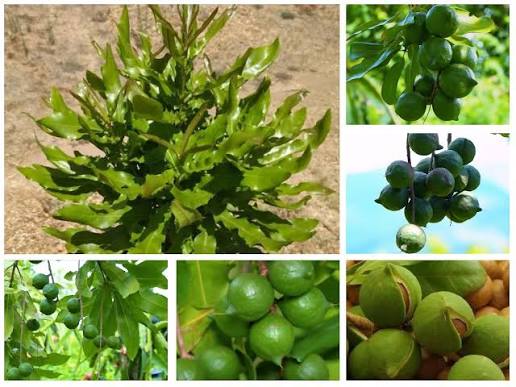
मेकाडेमिया नट
BHOJPUR, October 3.
Farmers in Bhojpur district are increasingly attracted to commercial macadamia nut cultivation, driven by its high market returns and lower susceptibility to damage by monkeys. In recent years, local farmers have actively expanded commercial farming of the crop.
Jiban Thapa, a farmer from Shadananda Municipality–1 (Nepaladanda), has been commercially cultivating macadamia nuts since 2019 (2076 BS). Bringing saplings from Pokhara, he expanded his orchard to nearly 2,000 macadamia trees. Thapa noted that because macadamia trees feature thorns and the nuts have a tough outer shell, they suffer significantly less damage from monkeys compared to other agricultural crops—making them an ideal choice for hilly regions plagued by monkey menace.
Last year, Thapa sold around 150 kilograms of macadamia nuts at NPR 2,000 per kilogram. He shared that selling processed kernels can yield up to NPR 5,000 per kilogram. His orchard started bearing fruit three years ago.
“I have planted 2,000 macadamia nut trees,” said Thapa. “Harvesting and processing are currently underway for this year. However, production is expected to decline slightly due to hail damage.” He also highlighted a shortage of agricultural labor in rural areas, adding that current local production falls short of meeting growing market demand. According to agricultural technicians, macadamia nuts can be cultivated at altitudes ranging from 100 to 1,800 meters above sea level, making Bhojpur’s geography and climate well-suited for expanding production.
Seeing its potential as a reliable source of income, local government bodies are encouraging its cultivation. Saroj Basnet, Chairperson of Tempkemaiyung Rural Municipality, stated that the municipality distributed 400 saplings free of charge to farmers last year as a pilot program. He added that the local government plans to distribute more saplings this year based on farmer demand, noting the strong commercial potential of macadamia nuts as a sought-after dry fruit in international markets.
“Macadamia nut farming shows great financial promise,” said Chairperson Basnet. “I have observed farming sites in various areas and we plan to expand its cultivation. This crop clearly suffers less damage from monkeys.”
Karan Rai, a young farmer from Pouwadungma Rural Municipality–3, echoed similar sentiments, stating that macadamia nuts could prove to be a highly lucrative crop. Having planted trees on a trial basis, Rai shared that his trees have started yielding fruit and emphasized that commercial expansion holds strong market prospects.
Farmers note that while macadamia nut trees take a few years to start producing, they yield fruit over a long period once established. Due to minimal monkey damage, premium market prices, and strong global demand, farmers are increasingly embracing macadamia nut farming as a sustainable, long-term revenue source. With growing local government support through sapling distribution and promotional initiatives, commercial coverage of the crop is expected to expand further in the coming days.