
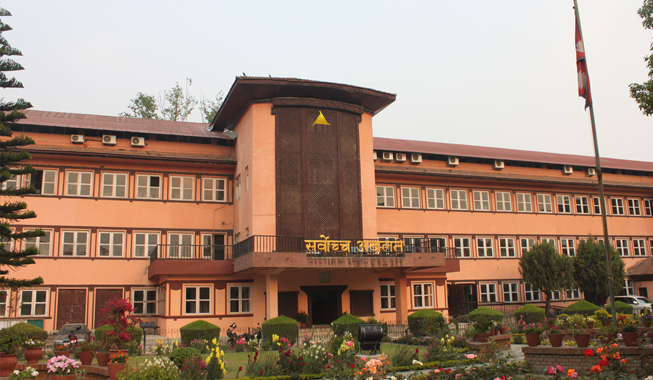
Kathmandu, September 28: The Supreme Court of Nepal and the Nepal Bar Association have expressed serious concern over the detention of former Chief Justice Cholendra Shumsher Rana at midnight, raising questions about personal liberty, due legal process and the independence of the judiciary.
Both institutions issued separate press statements on Monday, September 28, expressing concern over the circumstances in which Rana was taken into police custody and subsequently released to his family.
Supreme Court Expresses Serious Concern
In a statement issued following an emergency full-court meeting held on September 28, the Supreme Court expressed serious concern over the incident in which former Chief Justice Rana was taken from his residence by police at midnight on September 26.
According to the statement, Rana was taken to the Kathmandu Valley Crime Investigation Office in Teku, where he was kept for approximately 10 hours before being handed over to his family.
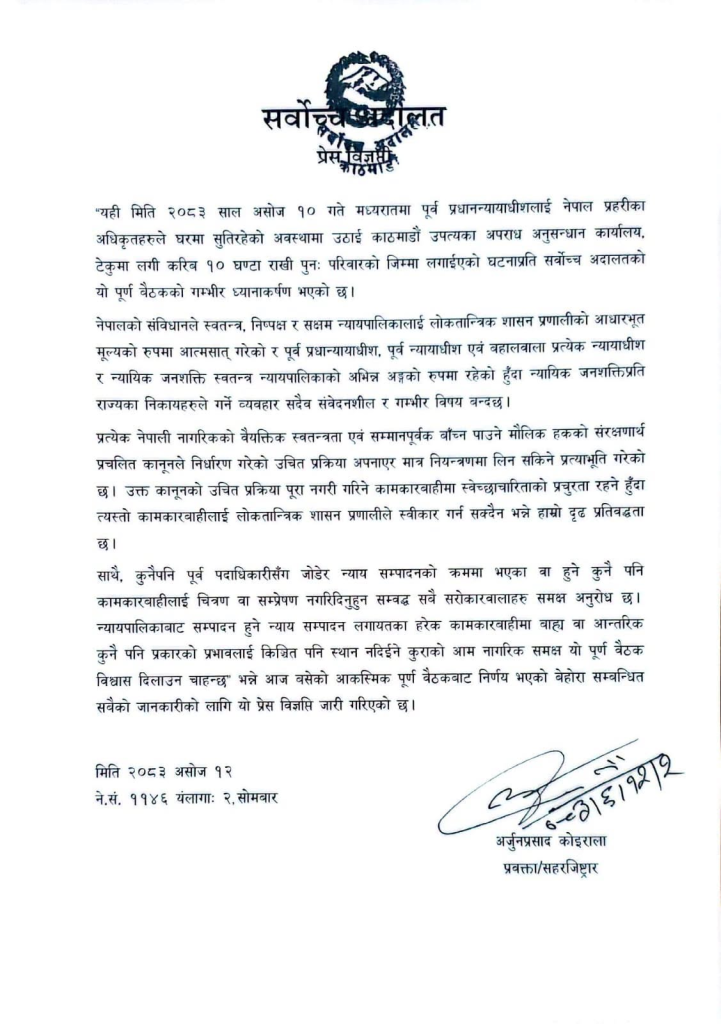
The Supreme Court recalled that Nepal’s Constitution recognises an independent, impartial and competent judiciary as a fundamental pillar of the democratic system.
It emphasised that matters involving former chief justices and judges are sensitive issues directly connected to public trust in the judiciary.
The court further stated that the constitutional rights to personal liberty and equality must be protected through due legal procedures. Restricting an individual’s freedom without following the procedures established by law cannot be accepted under a democratic system.
The statement also stressed that judicial proceedings must remain free from external or internal interference and urged all concerned not to create unnecessary influence or suspicion regarding the judicial process.
Nepal Bar Opposes Arbitrary Detention
The Nepal Bar Association has also objected to Rana’s detention, reportedly carried out on the grounds of a security threat.
In a statement issued by its General Secretary, Senior Advocate Kedar Prasad Koirala, the association said that detaining or releasing any citizen without sufficient grounds and reasons is contrary to the Constitution, the rule of law and the principles of democratic governance.
The Bar Association also raised concern over reports that representatives of the National Human Rights Commission were not permitted to meet Rana while he was in police custody.
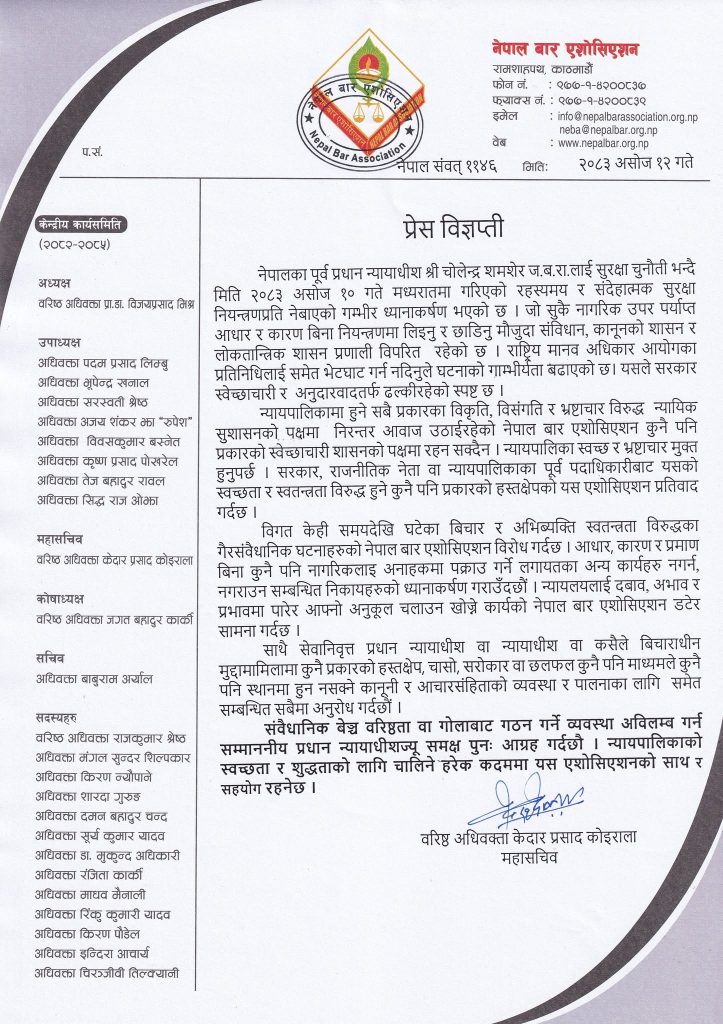
The association reiterated its longstanding commitment to raising its voice against irregularities, distortions and corruption within the judiciary.
However, it clarified that its commitment to judicial reform and accountability should not be interpreted as support for arbitrary governance or unlawful actions.
The Bar Association stated that it would oppose any activity by the government, political leadership or former judicial officials that interferes with the independence of the judiciary.
It also urged the authorities concerned not to arrest or detain citizens without adequate legal grounds, reasons and evidence.
Call to Respect Judicial Proceedings
The Nepal Bar Association further recalled that any retired chief justice, judge or other individual attempting to influence, intervene in or discuss matters involving pending judicial proceedings in an inappropriate manner would be acting contrary to legal and professional standards.
It urged all concerned to ensure that such activities do not take place through any means or in any setting.
The association also called for the prompt implementation of clear provisions concerning the formation of constitutional benches, particularly regarding the use of seniority or the lottery system.
It reaffirmed its support for all efforts aimed at maintaining the integrity, independence and credibility of the judiciary.
Questions Over Grounds for Detention
Following Rana’s detention, police reportedly stated that he had been taken into custody due to security concerns and placed in a secure location. However, detailed information regarding the nature of the alleged security threat and the grounds for the action has not been publicly disclosed.
Rana was subsequently released to his family after approximately 12 hours.
The reported denial of access to representatives of the National Human Rights Commission has further raised questions about the protection of individual rights and the conduct of security agencies.
Through their separate statements, the Supreme Court and the Nepal Bar Association have framed the incident not merely as a matter of security management but also as an issue involving personal liberty, due legal process and institutional independence.