

insurance claim
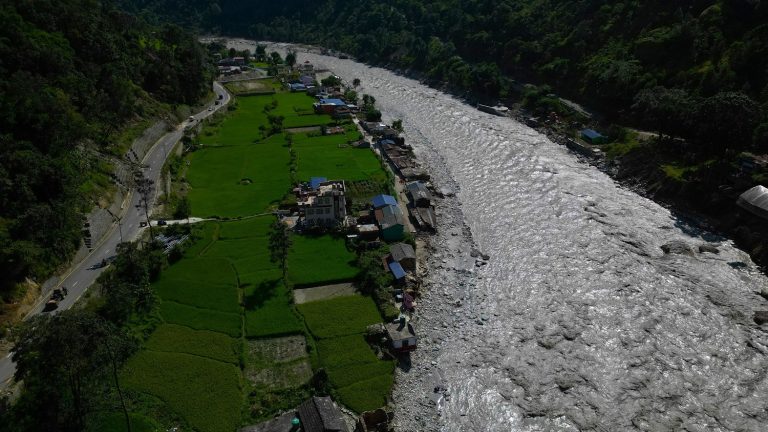
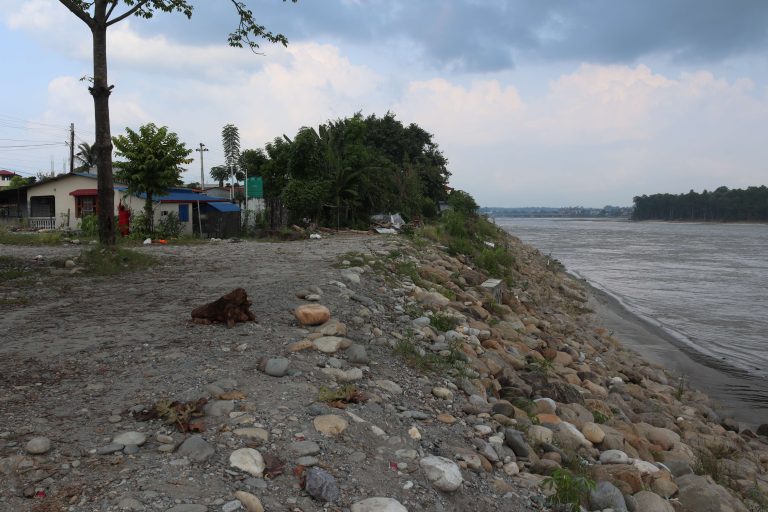
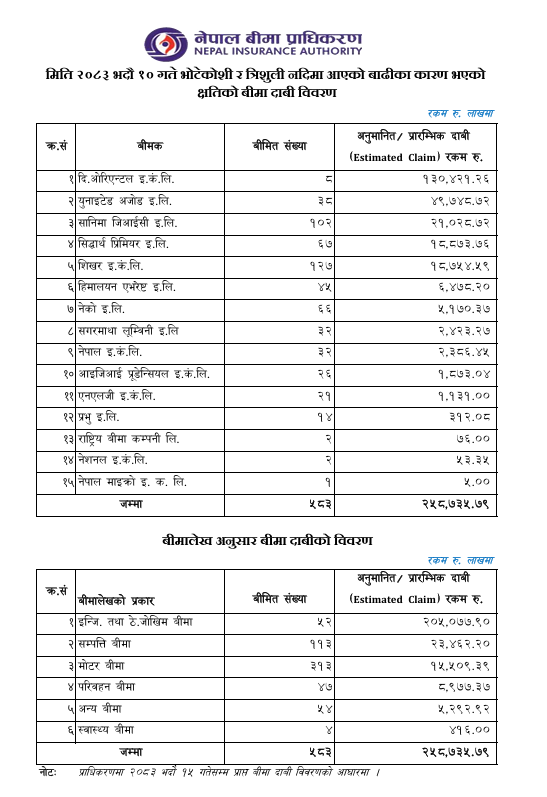
KATHMANDU, September 1— In the wake of devastating flooding triggered by the Bhotekoshi and Trishuli rivers on Bhadra 10, 2083 (late August 2026), Nepal’s insurance sector is bracing for a massive financial impact. Preliminary data compiled by the Nepal Insurance Authority reveals that a total of 583 insurance claims have been filed, carrying a combined estimated liability of 258,735.79 Lakhs Nepalese Rupees (approximately NPR 25.87 Billion).
A detailed comparative analysis of the data exposes two profound disconnects within the industry: a massive imbalance between claim volume and financial payout across policy types, and an extreme concentration of financial liability among a handful of insurance companies.
The Volume-Value Disconnect: Infrastructure vs. Personal Loss
The data highlights a dramatic contrast between the high volume of everyday consumer losses and the astronomical cost of heavy infrastructural damage.
- Engineering and Contractor Risk (CAR) Policies: While representing only 52 claims (just 8.92% of the total count), this category accounts for a colossal 205,077.90 Lakhs NPR. This single category commands 79.26% of the entire financial liability resulting from the floods. The high value of these claims strongly indicates that large-scale infrastructure projects—such as hydropower plants, bridges, and highways built along the volatile Bhotekoshi and Trishuli river corridors—bore the brunt of the destruction.
- Motor Insurance: In stark contrast, motor vehicle policies saw the highest volume of filings, with 313 claims comprising 53.69% of all reported cases. Despite representing over half of the flood’s claims, the total estimated payout for motor vehicles is a modest 15,509.39 Lakhs NPR—a mere 5.99% of the total insurance liability.
- Property Insurance: Standing in the middle, property insurance accounted for 113 claims totaling 23,462.20 Lakhs NPR (9.07% of total value), representing the impact on private homes and business premises.
- Transit and Health: Minor claims categories include transit (marine) insurance at 47 claims valued at 8,977.37 Lakhs NPR (3.47%), other miscellaneous policies at 54 claims for 5,292.92 Lakhs NPR (2.05%), and health insurance, which saw only 4 claims totaling 416.00 Lakhs NPR (0.16%).
- Corporate Exposure: Extreme Concentration of Risk
The distribution of liabilities across Nepal’s insurance companies reveals an astonishing concentration of risk, contrasting high-volume retail underwriters with those heavily exposed to major infrastructure projects.
- The Oriental Insurance Co. Ltd. : Demonstrating the most extreme risk concentration, this company received a mere 8 claims. Yet, these 8 claims carry an unprecedented preliminary estimate of 130,421.26 Lakhs NPR (approx. NPR 13.04 Billion)—representing 50.41% of the entire insurance sector’s flood liability. It is highly probable that Oriental Insurance is the primary underwriter for one or more massive, heavily damaged hydropower or engineering projects.
- United Ajod Insurance Ltd. : Holding the second-largest exposure, the company faces 49,748.72 Lakhs NPR in liabilities across 38 claims (19.23% of the total industry payout).
- Shikhar Insurance Co. Ltd. : In contrast to Oriental, Shikhar Insurance took on the highest volume of work, registering 127 claims—the most of any single insurer. However, its estimated payout is a relatively manageable 18,754.59 Lakhs NPR (7.25% of the total). This reflects a retail-heavy portfolio dominated by smaller, high-frequency claims like motor and property damage rather than high-value engineering risks.
- Sanima GIC Insurance Ltd. and Siddhartha Premier Insurance Ltd. : These companies also face notable liabilities. Sanima GIC registered 102 claims totaling 21,028.72 Lakhs NPR (8.13%), while Siddhartha Premier registered 67 claims totaling 18,873.76 Lakhs NPR (7.29%).
- Minimal Exposure: On the opposite end of the spectrum, companies like National Insurance Co. (2 claims, 53.35 Lakhs NPR) and Nepal Micro Insurance (1 claim, 5.00 Lakhs NPR) escaped with virtually negligible exposure.
A Wake-Up Call for Climate-Resilient Infrastructure
As the Nepal Insurance Authority compiles these figures—received up to Bhadra 15, 2083—the findings underscore the severe economic vulnerability of major engineering developments in Nepal’s mountainous river basins. With nearly 80% of the flood’s insured damage concentrated in engineering and contractor risks, the disaster serves as a stark reminder of the urgent need for enhanced climate resilience and rigorous risk assessment in infrastructure planning along Nepal’s major river corridors.