
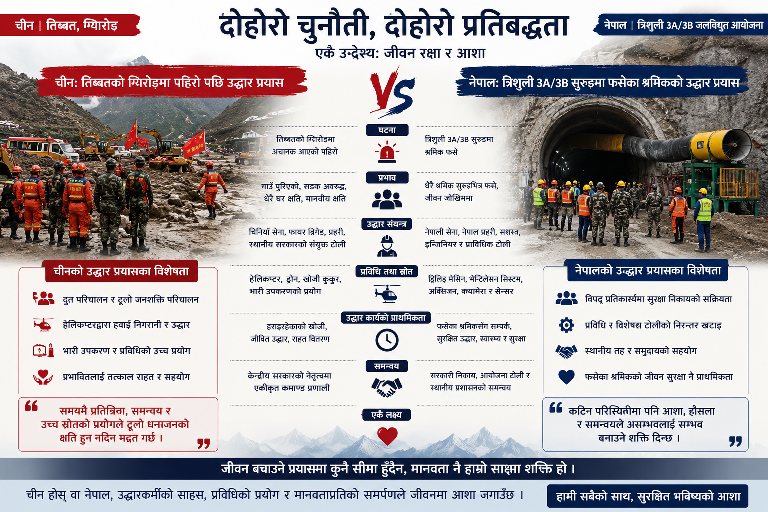
Comparison of rescue efforts in Tibet and Nepal
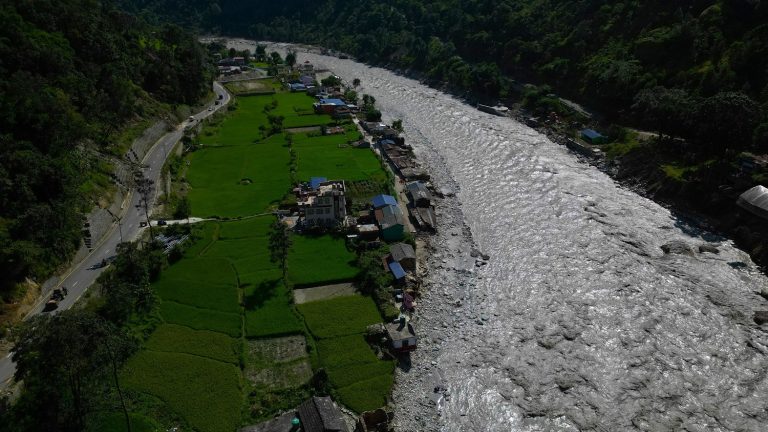
The mountains gave no warning worth its name. On the morning of 26 August, a wall of ice, rock and water broke loose near the roof of the world and thundered down toward two countries that share a border but, as the past week has shown, precious little by way of trust or readiness.
On one side lies Gyirong, a remote Tibetan county now etched into official Chinese memory through the tireless efforts of well-managed rescue efforts of the government there.
On the other side lie Rasuwa and Nuwakot, districts in Nepal where hundreds of hydropower workers still lie entombed beneath a shroud of frozen mud, waiting for a government that took days to decide whether saving them was worth the trouble of asking for help.
International media coverage of Gyirong, whatever one makes of its polish, tells the story of a state moving with purpose.
Within a day, rescue teams from various sectors of Tibet had rushed to the port; soon the People’s Liberation Army sent coordinators; base stations were rebuilt one after another until an official could once again speak by phone to rescuers a mile away.
Whether every word deserves to be taken as gospel is a fair question, since Beijing’s own casualty figures stayed frozen for two days even as Nepal’s death toll kept climbing.
But the picture the Chinese state wished to paint, and largely succeeded in painting, was one of visible, disciplined response.
Set that beside what has unfolded across the border. In Rasuwa, at sites like Trishuli 3A and 3B, soldiers armed with excavators and hydraulic cutters spent three full days simply locating the mouths of buried tunnels.
At the Rasuwagadhi project alone, nearly fifty employees vanished without a trace, their fate unknown even to the company that employed them.
By the end of last week the country’s own disaster authority admitted that more than nine hundred hydropower workers were unaccounted for, most of them buried in a darkness no drill could reach fast enough.
Barely a handful of bodies had been pulled from those tunnels even as the missing count in Nepal and Tibet together crossed four thousand.
What ought to trouble every citizen, and certainly this writer, is not the flood itself, for no government commands the glaciers, but the government’s own hesitation in the hours that followed.
Nepal initially kept international rescue teams at arm’s length, even as India, with one hundred seventy eight of its citizens missing, more than any other nation, and countries as far afield as the United States, Australia, Ukraine and South Korea, offered specialised tunnel rescue units and forensic experts.
It took mounting diplomatic pressure, and no small amount of public fury at home, before Kathmandu relented and gave foreign teams the green light they had been waiting for.
The head of Nepal’s own private power producers association put the matter bluntly, the country simply does not possess the technology or expertise to mount such a rescue on its own, yet pride, or perhaps old wounds from the tug of war that followed the 2015 earthquake, kept the door shut precisely when every passing hour mattered most.
This is where Amartya Sen’s Idea of Justice earns its place in the conversation, not as an ornament of scholarship but as a blade sharp enough to cut through official excuse making.
Sen draws a distinction, borrowed from Sanskrit jurisprudence, between niti and nyaya. Niti concerns the correctness of rules, institutions and procedure on paper; a country can boast a disaster management act, an inter-ministerial coordination committee and a chain of command that reads impeccably in a textbook.
Nyaya, by contrast, concerns the world as it is actually lived, whether real people are spared real suffering. A government absorbed in niti while nyaya rots underground is not merely inefficient; it is unjust in the deepest sense Sen describes.
He also reminds us that recognising manifest injustice, a child going hungry before our eyes, a worker breathing through a narrow pipe in a flooded tunnel, requires no grand unified theory of the good society.
It requires only the will to act. Nepal’s leaders did not need a philosopher to tell them that trapped men needed oxygen and machinery faster than pride could supply either. Every day spent weighing sovereignty against survival tightened its own noose around men who had gone to work that morning, not to become bargaining chips in a contest between Beijing, Delhi and a fragile new government in Kathmandu still finding its feet.
If, in the end, these workers are found lifeless because help that could have arrived sooner arrived late, no ledger of protocol will absolve the state. Sen would call it a failure of nyaya, a triumph of correct-looking arrangements over the lives those arrangements were meant to protect.
Ordinary people will simply call it what it resembles: a government’s silence dressed up as sovereignty, and a slow, needless killing worn as governance.
History will not remember whether the paperwork was in order. It will remember only whether the men in that tunnel came home. Nepal must not let the mountains carry blame that belongs, in good part, to Singha Durbar itself.
Author is an international lawyer based in Kathmandu. He can be contacted at amritkharel@jurisnepal.com