
‘लाखे नाँच’को विरासत
Damauli (Tanahun), October 3
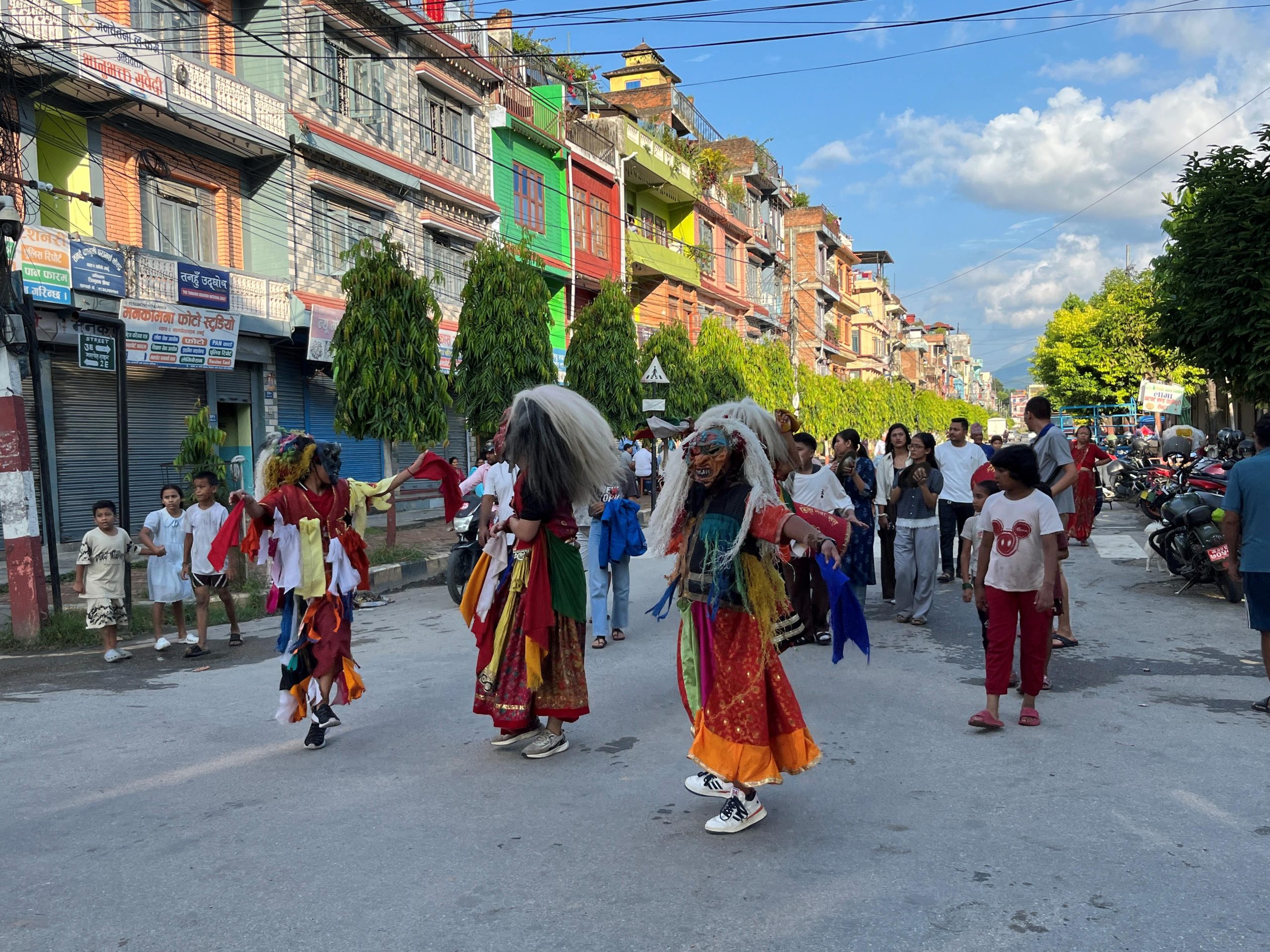
When young people don the Lakhey mask and start dancing, the surrounding environment instantly fills with joy and celebration. The harmonious blend of traditional attire, musical instruments, and rhythmic dance brings the centuries-old cultural heritage of the Newar community to life.
The highlight of the Lakhey dance observed in various neighborhoods of Vyas Municipality is not just the presentation of a traditional dance form, but also the growing participation of the younger generation and the cultural transfer happening from elders to youth.
Youths in Vyas have actively engaged in preserving the Lakhey dance, which is considered a crucial part of the Newar community’s original culture and traditions. Associated with Newa: Tajilaji Puchh:, young people have learned the steps, expressions, rhythm, and presentation techniques from their elders and have begun performing it themselves.
A cultural responsibility previously managed solely by the older generation is now being carried on by the youth. As a result, the Lakhey dance is no longer merely a special festival performance; it has evolved into a living cultural classroom passed down from one generation to the next.
According to Sandesh Narayan Shrestha, President of Newa: Tajilaji Puchh:, interest among the younger generation toward their language, culture, and traditions has been steadily rising. He noted that as youth embrace the skills learned from elders and pass them on to those after them, the cultural preservation campaign becomes significantly stronger.
“The Lakhey dance is a tradition deeply connected to our values and culture. We have been involving the new generation to ensure its preservation,” Shrestha said. “Only when the youth continue learning from elders and teaching others can our authentic traditions be sustained for generations.”
To safeguard the Lakhey dance, the organization hosts annual performances. During these events, youth are not only directly involved in performing, but are also provided with regular practice sessions and formal training.
Young participants are taught the nuances of dance steps, body language, rhythm, presentation, and the traditional musical instruments used. Applying these learned skills during performances has visibly boosted their confidence.
From Five-Year-Old Children to Youth
Currently, around 100 young men and women are associated with Newa: Tajilaji Puchh:, with a remarkable presence of young children. Children as young as five years old are involved in cultural activities.
President Shrestha believes that familiarizing children with their culture and heritage from an early age helps them accept it as an integral part of their lives. “If we connect children to our culture early on, preserving it in the future becomes much easier,” he said.
Children who used to watch and enjoy the Lakhey dance are now learning the steps themselves. They are learning to move to the rhythm of the Dhime drum and practicing to sync their dance with the musical beat.
Intergenerational transfer is the most critical aspect of cultural preservation. If a tradition remains confined to written documents, its vitality can fade. However, when one generation hands down skills practically to the next, culture thrives for centuries.
This process is now visible in Vyas. Youth who learned the Lakhey dance from their elders have started teaching the younger children. This creates an environment where the knowledge and skills passed from the older generation reach the youth, and subsequently flow down to the children.
Local youth Nimesh Shrestha shared that learning from elders and participating in cultural activities has made it easier to maintain the tradition. According to him, learning the Lakhey dance is not just about mastering a dance form—it is an opportunity to understand their community’s history, values, and identity.
Rhythm of Dhime Alongside Lakhey
The cultural campaign of Newa: Tajilaji Puchh: goes beyond the Lakhey dance. The group also offers training in the Dhime drum, traditional music, and various folk dances unique to Newar culture.
Regular practice sessions are conducted so that the younger generation understands the deep connection between the rhythm of the Dhime drum and the Lakhey dance. President Shrestha mentioned that training in Dhime play is actively provided to youth and children to prepare them for cultural events.
He emphasized that cultural activities should not be limited to seasonal festivals and celebrations; rather, an environment must be created for continuous learning, practicing, and performing. “Culture isn’t just something to showcase during festivals. If we integrate it into daily life, the new generation will feel a stronger sense of ownership,” Shrestha remarked.
Uniting Youth Across 15 Guthis
Newa: Tajilaji Puchh: has brought together youth from 15 different Guthis (traditional community trusts) within Vyas Municipality under a unified cultural campaign. Despite having distinct customs and practices across individual Guthis, bringing youth onto a shared platform aims to protect the Newari language, art, values, and traditions collectively.
Shrestha noted that this initiative has expanded cultural ties among young people while offering a shared opportunity to promote the traditional knowledge and skills embedded across various Guthis.
Concerns for Language and Script Beyond Dance and Music
Moving forward, the organization is preparing to launch training programs for Nepal Bhasa (Newari language) and the Ranjana script alongside dance and music. President Shrestha explained that preserving dance and music alone does not fully safeguard a culture. Language and script serve as vital foundations, making it essential to involve the new generation in their preservation.
“Dance and music alone are not enough; our language and script are also essential pillars of our culture. Therefore, we are preparing to teach Nepal Bhasa and the Ranjana script to the youth,” he stated.
He noted that the influence of modern lifestyles and technology has led to a decline in the everyday use of native languages and scripts among younger people. To address this, engaging programs are being designed to attract children and youth toward learning their language and script.
Seeking Authenticity Amid Modernity
Rapid advancements in technology have transformed modern lifestyles. Mobile phones, social media, and modern entertainment channels heavily influence the daily lives of the younger generation.
In such a context, passing down traditional culture and authentic practices to youth has become increasingly challenging. Yet, in Vyas, young people are willingly putting on Lakhey masks, playing the Dhime drum, and passing on the steps and rhythms learned from elders to the next generation. This proactive involvement offers a beacon of hope for preserving indigenous culture.
Cultural preservation cannot rely solely on the efforts of elders; the younger generation must embrace it as their own. The youth engagement currently observed in Vyas signals a growing sense of cultural ownership. While the Lakhey dance may serve as entertainment for onlookers, Shrestha emphasized that for the Newar community, it is a living tradition tied to their history, values, and cultural identity.
Expectations for Support Alongside Preservation
Although youth participation in Lakhey dance and other cultural activities is rising, young people emphasize that sustained support from local government bodies, the community, and relevant organizations is vital for long-term preservation.
To keep the learning and teaching process going smoothly, requests have been made for assistance with training logistics, traditional costumes, musical instruments, rehearsal spaces, and cultural program funding.
(RSS)