
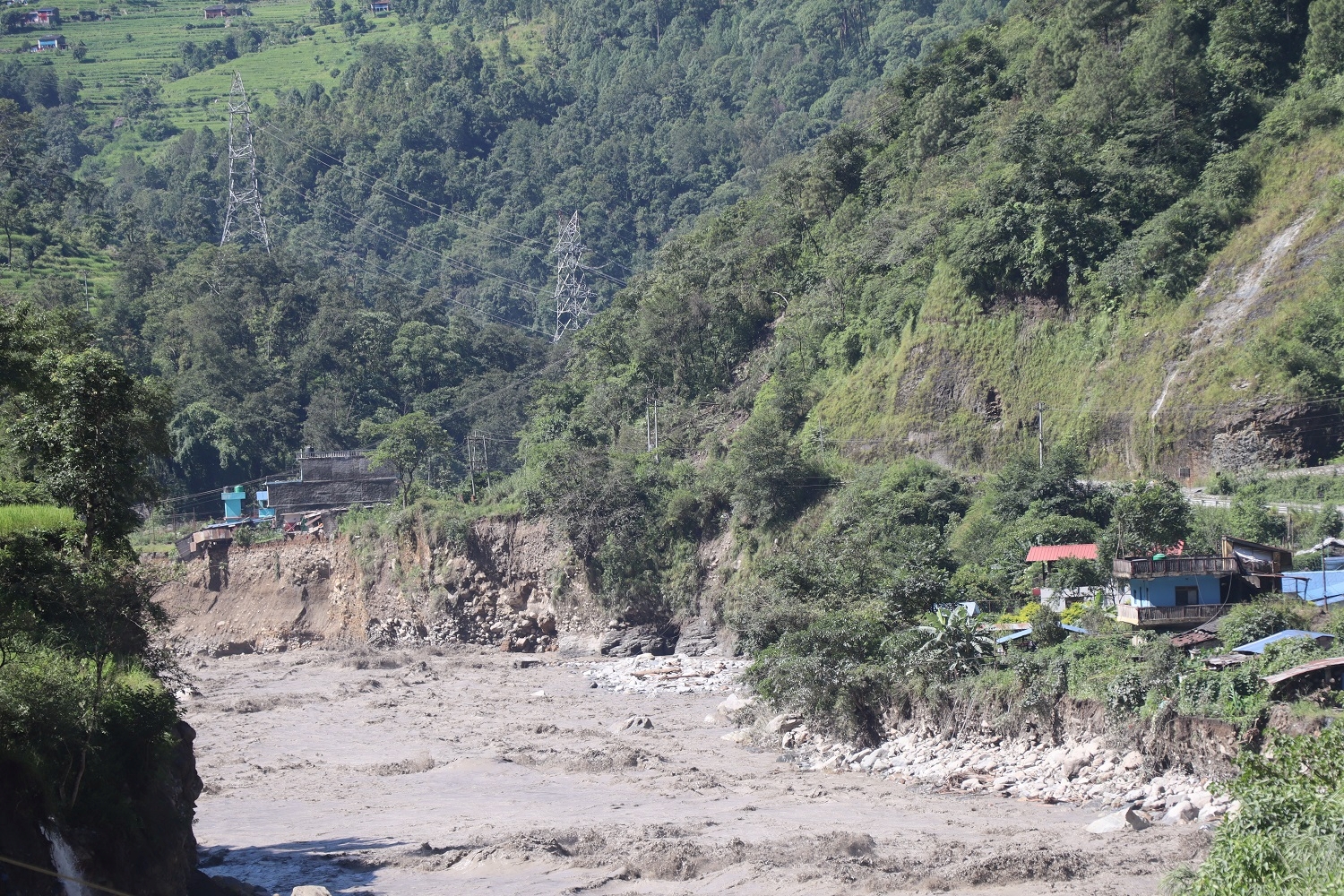
कालीगण्डकी बाढी
MYAGDI, September 29
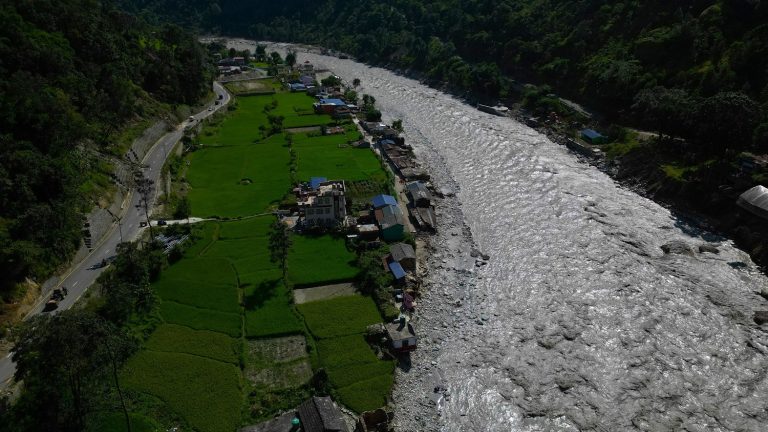
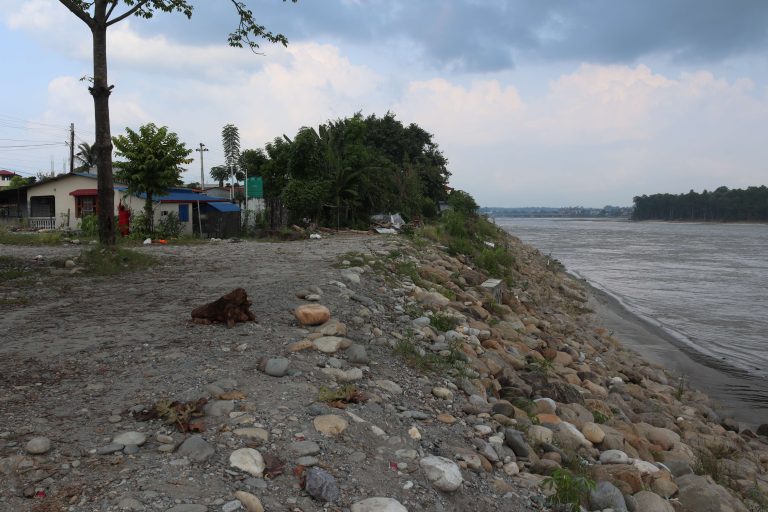
The Kaligandaki River has begun flowing adjacent to the house of Gam Bahadur Century in Tilkenichaur, Raghuganga Rural Municipality–3, Myagdi, following two days of severe flooding and erosion.
After the river started eroding the land on Sunday morning, Century moved his belongings out of his house and piled them on the road in front. However, he remains uncertain about where to take his family and reside.
“The Kaligandaki swept away my entire kitchen garden. Now that the river flows right in front of our doorstep, it is no longer safe to stay here,” Century said on Monday afternoon, his voice heavy with emotion as he moved his belongings. “The flood and erosion have turned us into squatters. We have no idea where to take our family.”
The river swept away over one ropani of land along the roadside, which Century had purchased using his hard-earned savings from working abroad. Leaving behind the house he had lived in for 20 years, Century was visibly moved to tears.
Tilkenichaur, home to eight families, served as a bustling commercial hub along the Beni–Jomsom–Korala road section of the Kaligandaki Corridor, connecting China and India. Restaurants in Tilkenichaur were popular among travelers along the route as well as visitors from Beni, Baglung, Kushma, and Pokhara for local dishes like local fish and chicken. Following heavy rainfall from September 24 to 27 (Asoj 8 to 11), the houses that once served delicacies to visitors now stand completely empty.
Local restaurant owner Gopal Bhandari also shared his grief over having to abandon the house he built with his life’s savings. Changing its course, the flood eroded nearly 80 percent of the playground next to Bhandari’s house, where the river now flows.
“I never imagined the Kaligandaki, flowing 50 meters away, would suddenly shift its course and enter our settlement,” Bhandari said. “This disaster has not only destroyed our property and land, but it has also devastated laborers who worked here and local farmers who relied on selling vegetables, milk, fruits, and poultry for their livelihood.”
Mahendra Gurung, operator of the Chamere Hotel in Tilkenichaur, stated that after nearly two decades of running his business there, he was forced to relocate to Galeshwor. “The remaining houses in Tilkenichaur are at risk of being swept away at any moment,” Gurung noted. “Only abandoned homes will remain here.”
Local resident Hari Chand reported that the river’s erosion at nearby Ghumaune Taal has created further hazards. Fearing floods and landslips, he now sleeps at a hillside poultry farm at night.
The suspension bridge connecting Ghumaune Taal to Banskharka in Jaljala Rural Municipality–1, Parbat, was swept away by the flood. The bridge served as the entry point for the Annapurna–Dhaulagiri Circuit Trekking Route, spanning Myagdi’s Annapurna and Parbat’s Jaljala rural municipalities.
According to Chand, the collapse of the bridge also broke the water supply pipeline brought from Banskharka, leading to a drinking water shortage for about 10 families in the area. The flood has also eroded arable land toward Banskharka, disrupting movement for residents of the Raghu and Banskharka areas.
The Kaligandaki River has also eroded the power house premises of the Rahughat Hydroelectric Project in Tilkenichaur. Developed by Raghuganga Hydropower, a subsidiary of the Nepal Electricity Authority, the 40 MW capacity project had commenced test production just last week.
Shifting its course from 50 meters away, the river moved near the switchyard and began flowing through the tailrace meant to discharge water from the powerhouse. Although the tailrace was affected, the powerhouse itself suffered no structural damage.
Consequently, trial generation at the project, constructed over 16 years, has been suspended. Project Chief Raj Bahadur Bista stated that test production was halted temporarily due to the natural disaster. Additionally, the Beni–Jomsom road section situated between the powerhouse and the river was swept away; the river now flows over what was previously a vehicular road.
Equipment and vehicles belonging to the Indian contractor firm Jaiprakash Associates (JP) parked in the powerhouse premises were also washed away. Kumar Yadav, an employee at JP, confirmed that around 20 vehicles were swept away by the flood, expressing sadness over incurring billions in losses just as project construction was nearing completion.
Across from the Gayatri Temple, the river’s main flow hit the Ram Temple area, leaving the temple situated at the confluence of the Kaligandaki and Rahuganga rivers at high risk. Furthermore, landslides from the hillside have accumulated debris on the road.
Local resident Mim Thakali mentioned that slurry flowing from the road inundated houses with mud. Rahughat residents expressed concern that the lack of a long-term solution for recurring hillside landslides causes hardship every year, with 21 households currently facing landslide risks.
rss