
कृषक अलैँचीखेतीमा आकर्षित
Panchthar, September 29
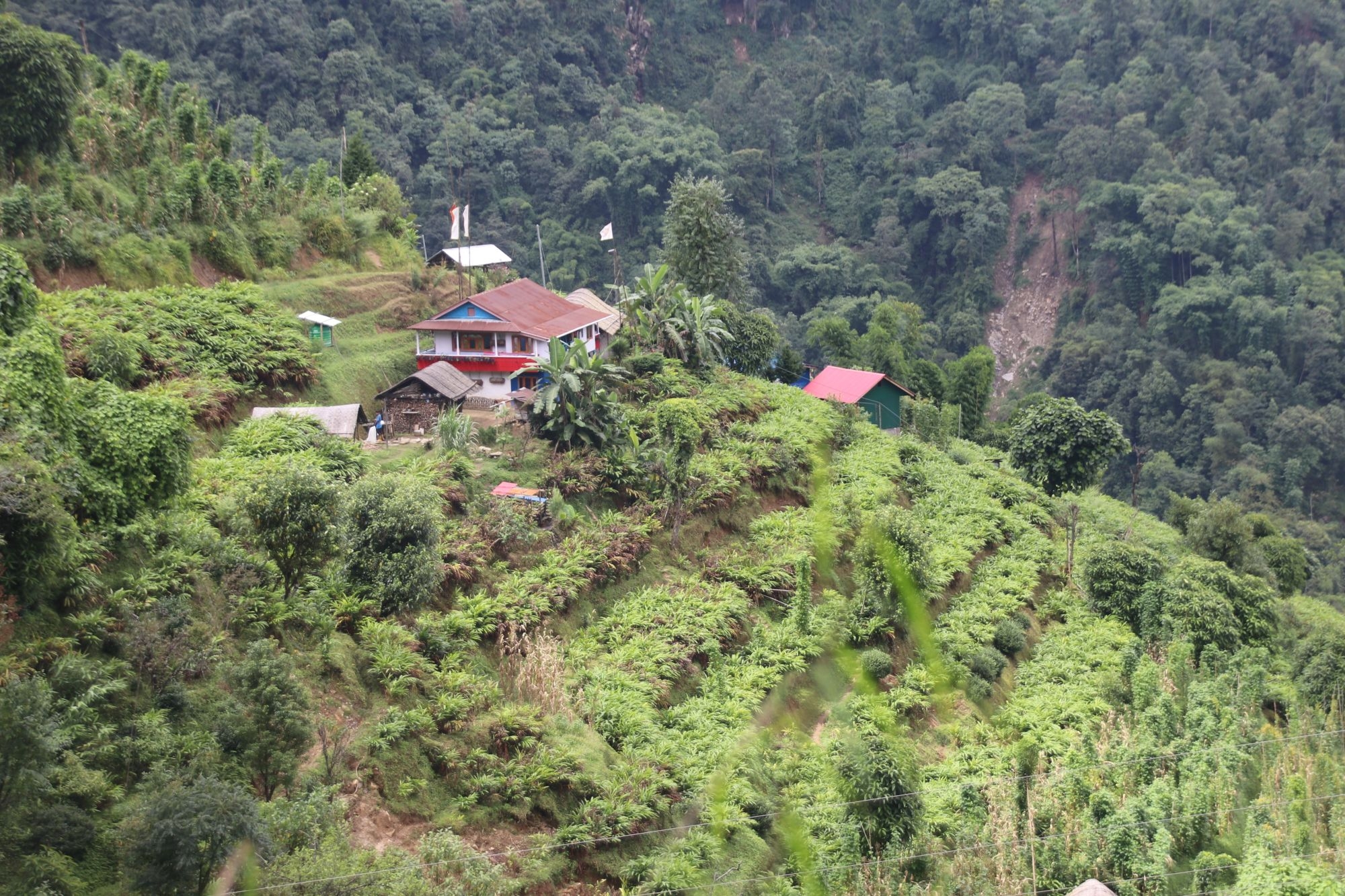
In Thingepur, Ward No. 1 of the remote northern Yangwarak Rural Municipality, Suk Bahadur Begha has expanded large cardamom cultivation right up to the courtyard of his home. Having extended his plantation across his entire homestead, Begha has in recent years completely given up farming paddy and maize.
Suk Bahadur’s neighbor, Dhanmaya Begha, has similarly planted large cardamom in her kitchen garden, noting that the crop now covers every available plot of land. In the same ward’s Biruwa settlement, Balananda Begha has also extended his cardamom field up to his doorstep. Attracted by strong market prices, farmers across these remote rural areas are increasingly adopting large cardamom as their primary commercial crop.
Having cleared fields previously dedicated to paddy, maize, and millet to make way for cardamom, Suk Bahadur shares a deep attachment to the crop.
“This crop is what sustains and protects us. Large cardamom is our only direct path to earning cash,” Begha said. “Traders only trust us and lend money when we grow cardamom. Once you farm this, creditors are willing to provide whatever we request.” He added that cardamom farmers are easily able to secure year-round provisions on credit from local rural markets.
As large cardamom cultivation has made earning a livelihood significantly easier, farmers have given it top priority. Suk Bahadur believes cardamom has restored dignity to the farming community. “Cardamom is what maintains our prestige,” affirmed Purna Bahadur. “We have planted cardamom everywhere—in our backyards, homestead margins, and former paddy fields.”
The primary driver behind this shift is the highly lucrative market price for large cardamom. Since last year, prices have remained above NPR 80,000 per man (approximately 40 kilograms). “Receiving up to NPR 80,000 per man is very profitable, as it equates to roughly NPR 2,000 per kilogram. No cereal crop can match that return,” Suk Bahadur explained. “As long as cardamom fetches a good price, it remains highly beneficial for us.”
Dhanmaya Begha has likewise converted her farm fields for cardamom expansion. “The price of cardamom is quite favorable, and it has become our primary means of hand-to-mouth survival,” she said.
However, continuous rainfall triggered a massive landslide on May 22 that swept away her main cardamom grove located near a stream bank. “We had never experienced such a major loss before,” Dhanmaya reflected. “Fortunately, the cardamom planted on the converted field lands survived, which may still generate some income for us.”
Purna Bahadur Begha of Biruwa noted that traditional farming of paddy, maize, and millet fails to even cover production costs, prompting many farmers to switch to cardamom. Meanwhile, Ram Kumar Rai of Chamlingdada in the same ward reported that successive landslides in June 2023 and May 2024 destroyed his plantation, which previously yielded nearly 30 man of cardamom. Rai expressed concern that losing cardamom production leaves villagers with no alternative source of income.
“Cardamom is the sole reason residents are still staying in this village; otherwise, unable to meet basic food needs, everyone would have already migrated,” Rai remarked. “Our daily lives are entirely dependent on cardamom. It is cultivated not just in Yangwarak-1, but across more than 40 wards in the district.”
According to data from the Agriculture Knowledge Center in Panchthar, large cardamom was cultivated across a total area of 3,326 hectares in the fiscal year 2025/26. Agriculture Extension Officer Pradeep Nepali reported that total district production reached 1,396.92 metric tons.
National News Agency (RSS)