तिहार र देउसी
Ram Kumar Rai
Kathamandu, Nov 9.
The presentation of Deusi dance is in itself a grand theatrical and cultural art. The core tradition of Deusi is collective dance and singing performed predominantly by men on the day of Kartik Shukla Pratipada and Bhai Tika.
Although there are some differences in the singing style and presentation of Bhailo—sung by women on the night of Aunshi—and Deusi—sung by men—the core sentiment of both is public welfare and entertainment.
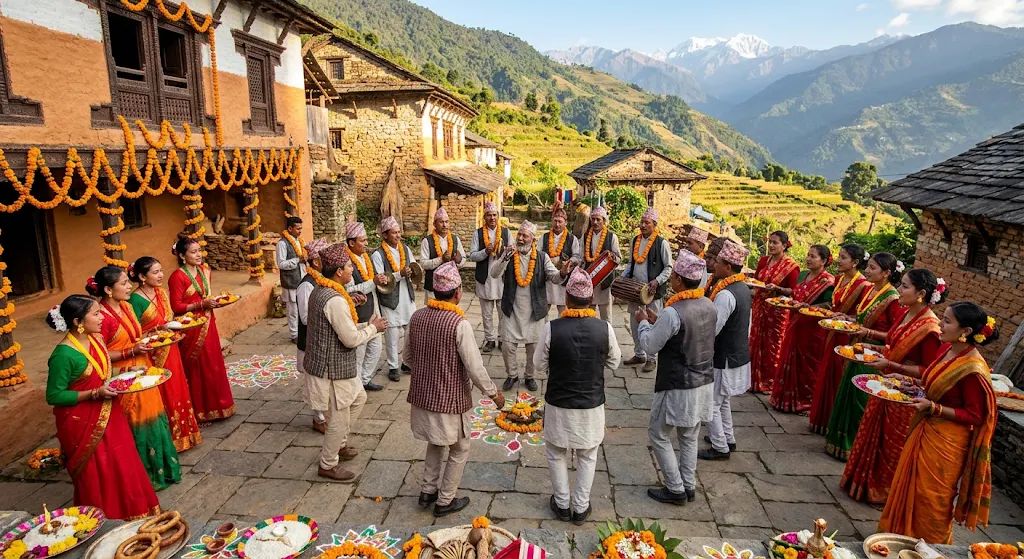
The structure exhibited while playing Deusi is extremely organized. In the courtyard of a house, the Deusi players stand in a circular formation and move around rhythmically as they play.
This circular formation conveys a message of social collectiveness and equality. In the middle of this group is a lead singer, known as the Bhatyaune (lead chanter). Alongside them, based on the nature of the song, other skilled dancers also perform dances in the center.
The most captivating aspect of Deusi is its chanting style. The lead singer single-handedly chants verses filled with emotional, poetic, and narrative elements, while at the end of every line, the other members of the group chorus “Deusire” in unison to echo or support the refrain. This call-and-response style generates extraordinary energy and sweetness in the singing.
Deusi songs and dances are not presented spontaneously. Following a definite procedure, Deusi dance and singing—much like Bhailo—consist mainly of three distinct stages:
First Stage: This is the beginning of Deusi, where the Deusi group arrives at someone’s courtyard and announces their presence. In this stage, addressing the homeowners respectfully, they ask to wake them up if they are sleeping and request them to open the main door and welcome the group into the courtyard:
- Hey… Bhanabhana bhai ho – Deusire!
- Hey… Ramrari bhan – Deusire!
- Hey… bhana na bhana – Deusire!
- Hey… Ayeka hami – Deusire!
- Hey… Deusire khelna – Deusire!
- Hey… Hajurko gharma – Deusire!
- Hey… Ayeka hami – Deusire!
- Hey… Gharbeti baba – Deusire!
- Hey… Gharbeti aama – Deusire!
- Hey… Dhoka ughari – Deusire!
Second Stage: In this stage, the Deusi players describe how far they have come and what difficult, rugged paths they traversed. They urge the homeowners to offer donations accordingly, explaining that they are not mere beggars who come every time, but messengers of King Bali. They state that they have not come for nothing, but to obey the command and orders of King Bali:
- Hey… Hami tyasai – Deusire!
- Hey… Ayeka hoinau – Deusire!
- Hey… Bali rajako – Deusire!
- Hey… Hukumai le – Deusire!
- Hey… Ayeka hami – Deusire!
- Hey… Yesai Gharko– Deusire!
- Hey… Nam suvas sunda – Deusire!
- Hey… Fulmala unda – Deusire!
In this stage, the homeowners place unhusked rice, selroti, fruits, and coins on a flat plate (nanglo) according to their capacity and offer them to the Deusi players—a practice known as Dan Thapne (receiving donations).
Third Stage: The most beautiful, spiritual, and socially beneficial aspect of Deusi is the granting of blessings. After receiving donations from the homeowners, the Deusi players offer loud, poetic blessings wishing for the prosperity, economic growth, health, and lineage expansion of the household. There is a popular belief that blessings given by Deusi players always come true.
What blessings shall we give to the homeowner of this house? May you live for a hundred years, flourish like the Dubo grass, maintain a good reputation, may your grain-store be filled, may your money-bag be overflowing, and may this house turn into a mansion when we return next year, oh speak brothers.
This blessing is not merely a narrow-minded wish; it spreads positive energy and mutual harmony throughout society.
Deusi performed according to such rituals is gradually disappearing from villages across Nepal with the advent of modern lifestyles and technology. As traditional customs, procedures, and the use of local materials passed down through generations diminish, the originality of our festivals is weakening.
According to culture experts, the traditional practices of Tihar are not just methods of celebrating festivals, but are tied to the cultural identity of Nepali society and experiential indigenous knowledge passed down through generations. They state that the younger generation must understand the value of old traditions and keep them alive.
Previously, when celebrating Tihar in villages, festivals were observed using locally available resources. Notably, there was a practice of lighting oil lamps on banana trunk sections (damcha) during Deepawali. For Dashain and Tihar, houses were decorated using white clay (kamero mato), red clay (rato mato), and colors made from coal or tree bark.
Neighborhoods would come together to clean roads, bridges, and water spouts. Traditional swings like linge and charke were set up in open fields, and people would play on them collectively while making joyous calls. The originality of such traditional forms of entertainment and knowledge has now vanished.
While there used to be a strong trend in villages during Tihar to collectively play Deusi-Bhailo, sing local folk tunes, and use traditional local materials, that practice also seems to be fading. Such activities played a vital role in maintaining mutual harmony, reconciliation, and social unity in villages. Today, due to the use of modern entertainment mediums and changing lifestyles, traditional skills and practices have declined.
Although setting up swings, cleaning courtyards, lighting lamps, playing Deusi-Bhailo, worshipping crows, dogs, cows, and oxen, and performing Bhai Tika are the core activities associated with Tihar, the special charm of the Maruni and Sororthi theatrical dances performed every year was unique. It has been years since people last witnessed the traditional custom where audiences from neighboring villages would gather just upon hearing the resonant rhythm of the Queen Maruni.
While the growth of modernity, ease, and convenience is positive, the loss of indigenous culture and tradition remains a matter of concern in itself.