Cueva_del_Castillo_interior

Ramkumar Rai
Kathmandu, November 13
The invention of letter/ alphabets rescued humanity from the darkness of prehistory and ushered it into historical enlightenment.
Today’s towering structures of modern information technology, artificial intelligence, and digital communication all stand firmly upon that very first stroke drawn on a cave wall and the foundation of the Greek alphabet laid around 800 BCE.
In the history of human civilization, the development of the art of writing stands as a revolutionary milestone, every bit as significant as the invention of fire and the wheel (physics).
Spoken language alone could not ensure that human thoughts, experiences, and knowledge survived safely from one generation to the next. Writing is the very medium that gives physical form to abstract thoughts born in the human mind, carrying them far beyond the boundaries of time and space.
Today, as we effortlessly write characters on digital screens or paper pages and understand their meaning, a nearly forty-thousand-year-long chronicle of human imagination, contemplation, struggle, and intellectual growth lies behind it.
From the hunting scenes painted on the walls of dark Upper Paleolithic caves to pictographs, ideographs, logographic writing systems, syllabic writing systems, and finally the full-fledged alphabetic writing science perfected by the Greeks (the Hellenic region) around 800 BCE, this continuous journey is an epic of human consciousness.
The Primal Embryo of Writing: Upper Paleolithic Cave Paintings
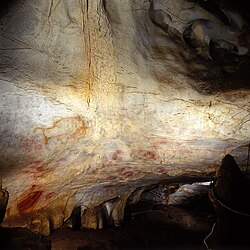
Humans learned to draw thousands of years before they learned to recognize letters. During the Upper Paleolithic period—roughly spanning 40,၀၀० to 10,000 BCE—early humans used the walls of dark caves as canvases to express their emotions, fears, hopes, and daily life experiences. The cave paintings found in Lascaux and Chauvet in France, and Altamira in Spain, stand as living proofs of humanity’s first visual language.
Communication of Meaning and Magical Beliefs
Those primitive cave paintings were far more than casual art for aesthetic display. Wild buffalo, mammoths, horses, deer, and human figures engaged in hunting are depicted with remarkable vitality.
According to anthropologists, profound psychological and cultural motivations drove early humans to paint animals on cave walls. On one hand, these paintings served as instructional guides for fellow group members on how and which animals to hunt; on the other hand, they embodied a spiritual belief that successfully executing a hunt involved the intervention of unseen forces.
Painted using red ochre, black charcoal, and mineral pigments, these artworks ultimately served as the primary seed of scripts.
The Rise of Pictography
As time progressed, the detailed and artistic drawings on cave walls grew more concise. Instead of rendering entire scenes, humans began conveying meaning through simplified outlines or symbols of objects and creatures. This is known as pictography.
For instance, drawing a simple circular disc to represent the sun, drawing only a triangular line to represent a mountain, or sketching wavy lines to represent a river became standard practices. Here, the drawing directly represented the exact physical object it portrayed.
However, pictography suffered from a major limitation: while it could successfully communicate physical objects visible to the eye, expressing abstract emotions such as love, anger, hunger, time, or truth proved entirely impossible.
The Leap Toward Abstract Thought: Ideographs
Breaking through the limitations of pictography, the human mind took another intellectual leap, giving rise to ideographs.
In ideography, drawings no longer represented just direct physical objects; instead, they began to signify related ideas, qualities, and actions.
For example, while an early drawing of the sun strictly meant the sun, at the ideographic stage it began to signify light, warmth, divinity, and related concepts. Similarly, the drawing of two walking feet came to represent not just feet, but the actions of walking or traveling. Adding a teardrop to an eye drawing expressed crying, sorrow, or grief.
While ancient Chinese and Egyptian hieroglyphic scripts made remarkably rich use of ideographs, remembering and writing thousands of separate signs for thousands of separate ideas remained exceptionally complex and cumbersome.
The Dawn of Civilization and Logographic Writing
Between 35,000 and 3,000 BCE, urban civilizations flourished along the great river valleys of the world: the Mesopotamian civilization in the region between the Tigris and Euphrates rivers, the Egyptian civilization along the Nile valley, the Indus civilization around the Indus River, and city civilizations along the Yellow River (Huang He) in China.
The growing demands of agricultural production, expanding trade, tax collection, and state administration forced writing into an organized system. This necessity sparked the invention of logographic or word sign writing, where each symbol represented a single, complete word.
Development of Mesopotamian Cuneiform
The Sumerians of Mesopotamia developed the world’s oldest systematic writing system around 32,000 BCE. Initially, they drew pictures on wet clay tablets to keep track of grain, livestock, and commerce. Because these clay marks resembled wedge-like shapes after drying, the script became known as Cuneiform.
This script stands as an exemplary model of logographic writing. Initially comprising over 1,500 distinct symbols, it was later streamlined to about 600. The laws of Sumerian, Akkadian, and Babylonian civilizations—such as the Code of Hammurabi—and the world’s first epic, the Epic of Gilgamesh, were written in this script.
Ancient Egyptian Hieroglyphics and Demotic Writing
Contemporary with Mesopotamia, another script emerged in Egypt: Hieroglyphics, meaning “sacred carvings.”
Developed around 3,100 BCE, this script was inscribed on temple walls, tombs, and paper made from the papyrus plant. It featured over 700 artistic pictographic symbols, where some signs represented whole words while others functioned phonetically.
The Rebus Principle: The Revolution from Picture to Sound
The greatest revolution in the history of writing arrived with the invention of the Rebus principle.
When scribes faced difficulty writing abstract words or proper nouns, they bypassed the literal meaning of a picture and began utilizing its spoken pronunciation sound.
To understand this simply through an English analogy: drawing a picture of a bee and a leaf and combining their sounds to form the new word belief illustrates the Rebus principle.
This principle detached writing from direct visual representation and bound it to the spoken sounds heard by the ear. It opened the vast gateway toward syllabic and alphabetic writing.
The Evolution of the Syllabic Writing System
Because logographic writing required memorizing thousands of symbols, literacy remained an exclusive monopoly of court priests and restricted scribes, proving far too difficult for ordinary people.
As the use of the Rebus principle spread, contemporary linguists and scribes realized that countless words could be broken down into phonetic components (syllables) and written using a smaller set of symbols, leading to the development of the syllabic writing system.
In a syllabic system, each script symbol represents a consonant combined with a vowel sound, reducing the total number of characters to a manageable range between 60 and 100.
Major Historical Examples of Syllabic Writing:
- Elamite and Hurrian Scripts: Ancient peoples around Mesopotamia began adapting Cuneiform signs for pure syllabic use.
- Linear B: Used around 1450 BCE in the Mycenaean civilization of ancient Greece, Linear B was a fully syllabic script containing about 87 sign characters.
- Japanese Kana and Devanagari: Modern Japanese Hiragana and Katakana are pure syllabic scripts. Similarly, the Devanagari script—derived from South Asia’s Brahmi script—is considered a syllabary-alphabetic system in linguistics, where every consonant inherently carries an “a” vowel sound.
Although syllabic writing simplified the process, one complexity remained: if a language required separate symbols for every variation of a consonant-vowel matrix (like ka, ki, ku, ke, ko…), the total number of characters remained quite high. The alphabetic system provided the ultimate solution to this problem.
The Birth of Alphabetic Writing and Completion Around 800 BCE
Alphabetic writing represents the supreme achievement in the history of human writing. In this system, words and syllables were broken down into even more minute units—split into individual consonant and vowel sounds.
By combining 20 to 30 fundamental signs based on the phonetic needs of a language, people discovered they could effortlessly write any letter, word, sentence, thought, or piece of literature in the world.
Proto-Sinaitic and Phoenician Scripts
The preliminary sowing of alphabetic writing occurred between 1800 and 1500 BCE by Semitic laborers working in the Sinai Peninsula of Egypt. They selected about 22 pictographic signs from Egyptian hieroglyphics and used them to represent not whole words, but the initial sound of each word.
For instance, an ox was called aleph in Semitic languages, so aleph gave rise to the alpha or “A” sound symbol. A house was called beth, yielding the “B” sound symbol. A camel yielded the gimel sign (becoming Gamma/G), and a door (daleth) yielded the Delta/D sign.
Around 1050 BCE, the Phoenicians—master maritime traders of the Mediterranean—refined this system into a streamlined script of 22 consonant letters. Wherever Phoenician ships traveled for trade, this script spread. However, Phoenician writing possessed a notable characteristic: it contained only consonants, lacking written vowels. Readers had to deduce vowel sounds based on context—a trait still preserved today in Arabic and Hebrew.
The Historic Contribution of the Greeks Around 800 BCE: The Birth of the Full Alphabet
The decade around 800 BCE marked a revolutionary turning point in the evolution of writing. During Mediterranean trade, ancient Greeks learned the 22-letter consonantal script from Phoenician merchants.
However, the structure of the Greek language differed entirely from Semitic languages; pronouncing Greek words without explicit vowel sounds distorted meanings entirely.
Consequently, around 800 BCE, Greek linguists and scribes introduced a revolutionary reform. Certain Phoenician consonant sounds—such as aleph, he, yod, and ayin—did not exist in spoken Greek. The Greeks repurposed these signs into pure vowel characters (Alpha, Epsilon, Iota, Omicron, Upsilon).
This Greek innovation produced history’s first complete alphabet representing both consonants and vowels separately.
The Phoenician aleph and beth evolved into Greek Alpha and Beta, which directly gave birth to the English letters A, B, C, and D. This Greek alphabet transformed through Italy’s Etruscan civilization into the Roman script used today to write most of the world’s languages.
The Impact of Writing on Human Civilization
The emergence of full alphabetic writing around 800 BCE was much more than a technical invention; it fundamentally transformed the intellectual, social, and cultural fabric of human civilization. Memorizing thousands of symbols had been practically impossible for ordinary citizens.
But learning 24 to 26 letters was achievable for anyone, allowing literacy to break free from the confines of palace priests and ruling classes and reach the general public.
This accessibility enabled the recording of Homeric epics in Greece after 800 BCE, safeguarding profound philosophical reflections from Socrates, Plato, and Aristotle, along with historical archives and scientific principles.
Writing enshrined humanity’s collective memory, making it immortal. Even after individuals passed away, their ideas, experiences, and inventions continued to live on in written form through the power of letters.
From the bison painted in red ochre on Upper Paleolithic cave walls to the fully realized alphabetic script perfected by the Greeks around 800 BCE, the journey of writing stands as a wondrous epic of human intellect:
- Pictography: What humans saw, they drew.
- Ideography: What humans thought, they began to depict.
- Logography/Syllabary: What humans spoke, they captured in bounded word-signs.
- Alphabetic Writing: By capturing the finest acoustic sounds of speech, humanity mastered the art of encompassing the entire universe within just two dozen letters.