भैली नाच

Ram Kumar Rai
Kathmandu, November 11.
The Bhaili songs and dance are primarily associated with Bhai Tika. According to mythology, Yamraj, the lord of Yamlok (the abode of death), once took some time off from his realm and visited his sister Yamuna, staying with her for five days.
Yamuna was immensely delighted to have her busy brother visit her home, and she warmly welcomed him by performing various rituals and serving him delicious food.
Deeply touched by her hospitality, Yamraj happily promised to grant any wish she desired. For Yamuna, simply having her brother present in her home was the greatest joy. Therefore, she expressed, “Just as I am overjoyed by your visit here today, I wish to see every sister and brother equally content and satisfied.”
She requested, “May the five days you spend at my home become a festival celebrating the bond between sisters and brothers. Please command your messengers (Yamadoots) not to take the lives of brothers until the garlands of Dubo grass and Makhamali flowers, and the mustard oil offered by their sisters, have dried up.”
Yamraj accepted his sister Yamuna’s wish. Since that day fell on the second lunar day (Dvitiya), it is also known as Yamadvitiya. The Bhaili dance is performed precisely to commemorate and remember this profound love and pact between sisters and brothers.
According to another legend, a man was on his way to his sister’s house to receive Bhai Tika. On the way, he encountered the Yamadoots who had come to fetch him.
The messengers ordered him to accompany them to Yamlok. However, the man pleaded, “Today is Yamadvitiya, and my sister is eagerly waiting for me with worship materials. Please let me go and receive tika from my sister after performing the worship of Yamraj and Yamuna, and I will come with you afterward.” Hearing that he wanted to worship Yamraj, the messengers agreed under the condition that he report back once his tika ceremony concluded.
The man reached his sister’s house and received the flower tika. Soon after, the Yamadoots arrived there as well and informed the sister that they had come to take her brother away.
The sister requested the messengers not to take him until the oil spilled around her brother as a protective shield during the worship, and the Makhamali flower garland placed around his neck, had completely dried.
The Yamadoots waited for a long time, but miraculously, the oil and the Makhamali flower garlands refused to dry. Helplessly, the messengers had to return empty-handed—so goes the legend.
With the arrival of autumn, the festival of lights and colors known as Tihar or Yamapanchak brings a radiant glow to the psychology of Nepali society.
This festival also manifests the beauty of nature, humanity, coexistence, and inner consciousness. Laxmi Puja, the central focus of this five-day festival, carries profound significance in Nepali literature, art, and culture.
The night of Laxmi Puja is not merely limited to religious rituals worshipping the goddess of wealth and prosperity; it can also be portrayed as an opportunity to explore knowledge, opulence, and spiritual enrichment by dispelling the darkness within the human mind.
The dark night of Kartik Krishna Aunsi is termed Sukharatri in scriptures. The flickering lamps, candles, and colorful, captivating displays of various flowers working to banish darkness from consciousness and hearts act as metaphors for awakening dormant human awareness.
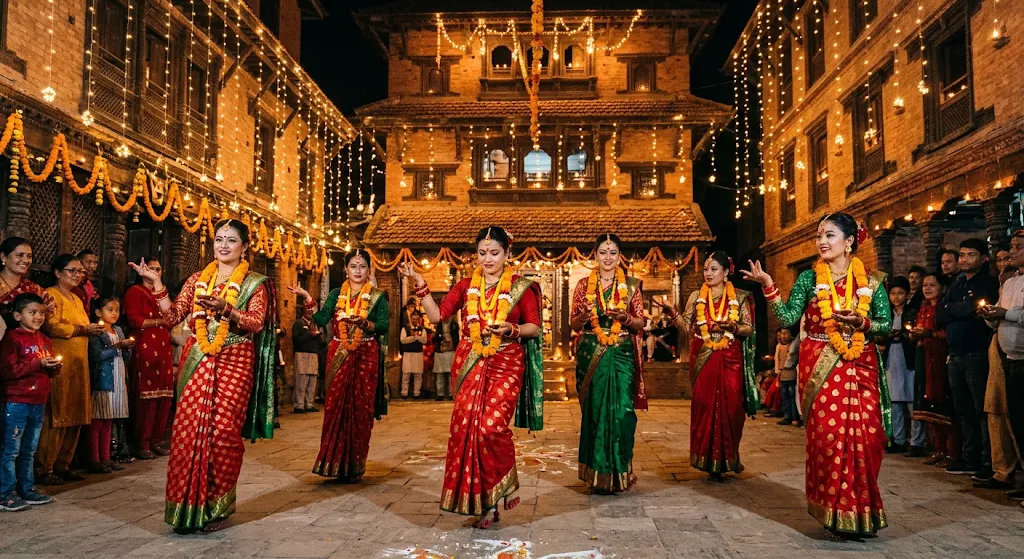
Following Laxmi Puja, women gather to play instruments like the Madal and Mujura while initiating the Bhaili or Bhaili dance. This allows them not only to adhere to cultural norms but also to experience joy and freedom. Specifically, the dance performed from Ashwina Krishna Trayodashi to Ashwina Krishna Amavasya is called the Bhaili dance.
It is a traditional, group-based folk dance performed exclusively by women. In this dance, a group leader (team captain) recites soft-toned verses, songs, and couplets related to King Bali and the Vamana avatar while the group performs the choreography together.
After the leader chants the verses, the participants sing “Bhaili” or “Bhaili Re” and dance merrily. Traditional instruments like the Madal, Khaajadi, and Thapadi are played during this dance.
Bhaili songs and dances generally consist of three stages:
First Stage: Songs are presented to inform the homeowner of the Bhaili group’s arrival, wake them up, and request lodging arrangements.
Example:
Bhaileni ayin aagan, badhari kudari rakh na!
He… Aunsi ko bar, Gai Tihar Bhailo.
Second Stage: Melodious Bhaili songs explaining the purpose of coming to play Bhaili are presented.
Example:
Hami tyasai aayenau, Balirajale pathako!
He… Aunsi ko din, Gai Tihar Bhailo.
Third Stage: Attractive blessing songs are delivered to bestow prosperity upon the generous homeowner.
Example:J
asle dinchan mano, uskai sunko chhano!
He… Aunsi ko din, Gy Tihar Bhailo.
Jasle dinchan pathi, unkai sunko chhatti!
He… Aunsi ko din, Gai Tihar Bhailo.
Jasle dinchan muri, unkai sunko dhuri!
He… Aunsi ko din, Gai Tihar Bhailo.
On the day of Bhaili, songs with the “Simal Barulai” refrain are popular in the eastern hilly region, while “Sailena songs” are customary in the Far West.
Sailena Bhaili songs are sung in the form of lyrical ballads narrating the saga of Maharaja Salen Shah and Rambha Rani. Some scholars state that the praise of King Bali itself is echoed in the guise of Salen Shah.
In the Sailena songs sung in the Doti region, the chanting leader recites the sagas of the king and queen, while the group responds in chorus by chanting “Jyunapuri!”
Example:
Salen ka Shah Maharaj – Jyunapuri!
Dharu balyo bhai – Jyunapuri!
Gaura gauki Rambha Rani – Jyunapuri!