देउसिरे

Ramkumar Rai
Kathmandu, November 21
In the vast canvas of Nepali culture, Tihar is not merely a festival of lights and colors; it is also a glorious revival of the abstract arts, music, and dance embedded in Nepali folk life.
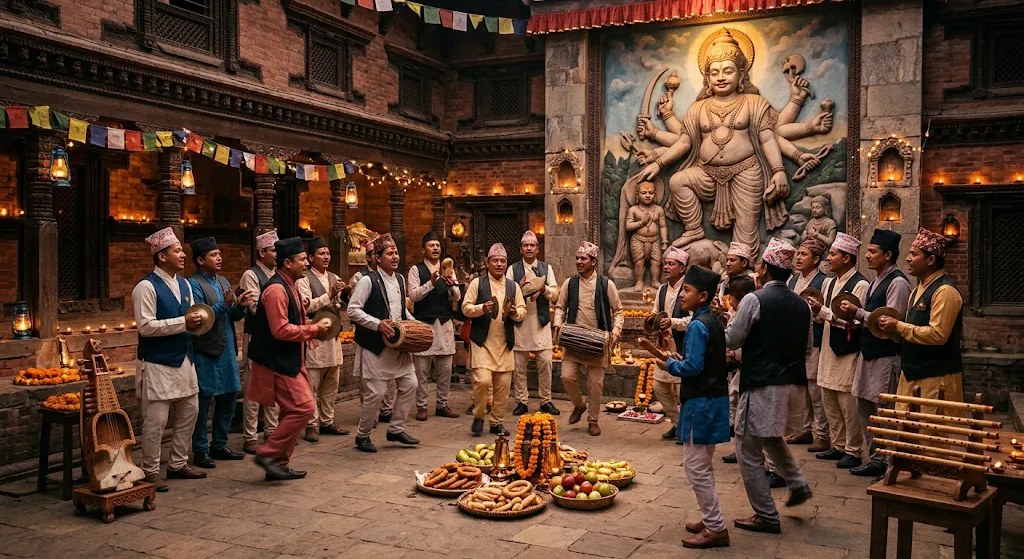
Amidst the chill of autumn, the Nepali sky resonates with a distinctive folk tune, accompanied by the fragrant aromas of glowing lights, velvet flowers, marigolds, and white chrysanthemums, alongside the sweet scent of sel roti wafting through village settlements, hills, ravines, and city alleyways and intersections.
That tune is none other than—“Deusi Re!”
The sweet chime of the collective chorus chanting, “A… bhanabhan bhai ho – Deusire!” evokes a supernatural energy and spiritual joy in the Nepali psyche.
Deusi is one of the old and foundational heritages of Nepali folk culture. Specifically danced and sung collectively by men, Deusi is not just a traditional form of entertainment; rather, it represents an entire era of Nepal’s ancient philosophy, historical legends, social unity, and economic exchange.
Regarding the origin of the Deusi tradition, it is primarily linked to two legends of the mythological philanthropist, King Bali, as well as to medieval Western Nepal. Towards the end of the Khas or Sinja kingdom, when Abhay Malla weakened, Kalyanvanshi Bali Raj Rawal of Kalaigaun established a separate, independent Khas kingdom in Jumla. This Bali Raj Rawal is also often associated with the Deusi tradition.
The Mythological Origin: King Bali and Lord Vishnu
Tracing the origin and underlying meaning of Deusi dance connects its roots directly to the great philanthropist King Bali of the mythological era.
According to the Srimad Bhagavata Purana and other Hindu scriptures, King Bali, the son of Virochana, was extremely powerful, just, and charitable in Satyuga. Frightened by his growing influence and supremacy over heaven, the deities sought the protection of Lord Vishnu. Lord Vishnu took the form of Vaman (a dwarf ascetic) and arrived at Bali’s sacrificial arena (Yagashala) to ask for alms.
There, employing a clever ruse, Lord Vishnu in his Vaman form asked King Bali to donate just enough land to cover three paces (footsteps). Despite warnings from his guru, Shukracharya, the truth-abiding King Bali agreed to grant the alms requested by Vaman.
Thereupon, Vaman assumed a cosmic form, covering the entire earth with one step and the skies and netherworld with the second. With no space left for the third footstep, King Bali honorably and humbly bowed his head to keep his word. Deeply moved by Bali’s unprecedented generosity, devotion, and surrender, Lord Vishnu appointed him as the ruler of the netherworld (Patal Lok) and granted him a boon:
“O charitable Bali! Because you have surrendered everything and even offered your head as alms, from today onwards, every year during this period in the month of Kartik, your worship, honor, and celebration shall take place.”
It is believed that the tradition of playing Deusi and Bhailo originated as a continuation of this mythological boon, commemorating King Bali on Earth and continuing his celebration.
The Second Legend: The Ashwamedha Yajna and the Gandharvas
Another legend associated with King Bali is equally popular in Nepali society. According to this folklore, King Bali once decided to perform a grand Ashwamedha Yajna (horse sacrifice). However, a situation arose where the state treasury and internal resources alone were insufficient to complete this grand ritual.
To overcome this dilemma, King Bali summoned the skilled musicians, dancers, and artists—the Gandharvas and Kinnars—of his court and kingdom. He assigned them the responsibility of visiting various states and societies across the country to perform musical programs, sing, and dance, thereby raising funds, grants, and contributions for the state’s upcoming Ashwamedha Yajna.
Accepting Bali’s command, the Gandharvas and Kinnars sang songs with tender, melodious, and poignant lyrics, dancing rhythmically from house to house in village settlements to collect grain, wealth, and provisions.
With the large fortune raised through the medium of art, King Bali successfully completed his Ashwamedha Yajna. At that very Yajna, Bali also sacrificed his kingdom and body as the ultimate donation; hence, tradition holds that Lord Vishnu granted him the boon of being celebrated for five days from Kartik Krishna Trayodashi to Kartik Shukla Pratipada.
It is on the basis of this folk belief that the culture of singing and dancing Deusi from house to house, invoking the name of King Bali, has remained vividly alive in Nepal.