



Kathmandu | November 21, 2026
Gold, once the undisputed safe haven of global investors, is facing a brutal reversal. After soaring to record highs earlier this year, the precious metal has entered a deep correction, and the latest plunge in Nepal’s bullion market has reignited a debate among investors: Is this the right moment to buy gold, or could prices fall further?
On Friday, November 20, gold prices in Nepal dropped by a staggering Rs12,200 per tola in a single day. According to the Federation of Nepal Gold and Silver Dealers’ Association, fine gold was traded at Rs245,400 per tola, down from Rs257,600 on Thursday. Silver also fell Rs225 to Rs3,110 per tola. The magnitude of the daily decline has shaken a market where gold is traditionally considered a reliable store of wealth.
The sell-off is not merely a local phenomenon. International spot gold plunged to around $3,514 an ounce on Friday, its lowest level in more than a year, and suffered nearly a 9.4 percent weekly decline—the steepest in eight months. Reuters reported that bullion is under pressure from a strengthening US dollar, rising interest-rate expectations and aggressive selling across financial markets.
The central force behind the decline is the changing outlook for US monetary policy. Persistent inflation, higher energy costs and resilient economic indicators have strengthened expectations that the Federal Reserve may raise interest rates rather than cut them. Higher yields on Treasury bonds make gold less attractive because bullion generates no interest income. A stronger dollar further discourages international buyers, while investors who accumulated gold during its spectacular rally are now rushing to lock in profits.
Ironically, global financial turmoil has also contributed to gold’s weakness. The recent technology-stock sell-off, particularly concerns surrounding the artificial-intelligence investment boom, has forced some investors to liquidate profitable gold positions to cover losses elsewhere. Even a traditionally defensive asset has not escaped the pressure of cash shortages and portfolio unwinding.
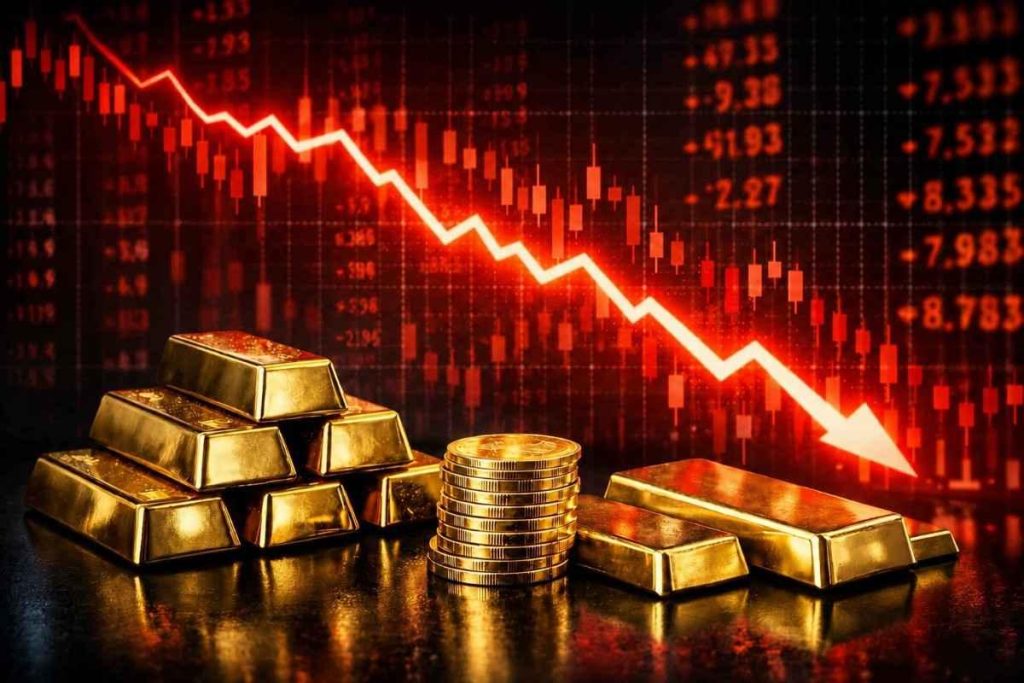
How far could the fall go?
How much further could gold fall? The immediate psychological support lies around $3,500 an ounce. If the dollar strengthens further, US yields remain elevated and speculative positions continue to unwind, a move towards $3,300–$3,400 cannot be ruled out. However, such levels represent a downside scenario rather than a certainty. A softer inflation reading, a reversal in interest-rate expectations, renewed geopolitical tensions or fresh central-bank buying could quickly trigger a rebound.
The correction may not be over. Nepal-based market estimates suggest international gold could test $3,500 per ounce, with domestic gold potentially approaching Rs245,000 per tola, provided the dollar, interest-rate outlook and global conditions remain unfavourable. This is a downside scenario—not a guaranteed price target.
Gold’s recent slide has been intensified by speculative unwinding and investors selling assets to raise cash. The World Gold Council says October’s decline was driven partly by portfolio rotation into bonds, reduced speculative positions and market deleveraging.
However, a freefall is not inevitable. Central banks continue accumulating gold as a strategic reserve, while fiscal deficits, geopolitical uncertainty, inflation concerns and distrust of conventional currencies remain powerful long-term supports. The World Gold Council expects central-bank demand to remain strong, and the World Bank’s outlook suggests gold may remain historically expensive even if prices soften further.
The correction also carries wider economic consequences. Lower gold prices could reduce import bills for gold-consuming economies such as Nepal, potentially easing foreign-exchange pressure. Jewellery buyers may benefit, while gold-producing countries could face declining revenues. But falling bullion prices also expose how quickly global capital can shift between assets in response to interest rates, currency movements and investor confidence.
For Nepali investors, the current decline presents both opportunity and danger. Gold remains a long-term hedge against inflation, currency depreciation, geopolitical uncertainty and financial instability. Yet buying aggressively during a falling market can trap investors in losses if the correction deepens.
A prudent approach would be staggered buying—accumulating small quantities over several weeks or months instead of investing the entire amount at once. Investors should avoid borrowing to buy gold, preserve emergency cash and diversify across deposits, equities and precious metals. Those purchasing jewellery for weddings or long-term use may find the correction attractive, while short-term traders should remain cautious.
Gold’s decline may be painful, but it does not necessarily signal the end of its long-term appeal. The real test for investors is distinguishing a temporary correction from a structural downturn. In a market driven by fear, patience and discipline may prove more valuable than predicting the exact bottom.
This article is based on market reporting and forecasts available as of November 21, 2026. Price projections are scenarios, not guarantees or personalised financial advice.