Image

Ramkumar Rai
Kathmandu, Mangsir 3
How were the British secretly breaking the geographical, social, political, and military secrecy that Nepal had adopted toward them prior to the Anglo-Nepalese War (1814–1816), while preparing for the upcoming war?
At that time, Nepal’s geographical terrain was its greatest shield of defense. Deeply understanding this, King Prithvi Narayan Shah had pursued a policy of remaining apart from the British for geographical secrecy right from the start of the unification campaign.
For that reason, after conquering the Kathmandu Valley, Prithvi Narayan Shah ordered the missionaries living in the valley to leave the country. From the time of King Prithvi Narayan Shah through that of King Rana Bahadur Shah, it is clear that Nepal followed a defensive foreign policy of staying aloof from external powers in order to protect its sovereignty and territorial integrity.
Strict bans were placed on foreigners—especially the British—entering or traveling through Nepal’s hilly regions. Those in power in Nepal up to the time of King Rana Bahadur Shah believed that as long as the British did not gain knowledge of Nepal’s geography, routes, and internal affairs, they could not immediately launch a major invasion. However, the British were gradually breaking this policy of isolation, and by 1814 that policy had become extremely weak.
Prior to 1792, British knowledge of Nepal’s geographical conditions, forts and strongholds, troop numbers, condition of roads and trails, political views, conditions inside the palace, and places of strategic importance was limited to mere guesswork. No matter how strict the restrictions Nepal imposed to maintain secrecy, the British never abandoned their efforts to uncover Nepal’s internal situation and geographical environment.
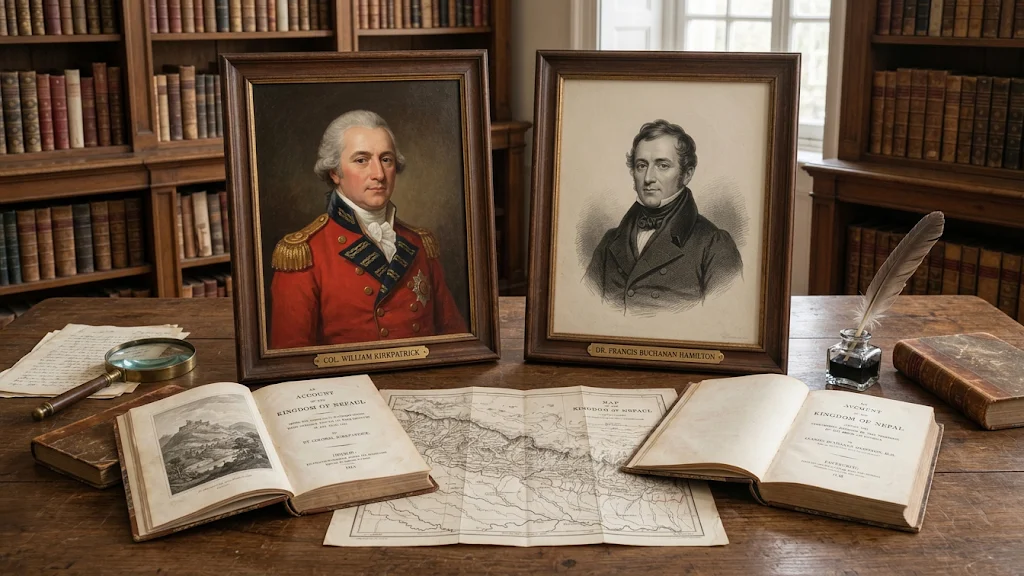
Using various diplomatic missions, commercial covers, and espionage networks, the British pierced Nepal’s secrecy and policy of isolation, laying the groundwork from 1792 onward for the Anglo-Nepalese War fought in 1814–1816. The individuals who broke Nepal’s policy of isolation within just 22 years were Captain William Kirkpatrick and Dr. Francis Buchanan Hamilton—whom we even praise for having written our history scientifically for the first time and introducing Nepal to the world.
The British gained their first golden opportunity to gather preliminary intelligence on Nepal in connection with the Nepal–Tibet War of 1792.
When the Nepal government requested military assistance during the Nepal–Tibet War in 1792, the British proposed a commercial treaty.
Representing the diplomatic mission of Captain William Knox for a commercial treaty between Nepal and the British East India Company, Colonel William Kirkpatrick arrived in Nepal on February 13, 1802, and stayed for a week until April 3, 1803 .
Although the war between Nepal and Tibet had already halted, Kirkpatrick traveled from Patna through Hetauda in Makwanpur to Nuwakot—then the winter capital—and afterward reached Kathmandu.
The Nepali side had held him in Patna for months to stop him. Captain Kirkpatrick used this visit to break Nepal’s policy of isolation and secrecy and to gather official information needed for a future war.
After returning from Nepal, he submitted a detailed report on Nepal to his East India Company government, mentioning Nepal’s forts, routes, Nepal’s view toward Tibet and China, and the internal policy of the Nepali court.
The book he wrote, An Account of the Kingdom of Nepaul, opened the doors of Nepal’s geography and military structure to the British and Europeans for the first time.
In it, alongside information on Nepal’s geography and palace politics, he clearly stated that British dominance over Nepal was essential to check Chinese influence and keep the fertile Gangetic plain safe.
Thus, although Captain Kirkpatrick’s ostensible purpose appeared to be mediating the Nepal–Tibet War, his covert purpose was to map out in detail Nepal’s geographical condition, forts and strongholds, military movements, routes, Nepal’s view toward Tibet, and internal factionalism within the palace.
In March of that same year 1792 , Scottish botanist and physician Dr. Francis Buchanan Hamilton came to Nepal as a diplomatic representative of the East India Company and spent 14 months in Kathmandu and areas around the valley.
After returning from Nepal, he also presented his report to the British East India Company in India, which made clear Nepal’s perspective toward China and the British as well as its military situation.
In greater detail than Kirkpatrick’s book, Dr. Hamilton gathered information on Nepal’s ancient history, castes and ethnicities, customs, flora, society, and so on, conveying information about Nepal to the East India Company.
In this way, after the British force led by Captain Kinlock was defeated at the Battle of Sindhuli Gadhi in 1767, the British realized the seriousness of Nepal’s hilly geography and Gorkhali military capability.
Following this incident, the East India Company adopted a policy of forcing various missions into Nepal under different pretexts to break Nepal’s geo-strategic policy of isolation and gather information of strategic importance.
As the geographical secrecy and diplomatic control policy that King Prithvi Narayan Shah had adopted toward the British weakened, Nepal had to suffer defeat in the Anglo-Nepalese War of 1814–1816.