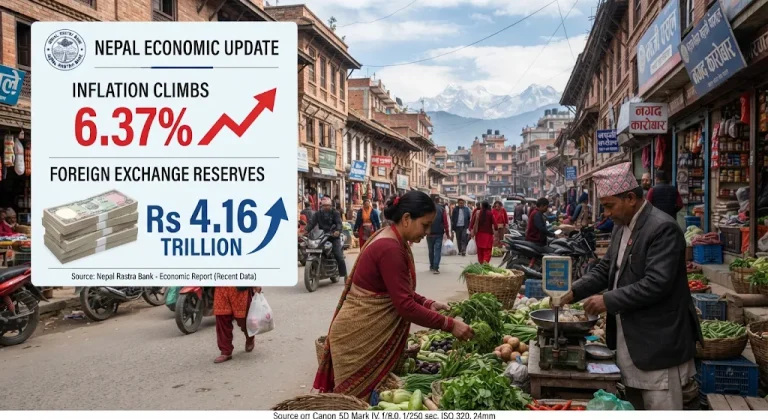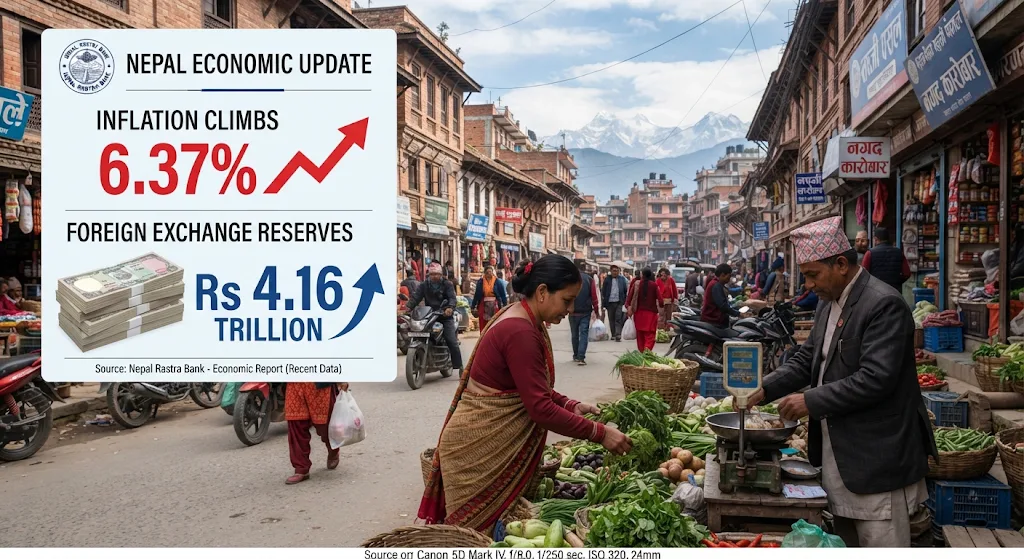
Kathmandu, November 19 – Nepal is facing renewed inflationary pressure, with consumer prices rising sharply to 6.37 percent in mid-October 2026, even as the country’s foreign exchange reserves continued to strengthen, crossing Rs 4.16 trillion.
According to the latest Current Macroeconomic and Financial Situation of Nepal report released by Nepal Rastra Bank (NRB), year-on-year inflation has surged from just 1.47 percent recorded during the same period last year.
Food prices are emerging as a major driver of the increase. Inflation in the food and beverage category reached 8.04 percent, while non-food and service prices rose by 5.46 percent. This marks a significant turnaround from a year ago, when food and beverage prices had declined by 2.54 percent.
The average inflation rate during the first three months of the current fiscal year also climbed to 6.22 percent, compared to 1.67 percent in the corresponding period last year.
Foreign Exchange Reserves Gain Strength
While rising prices remain a concern, Nepal’s external financial position has shown encouraging signs.
The country’s gross foreign exchange reserves increased by 6.8 percent to Rs 4,161.14 billion by mid-October 2026, up from Rs 3,897.67 billion in mid-July. In US dollar terms, reserves grew by 8.2 percent to USD 27.39 billion from USD 25.31 billion.
Reserves held by Nepal Rastra Bank rose 6.4 percent to Rs 3,695.24 billion, while those held by banks and financial institutions increased by 9.8 percent to Rs 465.9 billion. Indian currency accounted for 21 percent of the country’s total foreign exchange reserves.
Exports Surge Ahead of Imports
Nepal’s international trade also recorded strong growth during the review period. Exports jumped by 57 percent, significantly outpacing the 38.2 percent growth in imports.
The increase in exports offers a positive signal for the country’s external trade performance, although the overall trade balance remains an important indicator to watch.
Government Spending Outpaces Revenue
On the fiscal front, the government spent Rs 396.27 billion during the review period of fiscal year 2026/27.
Of the total expenditure, Rs 291.66 billion went towards recurrent spending, Rs 28.42 billion towards capital expenditure and Rs 76.19 billion towards financial management.
Meanwhile, total government revenue collection, including amounts to be transferred to provincial and local governments, reached Rs 298.61 billion. Tax revenue contributed Rs 279.35 billion, while non-tax revenue accounted for Rs 19.27 billion.
The figures show that government expenditure remained higher than revenue mobilization during the period.
Money Supply and Private Sector Credit Expand
Nepal’s broader monetary indicators also continued to move upward.
Broad money supply (M2) expanded by 4.4 percent during the review period, compared to 3.2 percent growth in the same period last year. On a year-on-year basis, money supply increased by 14.8 percent by mid-October.
Deposits mobilized by banks and financial institutions grew by 2.8 percent, while private sector credit increased by 3.1 percent. Compared to the same period last year, deposits rose by 13.7 percent and private sector lending expanded by 8.3 percent.
Interest Rates Remain Relatively Low
Interest rates continued to remain on the lower side. The weighted average interest rate on 91-day Treasury bills stood at 1.01 percent in mid-October 2026, down from 1.91 percent a year earlier.
However, the weighted average interbank rate among banks and financial institutions edged up slightly to 2.75 percent from 2.58 percent during the same period last year.
The Bigger Picture
Nepal’s latest economic indicators present a mixed picture: foreign exchange reserves are growing, exports are gaining momentum and banking sector deposits and lending are expanding. However, the sharp rise in inflation and the gap between government revenue and expenditure remain significant economic challenges.
For ordinary households, the immediate concern is the rising cost of food and everyday services. For policymakers, the challenge will be to maintain external sector stability while bringing inflation under control and improving public spending efficiency.