


Amrit Kharel

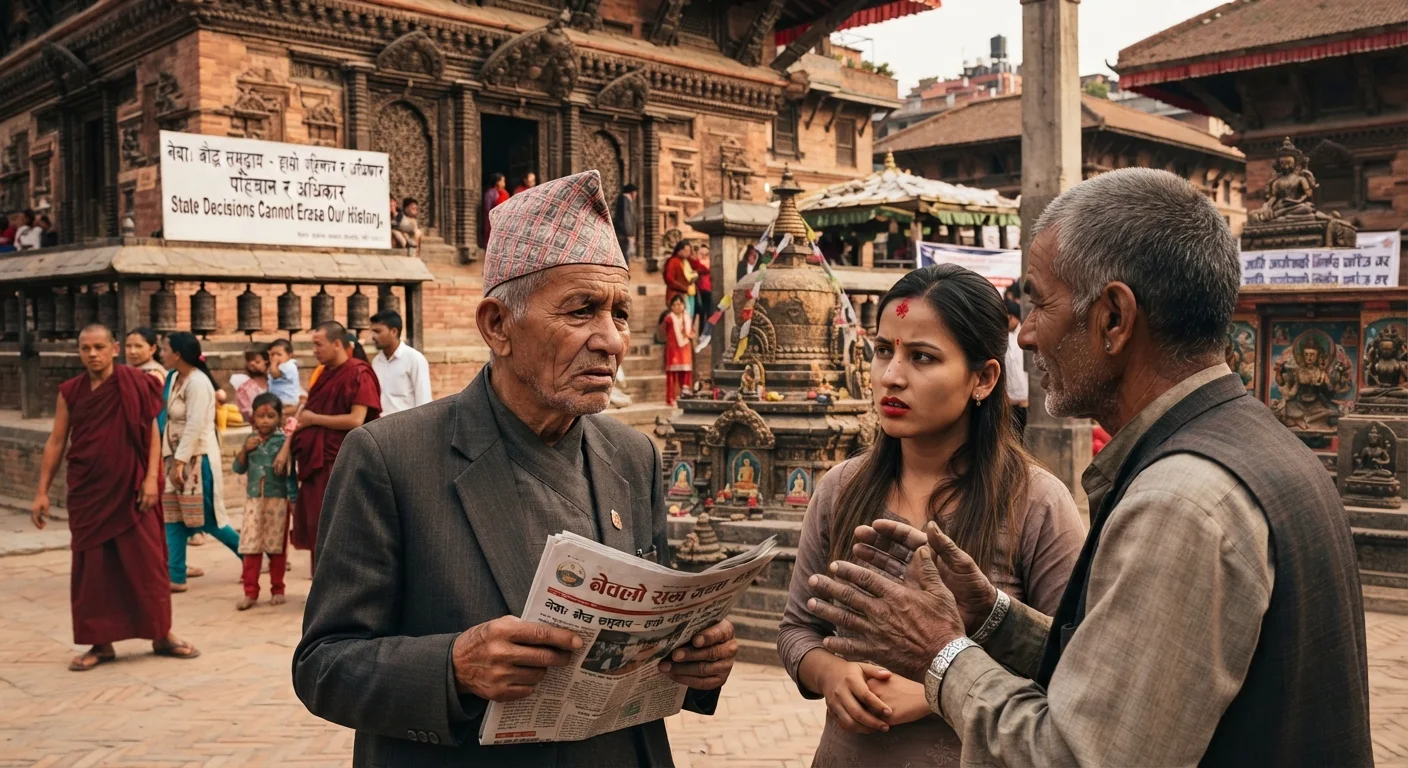
Shakya, Tuladhar, Tamrakar, Shrestha and other Newa Buddhist surnames found on a government Dalit list raise a fundamental question: Is the state protecting citizens from discrimination—or deciding who they are without asking them?
Kathmandu, November 26| Special Report
How can a community with centuries-old cultural, religious, social and historical identities suddenly find some of its surnames classified under a government list of Dalit castes? And who gave the state the authority to define a person’s identity simply by placing their surname in a gazette?
These questions have become unavoidable following the publication of a list of caste surnames recommended by the National Dalit Commission and approved by the government, which included a number of surnames associated with Newa Buddhist communities—including Shakya, Tuladhar, Tamrakar and others.
The controversy is no longer simply about a list of surnames. It is about the limits of state power, the dignity of communities, the absence of meaningful consultation and the troubling possibility that bureaucratic classification is being imposed upon people whose identities are far more complex than a government document can capture.
And now, the National Dalit Commission itself appears to be stepping back.
In a subsequent statement, the Commission acknowledged that the surname classification had created confusion and decided to recommend that the government suspend implementation of the disputed classifications for the time being. The retreat raises an uncomfortable question: If the list was sufficiently researched and justified to be recommended, approved and published in the first place, why has it now become necessary to reconsider it?
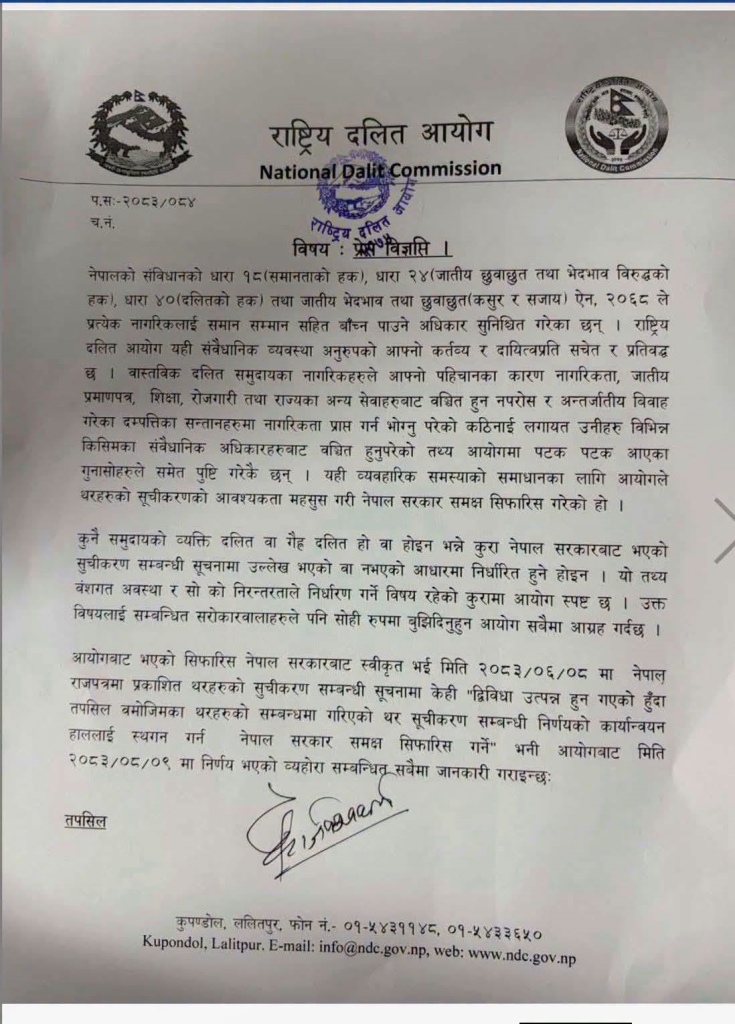
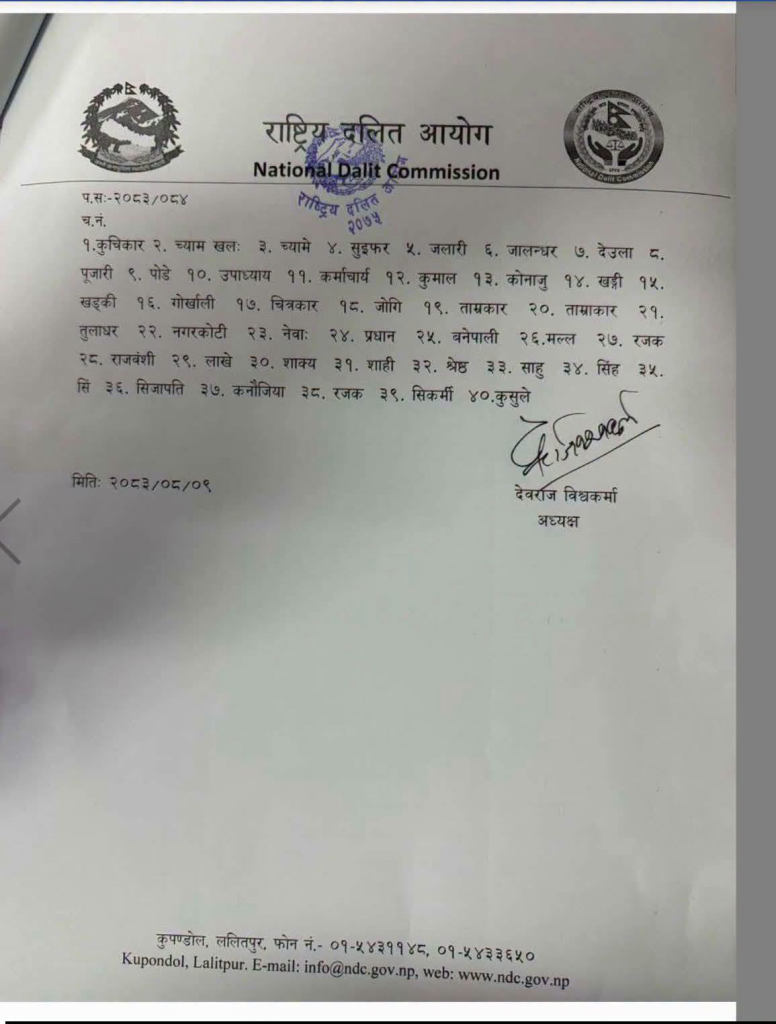
From recommendation to retreat: What went wrong?
The government published the list of more than 1,400 surnames following the recommendation of the National Dalit Commission. Among the names that triggered serious concern in the Newa community were Shakya, Tuladhar, Tamrakar, Shrestha, Pradhan, Chitrakar and other surnames historically associated with Newa social and cultural structures.
The backlash was immediate.
Newa organisations, Buddhist institutions and community representatives questioned the legitimacy of including these surnames in a Dalit classification without adequate consultation, historical scrutiny or a transparent explanation of the criteria used.
The National Dalit Commission’s subsequent statement is significant. Rather than firmly defending the disputed classification, it acknowledged the confusion and decided to recommend suspension of its implementation.
That is more than an administrative adjustment. It raises serious questions about the process through which identities were classified, recommendations were made, and a government decision was ultimately published.
If a surname-based classification can create confusion serious enough for the Commission to reconsider its own recommendation, the public deserves to know how that classification was originally prepared.
Was there a comprehensive sociological study? Were historical records examined? Were community institutions consulted? Were individuals and families given an opportunity to object before their identities were included in a government classification?
Or was the process driven primarily by bureaucratic paperwork?
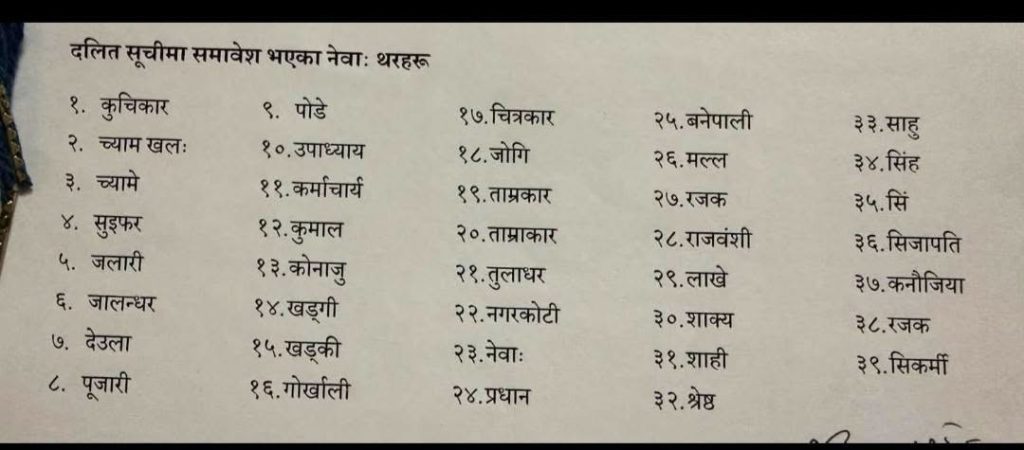
Is the government protecting people—or imposing an identity?
The central concern of many Newa community members is not the existence of protections for Dalit citizens. It is the imposition of a classification upon communities and individuals without their consent, historical context or meaningful participation.
The state has a constitutional obligation to protect citizens from caste-based discrimination. That obligation is unquestionable.
But protecting people from discrimination is fundamentally different from assigning identities to them.
A government cannot assume that everyone sharing a surname necessarily shares the same caste experience, ancestry, social position or history of discrimination. Surnames can overlap across communities, change over generations, carry different meanings in different geographical locations and reflect histories that cannot be reduced to a single administrative category.
If the Commission itself acknowledges that caste identity cannot be determined merely by whether a surname appears on a list, then what is the purpose of publishing such a list without a transparent mechanism for determining individual circumstances?
The contradiction is glaring.
A surname may belong to families with very different histories and social experiences. Yet a bureaucratic list risks turning a complex identity into a fixed government label.
Citizens should not have to prove to the state that they are not what the state has decided to call them.
The disturbing politics of dividing communities
The Newa community is not merely a collection of surnames. It is a civilisational community with a distinct history, language, cultural traditions, religious practices, social institutions and an intricate internal structure.
The inclusion of Newa surnames in a government Dalit classification, without adequately explaining the historical and social basis of that inclusion, has understandably generated anxiety that the state is interfering with community identity and potentially fragmenting an already diverse society through administrative categories.
Is this what social justice is supposed to accomplish?
Social justice should empower the historically marginalised, eliminate discrimination, guarantee equal opportunities and protect human dignity. It should not create new identity disputes, deepen mistrust between communities or turn the state into an authority that unilaterally determines how people must identify themselves.
There is no evidence in the documents presented that the list was deliberately designed to divide Newa Buddhists but it has given space for suspicion. Government cannot dismiss the consequences simply because deliberate intent has not been established.
Even without malicious intent, a poorly researched and inadequately consulted classification can damage community trust, create social confusion and produce consequences far beyond the intentions of those who drafted it.
That is precisely why the government must explain its process.
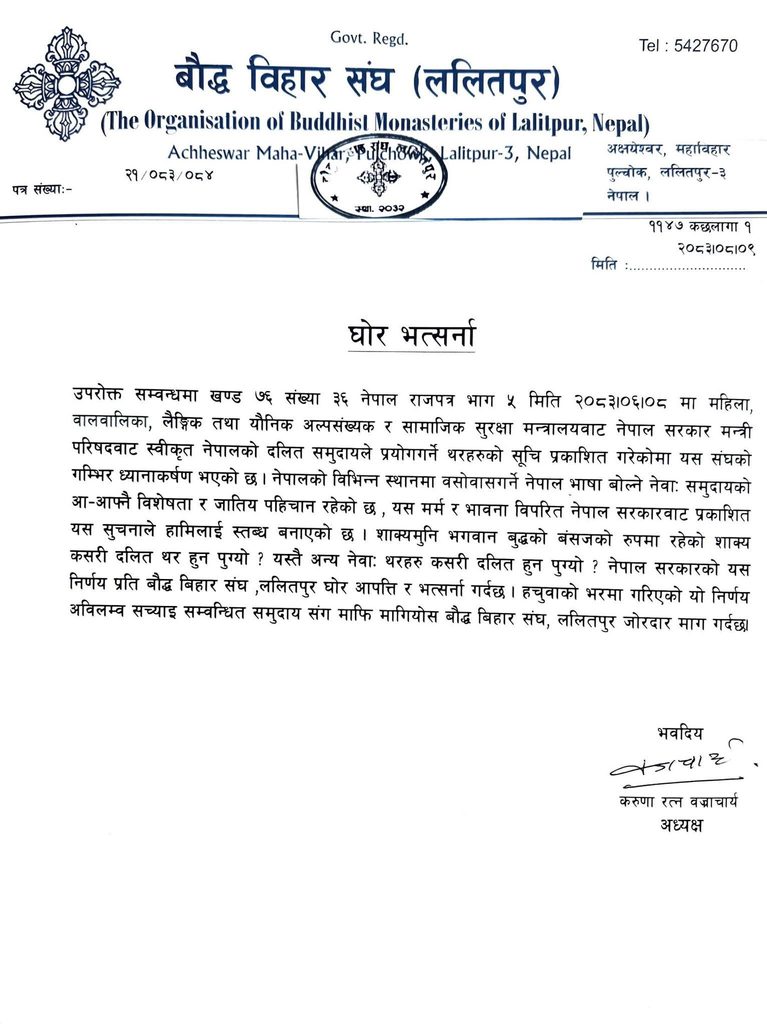
The Dalit identity is not an administrative insult—but neither should it be imposed
There is an important distinction that must not be lost in this debate.
Dalit identity is not something to be ridiculed, demeaned or treated as inferior. Dalit communities have endured generations of untouchability, exclusion, humiliation and structural discrimination. Constitutional protections, affirmative action and targeted welfare measures exist because historical injustice cannot be corrected merely by declaring everyone equal.
The issue, therefore, is not whether being Dalit is something shameful.
The issue is whether the government can assign a caste identity to a person or community without properly establishing the basis for doing so, without consultation and without allowing the affected people to be heard.
An identity rooted in lived experience, social history and community understanding cannot be reduced to an entry in a government spreadsheet.
If the state genuinely believes that certain families or groups are entitled to protection, it must establish the basis transparently and ensure that those who genuinely face caste-based oppression are not deprived of their rights.
At the same time, it must not casually classify entire communities based on shared surnames.
Justice cannot be delivered through careless categorisation.
Why has the Commission changed its position?
The National Dalit Commission’s decision to recommend suspension of the disputed classification raises an even more serious institutional question.
What changed?
Did the Commission discover flaws in its research? Did it realise that the list contained overlapping surnames? Did it receive new evidence? Did the protests reveal a failure of consultation? Or did the Commission simply recognise that its recommendation could have serious social and administrative consequences?
The Commission owes the public a clear explanation.
A recommendation of this magnitude cannot be made, withdrawn, suspended or revised without transparency. The public deserves to know what criteria were used, who was consulted, what evidence was examined and why the Commission now considers suspension necessary.
A backtracking decision without an explanation is not accountability. It is merely another bureaucratic manoeuvre.
Why must the state categorise people at all?
Perhaps the most fundamental question raised by this controversy is one that goes beyond Newa surnames.
Why does the state continue to approach citizens primarily through caste categories when its ultimate constitutional responsibility is to guarantee equal dignity, equal rights and equal opportunity?
Caste-based discrimination remains a reality, and targeted protections are necessary wherever people continue to suffer historical and structural oppression. But the state must distinguish between protecting people who face discrimination and permanently defining people through caste classifications.
The objective should be to dismantle discrimination—not to make administrative labels the defining feature of citizens’ identities.
A government that claims to uphold equality must exercise extraordinary caution before assigning social identities, particularly when those identities carry historical, cultural, religious and political significance.
The question is not whether the state should help disadvantaged citizens.
The question is whether it can do so without overriding the dignity, agency and identity of the very people it claims to serve.
The government owes Newa communities answers
The controversy demands more than a temporary suspension. It demands a transparent review and public accountability.
The government and the National Dalit Commission must clarify:
- What evidence was used to include Newa surnames such as Shakya, Tuladhar, Tamrakar, Shrestha and others in the Dalit classification?
- Were the concerned Newa communities, Buddhist institutions, guthis and representative organisations consulted before the recommendation was made?
- How can the state distinguish between families sharing the same surname but having different historical and social backgrounds?
- What safeguards exist against wrongful classification, and what happens when a citizen rejects an identity imposed through a government list?
- Why did the Commission recommend the classification initially, and what specific concerns led it to recommend suspending implementation?
- Will the government withdraw, amend or merely temporarily suspend the disputed entries?
They are essential questions in a democratic society.
Identity cannot be decided by a government stamp
The controversy surrounding Newa surnames on the Dalit list should serve as a warning against the dangers of careless state classification.
The state exists to protect citizens—not to manufacture their identities. It exists to guarantee dignity—not to create confusion about who people are. It exists to dismantle discrimination—not to deepen divisions through decisions made without adequate consultation or understanding.
The National Dalit Commission’s retreat from its recommendation may be a welcome acknowledgment that something went wrong. But a recommendation to suspend implementation is not the same as correcting the mistake, explaining the process or restoring public confidence.
The government must now decide whether it is willing to listen to the communities affected.
A surname is not a government verdict. Identity is not a bureaucratic assignment. And social justice cannot be built by imposing labels on people without their consent, understanding or consultation.
If the state is serious about equality, it must begin with a simple principle:
Recognise the human being before categorising the human being.
Because a government that claims to fight discrimination must be careful not to create another form of injustice in the name of correcting the first.