


Kavrepalanchok, Nov 28 :
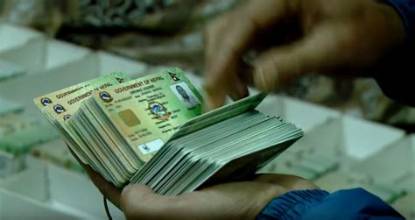
The Security Printing Center located in Dhaneshwar, Panauti Municipality–5, is printing an average of 62,000 QR-code-enabled smart driver’s licenses per month.
According to the Center, it is currently printing licenses received from the Department of Transport Management and its subordinate offices across the country.
A total of 250,000 licenses have been printed at the Center since Shrawan (mid-July to mid-August) of the current fiscal year.
Under Secretary Gopalraj Timilsina of the Center informed that licenses are currently printed daily based on data received from offices under the Department of Transport Management.
He stated that printing is carried out according to print requests received via email from the respective offices, and payments are made directly by those offices based on printing volume.
Timilsina shared that from the start of printing QR-code-enabled smart licenses until the end of Ashad (mid-July), 2.747 million licenses were printed and dispatched to the concerned offices. Printing of this standard began following an agreement between the Department and the Center on Baisakh 4 (mid-April) regarding the printing of QR-code-enabled smart licenses.
According to Timilsina, 1.2 million licenses were printed under the first-phase agreement with the Department, followed by an additional 1.547 million licenses by the end of Ashad. “A certain number of backlog licenses are also being printed alongside regular ones,” Timilsina said.
An agreement was initially signed between the Center and the Department on Kartik 12, 2082 BS, to print 1.2 million licenses within six months. The Center completed that task ahead of the stipulated deadline.
A second-phase agreement was subsequently signed on Baisakh 4 to print 1.547 million licenses. Timilsina also informed that in the previous fiscal year, the Center printed approximately 9 million postage stamps under an agreement with the Postal Services Department.
The Center currently has 25 staff members deployed—nine engineers and 16 technical personnel. Meanwhile, construction of a multi-purpose building within the Center premises has reached its final stage.
Six years ago, the then-government converted the site into the Center after physical infrastructure built for an Information Technology Park (IT Park) remained unused.
The Center will be able to conduct secure printing of passports, banknotes, driver’s licenses, smart cards, postage stamps, excise stickers, SIM cards, and other items.
Within the park premises, two water tanks with a capacity of 100,000 liters each have been built for drinking water, four large generators required for the printing press have been installed, and an underground diesel tank with a capacity of 300,000 liters has been constructed for fuel storage to operate those generators.
Once the press is brought into full operation, it is expected to save approximately NPR 10 billion annually that currently leaves Nepal for security printing abroad.
Construction of the IT Park began in 2057 BS, was completed, and was handed over to the Government of Nepal in 2061 BS.
Situated across a total of 257 ropanis of land, the park comprises 10 buildings, including two large commercial/administrative and storage buildings and four well-equipped residential buildings.
Considered at the time to be a model and the largest of its kind in South Asia, the park had fallen into a state of disrepair due to the inability to bring it into operation.
RSS