

Photo: RSS
Kathmandu, September 25: Prime Minister Balendra Shah has proposed establishing a Himalayan Climate Resilience Mechanism led by Nepal, India and China to address growing climate risks in the Himalayan region.
Addressing the 81st session of the United Nations General Assembly, Prime Minister Shah said disasters occurring in the Himalayas should not be viewed as problems of individual countries alone, but as shared risks with cross-border consequences. He said the recent floods in Nepal had further highlighted the need for joint preparedness, information sharing and coordinated response across the Himalayan region.
Under the proposed mechanism, Nepal, India and China would exchange satellite data and scientific expertise, jointly monitor high-risk glacial lakes, strengthen early warning systems and coordinate cross-border rescue and humanitarian assistance during disasters.
Prime Minister Shah said the Himalayas should be developed not merely as a boundary between countries but as a center for international cooperation. He noted that the Hindu Kush Himalayan region is connected to the water supply, agriculture, ecosystems and livelihoods of around two billion people, warning that environmental crises in the region could have consequences far beyond Nepal.
In his address, Shah also highlighted Nepal’s vulnerability to climate change despite its relatively low contribution to global emissions. He said Nepal was advancing forest restoration, hydropower and clean energy development, expanding the use of electric vehicles and strengthening climate adaptation measures at the local level.
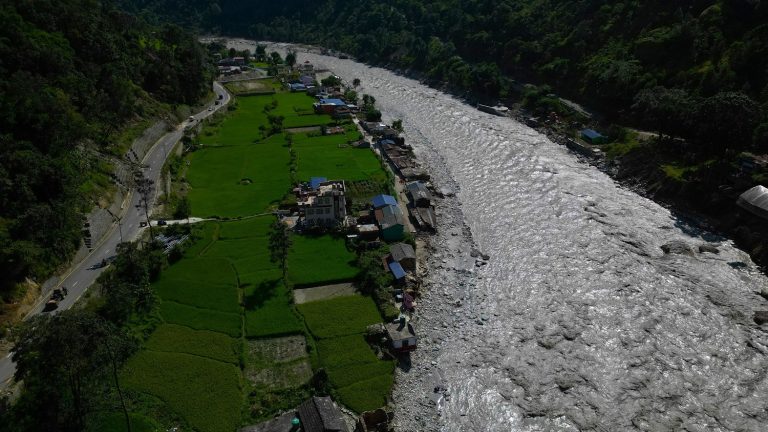
Referring to the recent Bhotekoshi flood, Prime Minister Shah described the disaster as a warning not only for Nepal but for the international community. He stressed the need to strengthen scientific information systems, early warning mechanisms and regional cooperation to address growing risks in the Himalayas.
The proposal places Himalayan climate risk management within a broader regional framework, seeking greater scientific cooperation and coordinated disaster preparedness among Nepal, India and China.
The proposal also comes against the backdrop of an earlier call for trilateral cooperation. Following the disaster caused by landslides blocking the Bhotekoshi and Lhende rivers in Rasuwa on August 26, a statement issued by the Secretariat of former King Gyanendra Bir Bikram Shah had also called for cooperation among Nepal, India and China to reduce disaster risks in the Himalayan region.