काल्पनिक तस्वीर
Ramkumar Rai
Kathmandu, Kartik 18
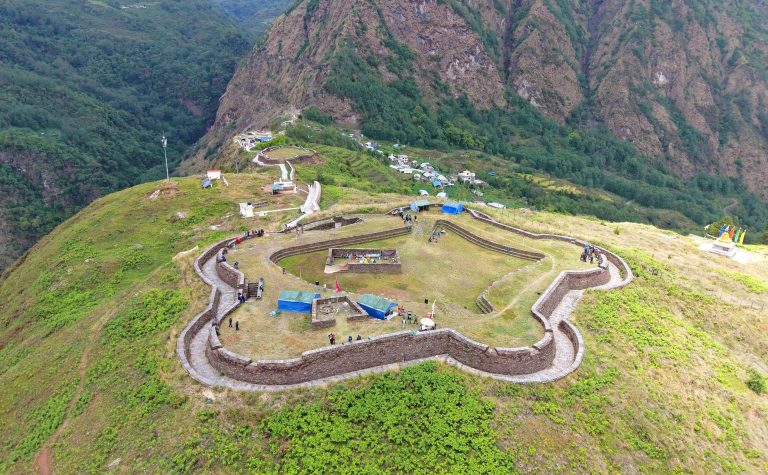
In the historical hill fort of Ligligkot in Gorkha, there was a unique and distinct tradition for choosing a king. Every year, on the day of Bijaya Dashami during Bada Dashain, a running competition would be held from Chapabhyang to Khurpajang, located just below Ligligkot, and the winner would be declared the chieftain or king under the Ghale dynastic tradition.
When Prince Dravya Shah of the Lamjung kingdom participated in this running competition, the Ghales allowed him to join easily, taking him to be an unarmed and ordinary person. However, they were completely unaware of Dravya Shah’s political ambitions.
The War and Capture of Ligligkot
The race began, but even before reaching Ligligkot from the starting point at Chapabhyang Kholli Pokhari, Dravya Shah’s armed soldiers—hidden along the path—launched a fierce surprise attack slightly below Mahibal.
A fierce battle broke out at a place called Pachyan near Aampipal between the unarmed Ghales running without weapons and Dravya Shah’s forces. Dravya Shah emerged victorious in this battle, and Ligligkot came under his control.
Following the victory of Ligligkot, on Bhadra 25, 1616 BS (1559 AD), Dravya Shah—with the assistance of Gorkhali supporters—deposed the Khadka King Mansingh Khadka of Gorkha, formally laying the foundation for the Shah dynasty rule and the unification of a greater Nepal.
The Historic Border Treaty of the Chepe River
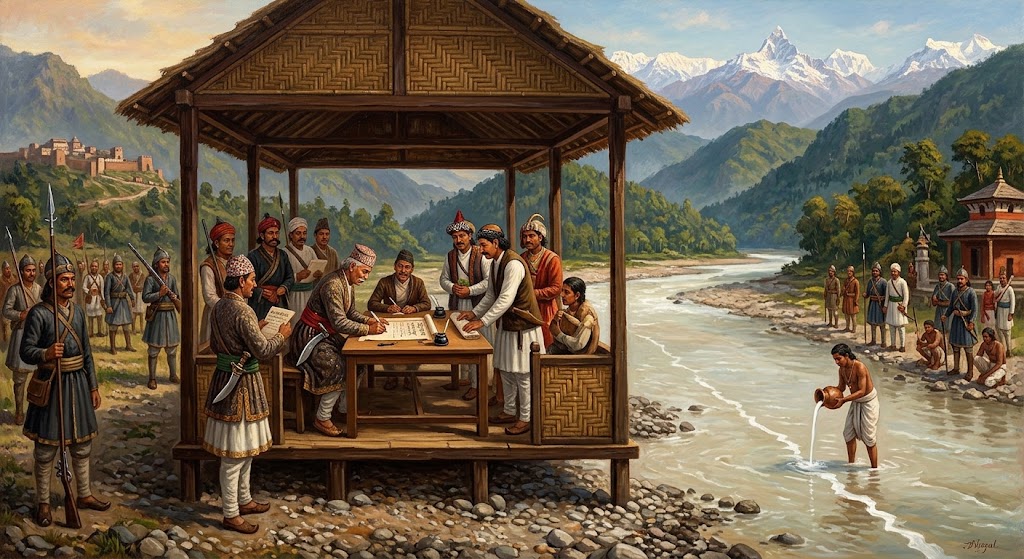
After establishing the Gorkha kingdom through his might, tensions and misunderstandings grew between Dravya Shah and his elder brother Narahari Shah, who had become the King of Lamjung. To resolve the border dispute between Lamjung and Gorkha and to prevent major bloodshed between brothers in the future, respected elders and representatives from both states were gathered.
With the advice and presence of Senior Queen Champawati, the Chepe River was established as the primary border. A sacred circle ritual (chakrabandhan) was performed at the confluence of the Chepe and Marsyangdi rivers, and a stream of milk was poured. With this milk as a witness, King Narahari Shah and Dravya Shah were made to take a solemn oath never to cross their respective state borders.
In the Gorkha chronicles, this event is described as the first historic border treaty between Gorkha and Lamjung. Later on, when King Narahari Shah of Lamjung craftily tried to summon an unarmed Dravya Shah under the pretext of their father’s memorial rituals in an attempt to kill him, Dravya Shah managed to escape secretly with the help of his wet nurse’s daughter, crossed the Chepe River, and safely reached Gorkha via the Palungtar route.