भेडाच्याङ्ग्रा
Mustang, November 4.
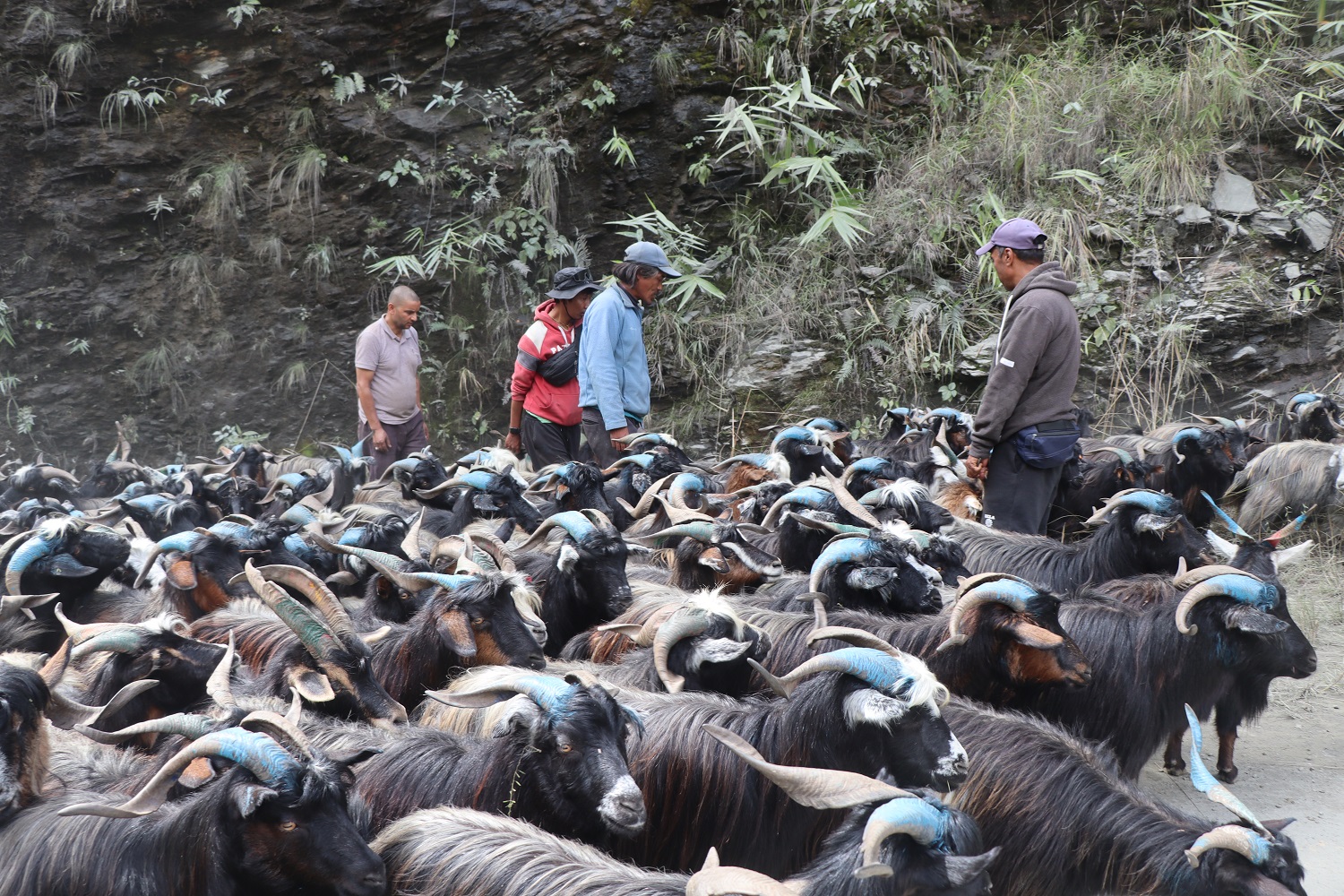
A total of 1,591 mountain goats (chyangra) and sheep have been brought down from Mustang to the lowlands (besi) for sale during the Tihar festival.
According to the Agriculture and Livestock Development Office here, traders have purchased and brought down these mountain goats and sheep—which were herded from Dolpa to Mustang and from Upper Mustang to Jomsom—toward the lowlands by Wednesday morning.
Dr. Lalmani Aryal, Chief of the Agriculture and Livestock Development Office, stated that targeting the Tihar festival, traders have brought down 1,385 chyangra and 206 sheep from Mustang to the lowlands.
Out of these, 1,150 chyangra and 136 sheep were brought down to the lowlands by Mustang’s local breeders and traders for Tihar. Additionally, Dr. Aryal informed that 235 chyangra and 70 sheep—totaling 305 mountain goats and sheep—brought to Mustang from Upper Dolpa were also moved down toward the lowlands.
The Office Chief Dr. Aryal noted that the mountain goats and sheep brought to Jomsom from Upper Mustang and Dolpa for Tihar were purchased by traders arriving from Kathmandu, Pokhara, Baglung, and Myagdi, who have taken them toward the markets for sale.
Moving mountain goats and sheep from one district to another, once brought to Jomsom from Mustang and Dolpa, requires verification of health fitness by a concerned veterinarian. Office Chief Dr. Aryal mentioned that veterinary health examinations were conducted on the mountain goats and sheep brought down to the lowlands for Tihar.
Earlier, targeting the Dashain festival, over 15,000 mountain goats and sheep were brought out of Mustang. Among them, over 500 chyangra were purchased from Tibet and brought into Nepal via the Korala border point.
During this year’s Dashain, livestock was herded on foot to Jomsom from Dolpa, Mugu, and Jumla in Karnali Province. Office Chief Dr. Aryal shared that only 10 percent of the volume brought down for Dashain was moved from Mustang to the lowlands for Tihar.
While local traders from both inside and outside the district transported livestock to Pokhara and Kathmandu for sale during Dashain, the mountain goats and sheep brought down to Jomsom for Tihar were taken toward Pokhara and Kathmandu by traders arriving from outside the district, according to Chief Dr. Aryal.
Traders earned good profits from the mountain goats and sheep brought to the market targeting this year’s Dashain festival. With fewer chyangra brought down from Mustang and the cultural tradition of consuming mountain goat meat reared in the cold climate of the Himalayan region during Dashain, the trade flourished.
Mustang’s farmers have traditionally pursued sheep, chyangra, and yak-chauri farming as a hereditary profession. With the federal, provincial, and local bodies introducing various grant programs to promote livestock farming in the Himalayan region, the number of people engaging in animal husbandry is on the rise.
Office Chief Dr. Aryal stated that farmers’ attraction toward livestock farming has grown following the introduction of subsidies and support schemes from the three tiers of government covering livestock insurance, shed improvement, and feed management.
The meat of mountain goats and sheep reared in the cold climate of high Himalayan regions is nutritious and flavorful. Because mountain goats graze on wild herbs such as yarshagumba, niramasi, jatamasi, panchaunle, banlasun, and jimbu in high-altitude pastures, meadows, and bogs, their meat is considered delicious and health-promoting.
Farmers in Gharpajhong, Baragung, Lomanthang, and Lo-Ghekar Damodarkunda Rural Municipalities of Mustang are commercially engaged in raising mountain goats and sheep. In recent times, animal husbandry is facing challenges due to climate change, including the growth of unauthorized weeds in the Himalayan region, drying water sources, and the risk posed by wildlife such as snow leopards.
— RSS