सङ्कटमा मादल बनाउने पेसा
OKHALDHUNGA, Nov 6.
Traditional Madal craftsmen are facing severe challenges in the local market, making it increasingly difficult to find newly made Madals.
Once upon a time, during the Tihar festival, craftsmen were overwhelmed with work—making new Madals and repairing old ones. Today, as skilled craftsmen have stopped producing new Madals, finding one in the market has become a struggle.
Shortage of Raw Materials Obtaining the necessary leather and wood for Madal production has become increasingly difficult. Craftsmen state that cutting wood in community forests is restricted, and animal hides are no longer easily available, making the creation of new Madals a major challenge. While new production has declined, repairing old Madals continues.
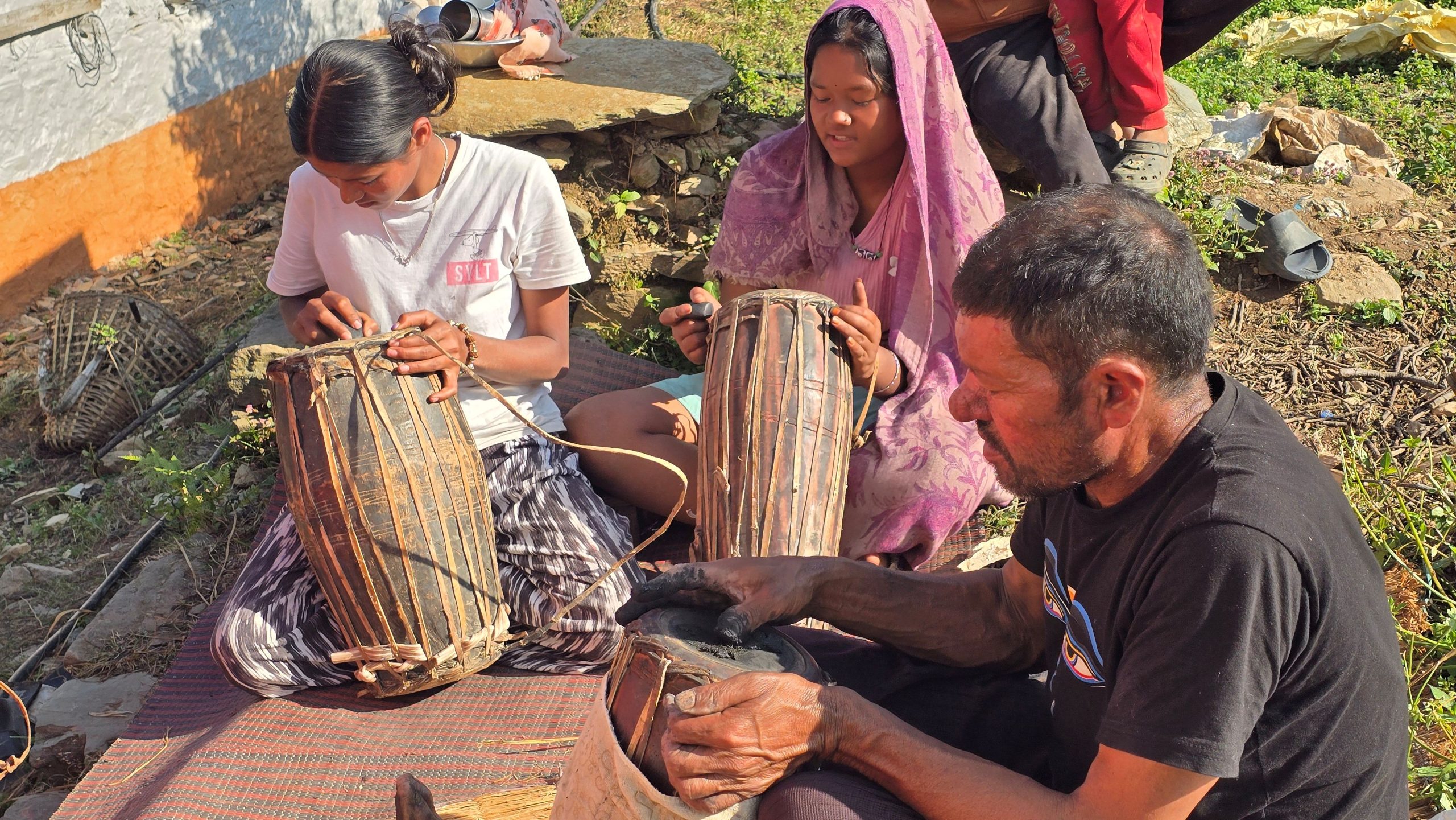
Nirkaji Bishwakarma mentions that he charges around 2,000 rupees just to apply the tuning paste (khari) on an old Madal, 4,000 rupees to retune both sides, and 3,000 rupees for a single side. Nirkaji, who has been crafting Madals for about 56 years in Thulachhap, Okhaldhunga, has closely witnessed this transformation.
For him, Tihar used to be the busiest season, filled with a rush of customers ordering and repairing Madals. He vividly remembers making and repairing hundreds of new and old Madals during the festival.
Declining Income and Loss of Tradition Nowadays, however, that same season is quiet. This year, he barely has a few Madals for repair. “Previously, there was plenty of Madal work. Now, there are hardly any Madals, and I rarely make new ones,” Nirkaji says. “Since our hard work doesn’t pay off, we stopped making new ones and are just passing the time by repairing old ones.”
Previously, Nirkaji earned over 150,000 rupees during the Tihar season, sometimes even reaching 200,000 to 300,000 rupees. As demand for Madals has dwindled over time, so has the income. Even though earnings were around 70,000 to 80,000 rupees until last year, the situation has now drastically changed. Income from Madal work is currently limited to just 25,000 to 30,000 rupees. There are four to five households making Madals in Thulachhap, but the situation is the same for all of them—mostly focused on repairs rather than new production.
Faced with a lack of customers and raw material shortages, craftsmen are hesitant to invest in new production. The biggest hurdle is the lack of raw materials. Crafting a Madal requires cow, buffalo, and goat hide, but cow leather has become scarce. Previously, cows were readily available in villages, making it easy to source hide. Now, with fewer cattle in villages, craftsmen must make do by combining buffalo and goat skin.
Impact of Modern Technology and Online Competition The decline in Madal usage is also attributed to the expansion of modern technology. In the past, people heavily relied on Madals during festivals, celebrations, and merrymaking, singing songs to its rhythm in villages. Today, the trend of playing music through decks and mobile phones has increased, reducing both the use and demand of Madals.
Lagane Sarki from Thulachhap notes that online-ordered Madals are also competing with locally crafted ones. While online Madals may look attractive, they lack the authentic sound and quality of the khari (tuning paste) applied by local craftsmen, which requires years of experience to master.
Uncertain Future The younger generation shows little interest in continuing the craft, as youth increasingly migrate out of the villages. With raw material scarcity, shifting cultural habits, and no new generation to inherit the ancestral skill, craftsmen worry that not only the profession but the generations-old craftsmanship itself is at risk of disappearing.
RSS