हात्तीदह सिमसारः
Lahan, Nov 23 :
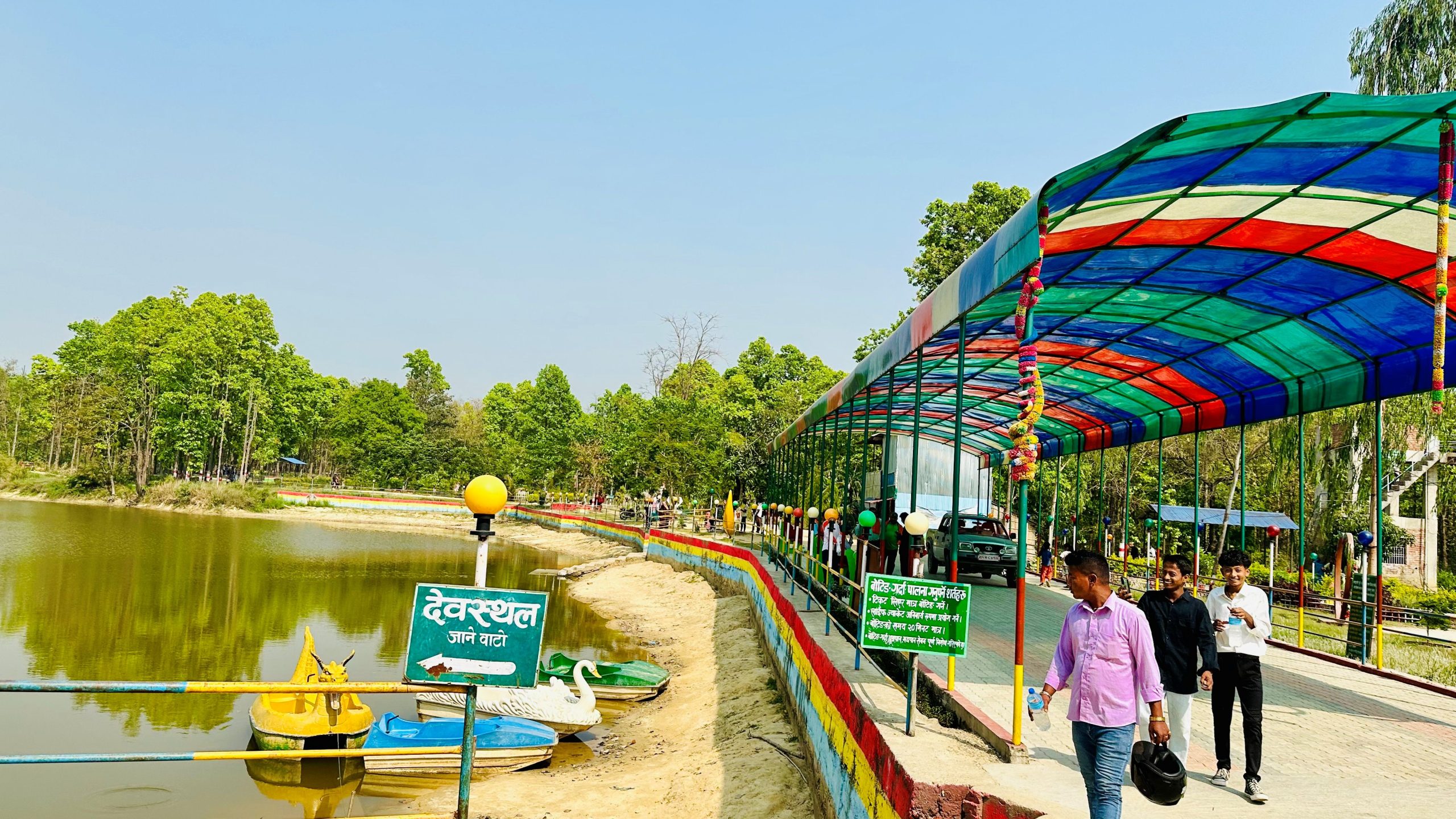
Once limited to local picnics and leisure visits, the Hattidah Wetland area in Lahan Municipality–Ward 15 has increasingly developed into an attractive ecotourism destination in recent times. The influx of tourists and economic activities in the area has surged following the advancement of wetland conservation and tourism infrastructure development projects funded by the federal, provincial, and local governments, along with various development partners.
Hattidah has served as an example of how combining public budgets and development partner support with community forest conservation and ecotourism can transform the local economy. With the growing tourist arrivals, the income of the community forest has expanded, providing locals with income-generating opportunities through e-rickshaw operations, small businesses, homestays (“One Stay”), and women’s entrepreneurship.
The Hattidah Wetland is situated at the foothills of the Chure range within the Koiralo Khola Model Community Forest. Handed over in 2000 AD (2057 BS), the community forest involves 119 consumer households. According to Rudranarayan Chaudhary, Chairperson of the Community Forest Consumer Committee, consumers have prioritized tourism development alongside forest and wetland conservation ever since the forest was handed over.
“After the forest was handed over, we prioritized tourism development alongside conservation,” he said. “With the ongoing addition of forest and wetland conservation, reservoir management, boating, rescue center operations, and other tourism infrastructure, the arrival of both domestic and cross-border Indian tourists has been steadily increasing.”
According to the committee’s records, 120,000 tourists visited Hattidah in the fiscal year 2081/82 BS (2024/25), while the number increased to 135,000 in the fiscal year 2082/83 BS (2025/26). Along with the surge in tourist arrivals, the income of the forest group has also grown significantly.
The total income stood at NPR 6,824,583 in the fiscal year 2081/82 BS, which increased to NPR 12,964,350 in the fiscal year 2082/83 BS. This represents an income growth of approximately 90 percent compared to the previous year. Committee Chairperson Chaudhary stated that the primary reasons behind the increased revenue are the addition of new income sources such as homestay and parking fees, alongside the expansion of tourism activities.
Chairperson Chaudhary mentioned that the income and expenditures of the forest group are made public to the consumers through an annual general assembly for transparency. After deducting necessary expenses, the remaining funds are reinvested in tourism infrastructure construction and development works, he added. The group reported spending approximately NPR 3 million from its own revenue on tourism infrastructure construction in the fiscal year 2082/83 BS.
Infrastructure Development through Multi-Stakeholder Investment
The development of Hattidah blends the community forest’s own resources with investments from government bodies and development partners. Lahan Municipality has supported road upgrades, drinking water, and other infrastructure. In the fiscal year 2082/83 BS, the municipality allocated NPR 2 million to construct an additional two-room building for the Hattidah homestay and NPR 1 million for constructing a selfie bridge. The ward office has also facilitated electrification, drinking water pipelines, and tubewell installations.
Back in 2079 BS (2022 AD), a support of NPR 1 million was received from the parliamentary development fund of the late former lawmaker Pradip Giri for constructing a drinking water tank. The Comprehensive Watershed Management Office, Udaipur, and the President Chure Conservation Development Programme have also contributed to picnic spot and watershed management works.
In the fiscal year 2082/83 BS, a total of NPR 5,235,476 was received through five different programs from various agencies for tourism infrastructure and conservation in Hattidah. This included NPR 1,833,132 from the Chure Utthanseel Project for fencing and bush clearing; NPR 1,903,000 from Lahan Municipality for beautification; NPR 489,131 from the Division Forest Office, Lahan, for program implementation; NPR 739,463 from a conservation project for building a guest house; and NPR 270,750 through the National Farmers’ Group Federation for agroforestry and plantation. The forest group confirmed that all these programs have now been completed.
Lahan Mayor Mahesh Prasad Chaudhary stated that he has kept the development of Hattidah as a priority ever since taking office. “We have advanced the development of Hattidah not just by limiting it to tourism promotion, but by linking it with local employment, income generation, and cultural preservation,” he said. “Alongside expanding tourism infrastructure, we are running programs to improve the livelihoods of surrounding communities. We have launched agriculture and income-generation programs targeting about 400 farmers associated with the forest group, and provided women’s groups with machinery to make duna-tapari [traditional leaf plates and bowls].”
According to Ward 15 Chairperson Tejnarayan Chaudhary, the ward office has also prioritized drinking water and electricity facilities for Hattidah’s development. He noted that continuous collaboration between the local community, forest group, and various government agencies has turned a place originally serving merely as a leisure and picnic spot into a prominent tourist destination.
Employment through Homestays and Local Businesses
With the rise in tourist arrivals in Hattidah, employment and business opportunities have also expanded locally. The homestay and canteen operated by the forest group have provided jobs to 10 people, four of whom are women. The homestay offers local cuisine, tea, snacks, and overnight accommodation.
Geetakumari Chaudhary, Treasurer of the forest group, stated that the homestay provides tea, snacks, local food, and an overnight stay for NPR 850 per person. This allows visitors to experience local Tharu culture and cuisine while supporting the forest group’s revenue, she noted.
During the first phase of homestay construction last fiscal year, a building with two rooms and a toilet was constructed at a cost of NPR 1,173,383. Out of this, NPR 806,088 came from project support, while the forest group contributed NPR 367,295 as cost-sharing, according to the forest committee.
The bustling tourist activity has positively impacted businesses ranging from e-rickshaw drivers transporting visitors to nearby shops, eateries, and cottages. According to forest group Secretary Badri Saday, more than 100 locals operate e-rickshaws to ferry tourists between Lahan market and Hattidah.
Ramnath Mahato of Shobapur, Lahan-15, shared that making up to six round trips daily between Hattidah and Lahan market brings in earnings of up to NPR 1,500 from his rickshaw, helping him support a four-member family.
Hattidah Manager Durgananda Chaudhary stated that tourist activities in Hattidah have generated employment and income opportunities for nearby residents. “With the increased visitor movement, businesses at surrounding cottages, eateries, and grocery shops have also grown,” he said. “Including these businesses, around 100 people have found direct employment and income-generation opportunities. The arrival of tourists has heightened the demand for local products and services.”
Women’s Entrepreneurship and Promotion of Tharu Culture
The development of ecotourism in Hattidah has created opportunities to engage local women in small enterprises. Efforts to reduce plastic use in the wetland area and promote local products have encouraged women to actively produce duna-tapari. Using sal and borla leaves gathered from the community forest, women have started manufacturing these eco-friendly leaf items right at home.
The women’s group members expressed that the machinery provided to them has made scaling up production and selling in the market much easier. This has supported women’s income generation through the utilization of local resources.
“Previously, we were confined only to household chores,” said Geetakumari Chaudhary, a group member. “Now, we make duna-tapari using sal and borla leaves found in the forest. The machine provided by the municipality has made production much easier. This has generated income, helping us cover household expenses and children’s education.”
According to Dharanidhar Koirala, a Lahan-based professor of economics, mobilizing scattered public budgets in an integrated manner with local community participation can help create long-lasting infrastructure and productive assets.
“Such investments can contribute to inclusive economic prosperity by fostering environmental conservation alongside green employment and income-generating opportunities at the local level,” he added. “The development of Hattidah demonstrates the potential to bring about positive changes in the rural economy by successfully linking public investment, community participation, and local enterprises.”
RSS