Kathmandu, November 8:
Nepal is a multi-ethnic, multi-lingual, and multi-cultural nation. Consequently, every festival here is celebrated in accordance with ethnic, religious, and community diversity, shaped by varying geography, communities, languages, and social environments. To the extent that even the same festival is observed with different names, religious beliefs, and cultural practices. Tihar’s Bhai Tika and Madhesh’s Bhardutiya serve as a prime example of this. The affectionate bond between brothers and sisters, celebrated as Bhai Tika in the hills, is observed as Bhardutiya—or Bhratridevitiya—in Madhesh. Despite variations in procedures and rituals, the core spirit of both festivals remains family love, intimacy, mutual respect, and the continuity of relationships.
In the hilly regions of Nepal, Tihar is traditionally celebrated over five days as Yamapanchak, whereas in the Terai-Madhesh region, it is observed as Diwali, Diyabati, and Bhardutiya. Although names and methods differ, these festivals are interconnected through religious faith, respect for nature, family ties, and social harmony. On the first day of Diwali, Kaag Tihar is observed in the hills, while Dhanteras is celebrated in Madhesh. In the hills, crows are worshipped and fed as messengers of Yamaraj (the god of death), based on the religious belief that worshipping crows helps ward off bad news. In Madhesh, Dhanteras is marked by purchasing new utensils, wishing for wealth, prosperity, and auspicious gains. Those with financial means also buy gold, silver ornaments, and other precious items. This day is considered an auspicious occasion to bring new belongings into the home.
On the second day, Kukur Tihar is celebrated in the hills, alongside Narak Chaturdashi or Chhoti Diwali in Madhesh. In the hills, dogs are regarded as loyal companions and messengers of Yamaraj, receiving garlands, vermilion (tika), and delicious food alongside Narak Chaturdashi rituals. In Madhesh, the tradition involves cleaning courtyards, lighting earthen lamps, and commemorating the legend of the defeat of Narakasura. In the evening, villagers gather in public spaces to collectively play Hukaloli, transforming the religious ritual into an occasion for community gathering and entertainment.
The third day marks Gai Tihar in the hills and the main Diwali in Terai-Madhesh. In the hills, cows are worshipped in the morning, followed by the worship of Laxmi, the goddess of wealth, in the evening. Traditions include lighting lamps in homes, courtyards, and cowsheds, playing Deusi-Bhailo, and wishing for prosperity and abundance. Similarly, in Madhesh, homes, courtyards, shops, and public areas are illuminated with earthen lamps. Decorating with rangoli, worshipping Laxmi and Ganesh, exchanging sweets, and setting off fireworks are customary. Lighting lamps symbolizes the triumph of light over darkness and good over evil.
On the fourth day, Goru Tihar and Govardhan Puja are celebrated in the hills. The Newar community marks this day by performing Mha Puja (self-worship) and celebrating the Nepal Sambat New Year. Bulls are honoured and worshipped as vital agricultural companions, and a symbolic Govardhan mountain is created to express gratitude toward nature, livestock, and agriculture. Mha Puja expresses the importance of an individual’s body, self-respect, and life through self-worship. In Terai-Madhesh, unique folk traditions related to livestock health and agriculture are practiced on this day. Cattle are bathed and decorated with various colors. A concoction made by warming mustard oil infused with leaves of neem, bakaino, kufuli, and ground black pepper is fed to cattle using a bamboo tube (chonga) or kair.
Bagiya prepared from newly harvested paddy is also fed to cattle for the first time. Farming tools, along with household wooden and iron items, are cleaned and worshipped. According to local belief, this medicinal concoction protects livestock health during the winter season. Afterward, cattle are brought to public fields for traditional sports like Hurahuri and wrestling competitions. Winning farmers are rewarded. It is a local belief that grass, straw, and husk remnants from the Hurahuri event enhance soil fertility and crop yields when placed in fields. Thus, this Madheshi tradition intertwines livestock, agriculture, community recreation, and faith in nature.
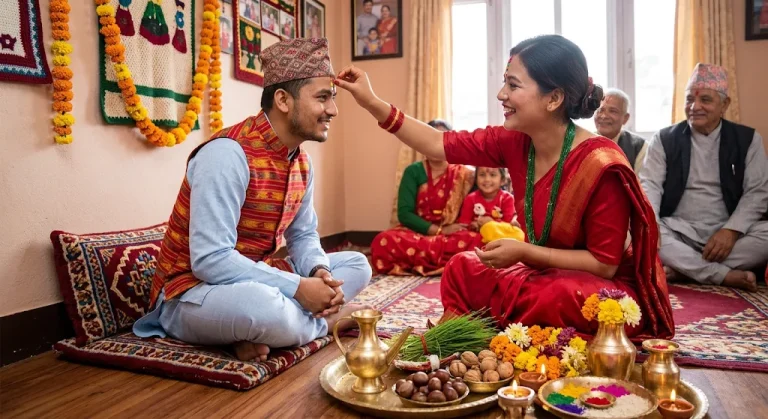
On the fifth day, Bhai Tika is celebrated in the hills and Bhardutiya in Madhesh. In the hills, sisters invite their brothers home, apply a seven-colored tika on their foreheads, adorn them with makhamali and sayapatri (globe amaranth and marigold) garlands, and offer sweets and delicacies to wish for their longevity, happiness, and prosperity. Walnuts, bimiro (citron), and protective oil circles hold special religious and cultural significance during this festival. Brothers, in turn, present gifts and cash to their sisters as a mark of respect. In Madhesh, sisters invite their brothers to their homes for Bhardutiya. A four-cornered square (chauka) is plastered with mud or cow dung in the courtyard, and brothers are seated on wooden low stools (pidha) facing east. Sisters then have their brothers place both hands onto the edge of their sari’s hem (aanchal). Five betel nuts placed on five betel leaves are sprinkled with water five times, a red tika is applied, and various offerings are made while praying for the brothers’ longevity and prosperity. Although rituals vary by location and family, the core purpose is to strengthen the lifelong bond between brothers and sisters.
The essence of Bhardutiya extends beyond the relationship between brothers and sisters. In rural Madheshi society, the relationship between maternal uncles and nephews/nieces, as well as visits from the maternal relatives (mawali), makes the festival especially meaningful. Key tokens of affection (koseli) include bagiya made from rice flour, curd kept in earthenware pots (matkuri), flattened rice (chiura), puffed rice (murahi), and homemade delicacies. The love, labor, and intimacy infused in these items far outweigh their market value. Although the style of bringing gifts has evolved with modern transport and market expansion, these changing traditions must not erode the underlying importance of family relationships.
Following Diwali, the Chhat festival in Terai-Madhesh further accentuates the region’s distinctive cultural identity. Dedicated to the sun, nature, and water bodies, this festival involves offering prayers (argha) to the setting and rising sun. Chhat expresses profound respect for nature, the environment, water resources, and collective participation, while reinforcing family faith and community harmony. However, in modern times, people often lack adequate leisure to celebrate their own festivals. Spending time together even under the same roof has become difficult, and the intimacy of festivals is sometimes overshadowed by expensive gifts, superficial spending, and competitive social status.
While cultural evolution over time is natural, the erosion of core human values is a matter of concern. Bhai Tika and Bhardutiya should not be understood merely as religious rituals; they must foster equality, mutual respect, and a sense of responsibility within families. Just as sisters pray for the longevity and happiness of their brothers, brothers must equally champion their sisters’ freedom, dignity, safety, and rights. Applying a tika while praying for longevity must connect directly with taking a stand against violence, discrimination, and injustice toward women. The true essence of any festival lies in translating blessings and goodwill into daily action.
Similarly, neither the hill-based Bhai Tika nor the Madheshi Bhardutiya should be viewed as culturally superior or inferior to the other. Whether it is the hill community’s seven-colored tika and marigold garlands or Madhesh’s ritualistic chauka, betel leaves, and hand placement on the aanchal, these are authentic cultural expressions developed by respective communities. Despite differences in language, rituals, attire, and cuisine, the center of both festivals remains love, trust, and intimacy. Nepal’s cultural diversity is not an obstacle to national unity; it is its foundation. Therefore, it is essential to cultivate a tradition of understanding, respecting, and passing down each other’s festivals and traditions to younger generations. Cultural preservation does not merely mean repeating old methods verbatim, but keeping alive the human values and social principles they embody.
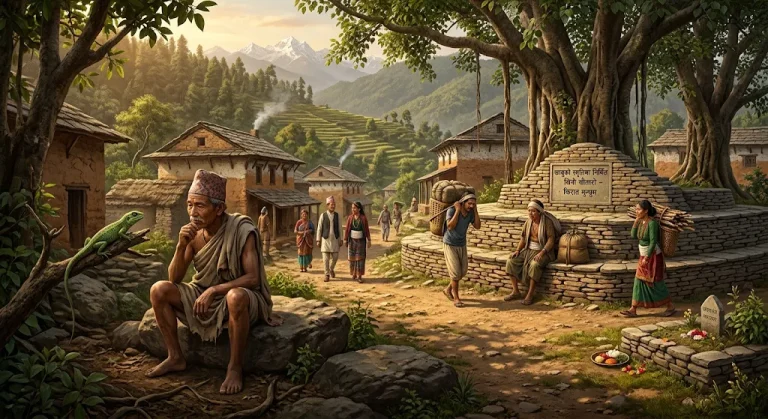
Ultimately, whether it is Bhai Tika in the hills or Bhardutiya in Madhesh, the core essence of both festivals is to cherish, respect, and sustain relationships throughout life. Even if the traditional gifts carried by uncles on their shoulders fade with time, the love imbued within them must endure as long as human society exists. The historical social and familial bond—where nephews and nieces stood on field ridges awaiting their uncle’s arrival—must not perish. The history of intimate family bonds between sisters and brothers must leap forward into a new era because the true wealth of our socio-religious and cultural traditions is not money, gifts, or display, but mutual love, trust, sacrifice, and affection. This shared human value is the genuine cultural significance of Bhai Tika and Bhardutiya, which keeps Nepali society vibrant and historically rich.
— RSS