भाइटीका
Ram Kumar Rai
Kathmandu, November 10.
According to mythological belief, Yamraj, the god of death and the ruler of cosmic law and order, accepted the invitation of his affectionate sister Yamuna and visited her doorstep on Karthik Shukla Dwitiya. Expressing her deep affection, the sister performed special rituals and adorned her brother’s forehead with a tika, praying for his long life, good health, and unwavering prosperity. Against the backdrop of this golden mythological foundation, the tradition of the great festival of “Bhai Tika”—where sisters and brothers share intimate bonds—remains alive to this day.
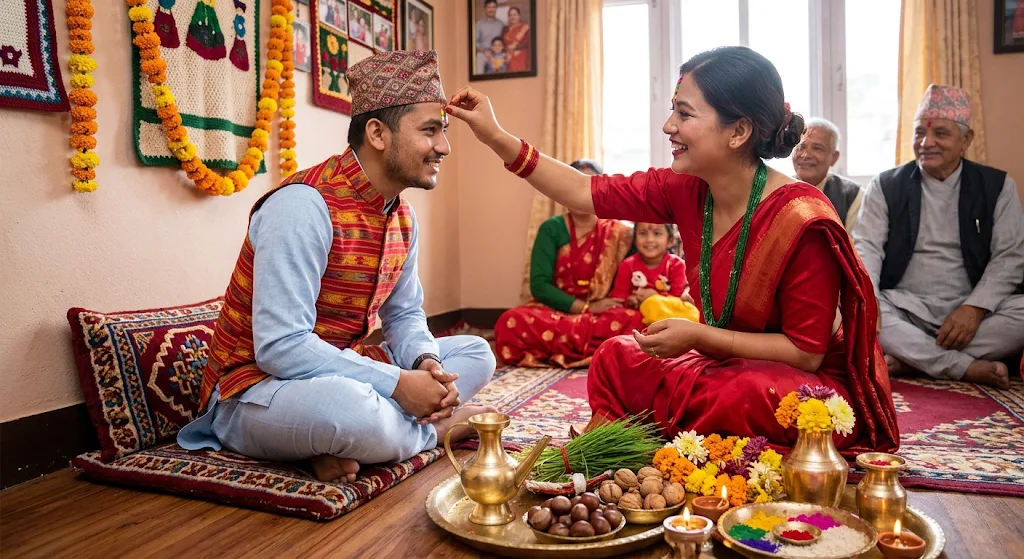
On this sacred festival, sisters apply a seven-colored (saptarangi) tika—comprising red, white, yellow, green, blue, purple, and orange—on the foreheads of their brothers. This tradition is not merely a mixture of colors; deep religious, spiritual, and psychological dimensions are intertwined within it.
Astrological and Spiritual Significance
According to astrological beliefs, the nine celestial planets of the universe and their rays possess their own distinct colors. Applying this seven-colored tika on the forehead is believed to protect brothers from various planetary negative influences while providing them with positive energy and radiance.
From the perspective of yoga science, the human body contains seven main energy centers or chakras. Situated precisely in the middle of this series, between the two eyebrows, is the Ajna Chakra, which is considered the source of consciousness and intuition. The seven-colored tika helps balance and awaken these energy centers, paving the way for longevity and the development of higher consciousness in life.
From the viewpoint of art and philosophy, these seven colors represent the diverse experiences and stages of human life. These colors resonate with the eternal dimensions of life such as happiness, sorrow, enthusiasm, peace, knowledge, prosperity, and sacrifice. Sisters apply this tika with the auspicious prayer that their brothers’ lives remain as beautiful, balanced, harmonious, and fulfilled as these rainbow colors.
Symbolic Meaning of Worship Materials
Alongside this, various worship materials used during Bhai Tika hold their own prestigious religious and symbolic meanings. The use of walnuts, chestnuts, a stream of oil, and dubo (Bermuda grass) is considered mandatory during the rituals of this day.
- Walnut: Enclosing sweetness within a hard outer shell, walnuts are placed at the threshold and cracked as a symbol of Yamraj or life’s obstacles. While cracking walnuts at the doorway, sisters pray that the malicious intentions of enemies be crushed and that brothers achieve success in every step they take. This act symbolizes mental resilience and victory over obstacles.
- Chestnut: Similarly, chestnuts, surrounded by a hard outer shell, are considered a “protective shield” for brothers. This prayer embodies the wish that this protective cover shields them from any crises and misfortunes that may arise at any turn in life.
- Stream of Oil: Before receiving the tika, brothers are seated on a traditional rug (radipakhi), and a continuous stream of pure oil is drawn in a circle around them. This carries the cultural sign of blocking the path of death or Yamraj to strongly pray for the long life of the brothers.
- Dubo Grass: Likewise, in Vedic Sanatan culture, dubo is considered a symbol of immortality and purity. Never-withering even under drought or adverse conditions and remaining perpetually green, this plant inspires the prayer that the brothers’ lives remain unwavering, invincible, and eternally thriving like dubo.