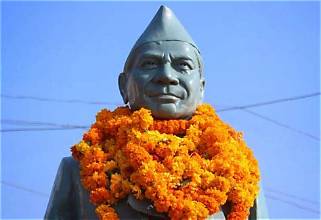
गणेशमान सिंह
Kathmandu, November 10:
The 112th birth anniversary of Ganesh Man Singh, the Supreme Commander of the 1990 (2046 BS) People’s Movement for the restoration of democracy, is being observed across the country today through various programs.
Regarded as a supreme symbol of sacrifice and courage in Nepali politics, leader Singh successfully established himself as a central figure of integrity for all. Following the success of the 1990 People’s Movement, when the late King Birendra urged him to become the Prime Minister, he set a remarkable precedent of political self-abnegation by putting forward his contemporary leader, Krishna Prasad Bhattarai.
Born on Kartik 24, 1972 BS (November 9, 1915) in Chhetrapati, Kathmandu, leader Singh passed away on Ashwin 2, 2054 BS (September 18, 1997). Born into a distinguished aristocratic family in Kathmandu, he actively joined the campaign to overthrow the Rana regime as a member of Nepal’s first political party, the Praja Parishad, established in 1997 BS (1940 AD).
Following his involvement in the anti-Rana movement, the government of the day imprisoned him alongside other leaders. A spirited youth, he successfully broke out of the Bhadrakaal Jail prior to 2007 BS (1950 AD) and became active in the anti-Rana movement even before going into exile.
Escaping from prison to India, he developed close political ties with fellow leader B.P. Koirala. Ganesh Man also played a pivotal role in providing dynamic and lifelong leadership to the Nepali Rastriya Congress, established in 2003 BS (1946 AD) with a few associates.
As a pioneering leader of the 2050 revolution (2007 BS revolution) for the establishment of democracy, he led armed struggles on the Birgunj front.
Dedicated to the restoration and consolidation of democracy in the country, Singh remained ideologically a loyal follower and the biggest supporter of B.P. Koirala, constantly working to enhance the popularity of the Nepali Congress.
Having served as a senior minister in the cabinet formed after the first general election in 2015 BS (1958 AD), Ganesh Man spent eight consecutive years in prison—first at Singha Durbar and later at the Sundrijal Detention Camp—after democracy was overthrown in 2017 BS (1960 AD).
Following his release from the Sundrijal detention in 2025 BS (1968 AD) alongside B.P. Koirala, he expanded political organization during his exile. In 2033 BS (1976 AD), he returned to Nepal alongside B.P. Koirala embracing the policy of national unity and reconciliation, and remained active against the then Panchayat system.
Along with B.P. Koirala, he was acquitted by a special court on eight charges for which the death penalty had been demanded by the Panchayat government. Ganesh Man played an equally leadership-driven role in the 2036 BS (1979 AD) student movement and the national referendum.
Following the demise of B.P. Koirala, as the supreme leader of the Congress, Ganesh Man led the Satyagraha movement of 2042 BS (1985 AD). Committed unceasingly to politics since 1997 BS (1940 AD), the strong-willed, resilient, and beloved leader played a crucial role in 2046 BS (1990 AD).
By declaring a joint movement against the Panchayat regime in collaboration with the communists, Ganesh Man Singh became the Supreme Commander of that historic movement and won the hearts of the public.
Leader Singh, along with B.P. Koirala, had been detained at the Sundrijal Detention Camp from the royal coup of December 15, 1960 (Poush 1, 2017 BS) until 1968 (2025 BS).
Upon their return to Nepal on December 30, 1976 (Poush 16, 2033 BS) carrying the policy of national unity and reconciliation after living in political exile in India, the leaders were arrested right at the Tribhuvan International Airport and imprisoned at Sundrijal for the second time.
On September 9, 2004 (Bhadra 24, 2061 BS), the detention camp was converted into the B.P. Museum, where structures including statues of detained leaders such as B.P. and Ganesh Man have been erected.
On the occasion of Ganesh Man Jayanti, various programs are scheduled to be organized today by both factions of the Nepali Congress, its sister and well-wisher organizations, and the Ganesh Man Singh Study Foundation.
— RSS