महासचिव एन्टोनियो गुटेरेस
Antalya (Turkey), Nov 12.
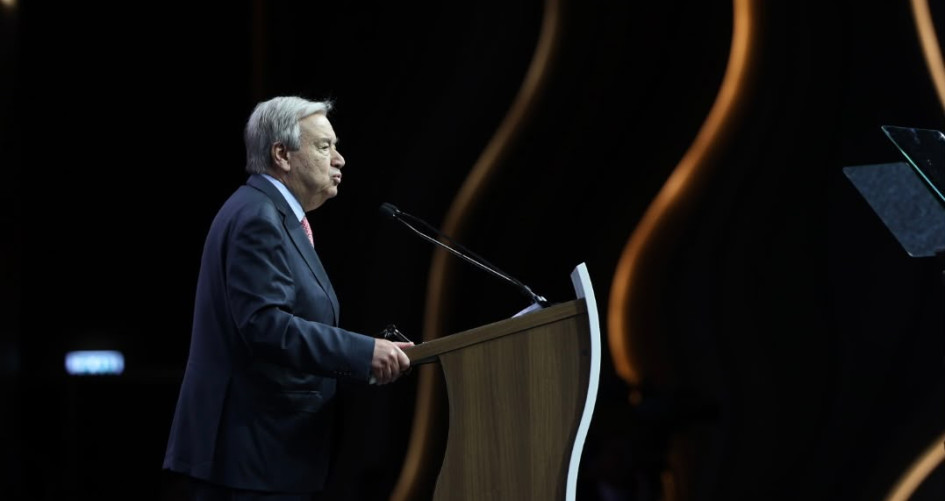
Stating that the climate crisis is escalating at a pace far outstripping the world’s preparedness and response capacity, United Nations Secretary-General António Guterres has urged world leaders to cut greenhouse gas emissions and intensify climate action.
Addressing the COP31 Leaders’ Summit held in Antalya, Turkey on Wednesday, he noted that global greenhouse gas emissions reached an all-time high in 2025, and the past four years have been the hottest on record globally.
He stated that while some interest groups are making huge profits from the fossil fuel trade, the world has to pay the price in the form of climate crisis and environmental devastation. Emphasizing that climate-related disasters are severely impacting human lives, livelihoods, and economies worldwide, he described the current situation as a journey toward collective destruction.
Recalling the 2015 Paris Agreement through which the world committed to limiting global temperature rise to 1.5 degrees Celsius, Secretary-General Guterres stated that temporarily breaching this threshold appears inevitable. However, he clarified that there is still an opportunity to prevent this from becoming a permanent state and to determine how much temperatures will rise and for how long they will remain high.
“Science is not telling us to surrender; it is telling us to fight harder,” he said. “We know the truth, and now we must act accordingly.”
Secretary-General Guterres highlighted three major lessons learned from a decade of climate action: that the rapid expansion of clean energy is possible, that the justification for fossil fuels is weakening, and that global climate action remains too slow.
According to him, while solar energy accounted for just one percent of global electricity production a decade ago, last year solar power met nearly three quarters of the growth in global electricity demand. Similarly, whereas one out of every hundred cars sold a decade ago was electric, it is estimated that nearly one in every three cars sold this year will be electric.
Mentioning that clean energy has become the cheapest source for new electricity generation in most parts of the world, he noted that its expansion is happening despite political obstacles.
He stated that three-quarters of the world’s population dependent on fossil fuel imports are at risk of energy insecurity caused by price hikes and international conflicts. Therefore, he emphasized transitioning to renewable energy in a science-based, just, orderly, and equitable manner.
He accused interest groups favoring fossil fuels of distorting scientific facts, delaying policy decisions and implementation, and evading accountability.
Stating that global emissions need to be reduced by about six percent every year, he noted that current national plans are projected to ensure at most one-third of that reduction. Even if those plans are fully implemented, global temperature rise by the end of this century risks exceeding 2.5 degrees Celsius, passing dangerous and irreversible tipping points, he said.
Identifying climate justice as the primary challenge of the coming decade, Secretary-General Guterres stated that developing countries must be provided with the necessary financial and technological means to transform their economies. He noted that while nearly two-thirds of the world’s population lives in emerging and developing economies outside of China, these countries receive less than one-fifth of global clean energy investment.
Pointing out that most of these countries have to pay two to three times higher interest rates to borrow money compared to other countries, he warned that without access to cheap clean energy, dependence on fossil fuels would persist for decades.
He emphasized the need for a new “Climate Justice Pact” based on shared responsibility, shared security, and shared benefits, presenting four main pillars for it:
First, accelerating a just transition away from fossil fuels; second, protecting people and communities from the impacts of climate change; third, ensuring adequate, affordable, and accessible climate finance; and fourth, prioritizing international cooperation over global division.
For a just transition from fossil fuels, he stated that renewable energy generation capacity must be at least tripled by 2035 compared to 2025, and unmitigated coal-fired power generation must be reduced by at least 75 percent. By 2040, such coal-fired power should be almost completely phased out, and the use of oil and gas should be reduced by about one-third, he said.
To achieve this, he called for halting new coal projects and new oil and gas infrastructure that hinder the 1.5-degree target, reducing methane emissions, and scaling up investments in renewable energy, power grids, and energy storage. He stated that the protection of forests, oceans, and biodiversity must also be made an integral part of a just energy transition.
Describing climate adaptation as a matter of survival, he said that developing countries need international support to design and implement a new generation of national adaptation plans. He stressed the need to put every person on Earth within reach of early warning systems and to protect every community from the risks of floods, droughts, and sea-level rise. He also underscored that where adaptation measures are inadequate, loss and damage assistance must be provided quickly and easily.
Regarding climate finance, he stated that developed countries should take the lead in providing at least USD 300 billion annually by 2035 and present concrete plans to at least triple adaptation finance by the same period. The proposed target of USD 1.3 trillion for developing countries must be translated into actual financial flows, he said.
Multilateral development banks should provide support exceeding the Baku commitment of USD 120 billion annually by 2030, mobilize private investment, and deploy innovative financial tools to address the needs of vulnerable developing countries, he noted. He urged donor agencies to secure additional resources for the Green Climate Fund and the Fund for Responding to Loss and Damage, and to expand access to technology and finance through South-South cooperation.
Stating that companies making super-profits from fossil fuels must bear the cost of climate damages, Secretary-General Guterres revealed that in the latest quarter, the world’s nine largest oil companies made USD 95 billion in profits, while only about USD 600 million was deposited into the Loss and Damage Fund.
Mentioning that this fund holds only an amount equivalent to what those companies earn in about 14 hours, he stated that governments should tax the windfall profits of fossil fuel companies and spend them on the recovery of vulnerable countries. “Polluters must pay,” he said.
Emphasizing the necessity of international cooperation, he stated that trade barriers, monopolies on technology, and geopolitical competition make the energy transition more expensive and difficult while leaving billions of people behind. While consensus on everything may not be necessary, cooperation is indispensable on issues that no single country can solve alone, he said.
Mentioning that the success of climate negotiations should be measured not just by agreements but by their actual implementation, he shared that the United Nations is fostering cooperation among countries and partners in areas such as power grids, critical minerals, methane emissions, and early warning systems.
Secretary-General Guterres stated that climate action should be seized as an opportunity to build a clean economy and a just society by linking it with sustainable development, peace, security, and human dignity.
Praising the contributions of youth, scientists, indigenous communities, civil society, and small island developing states who are on the frontlines of climate action, he portrayed them as the moral conscience of the climate struggle.
Expressing his commitment to continue exposing the truth of the climate crisis and fighting against it even after leaving office as UN Secretary-General next year, he stated he would stand alongside climate activists.
“Let us keep speaking the truth about the climate crisis, keep raising our voices for the action it demands, and keep fighting for a sustainable future that is in our own hands,” he said.
RSS