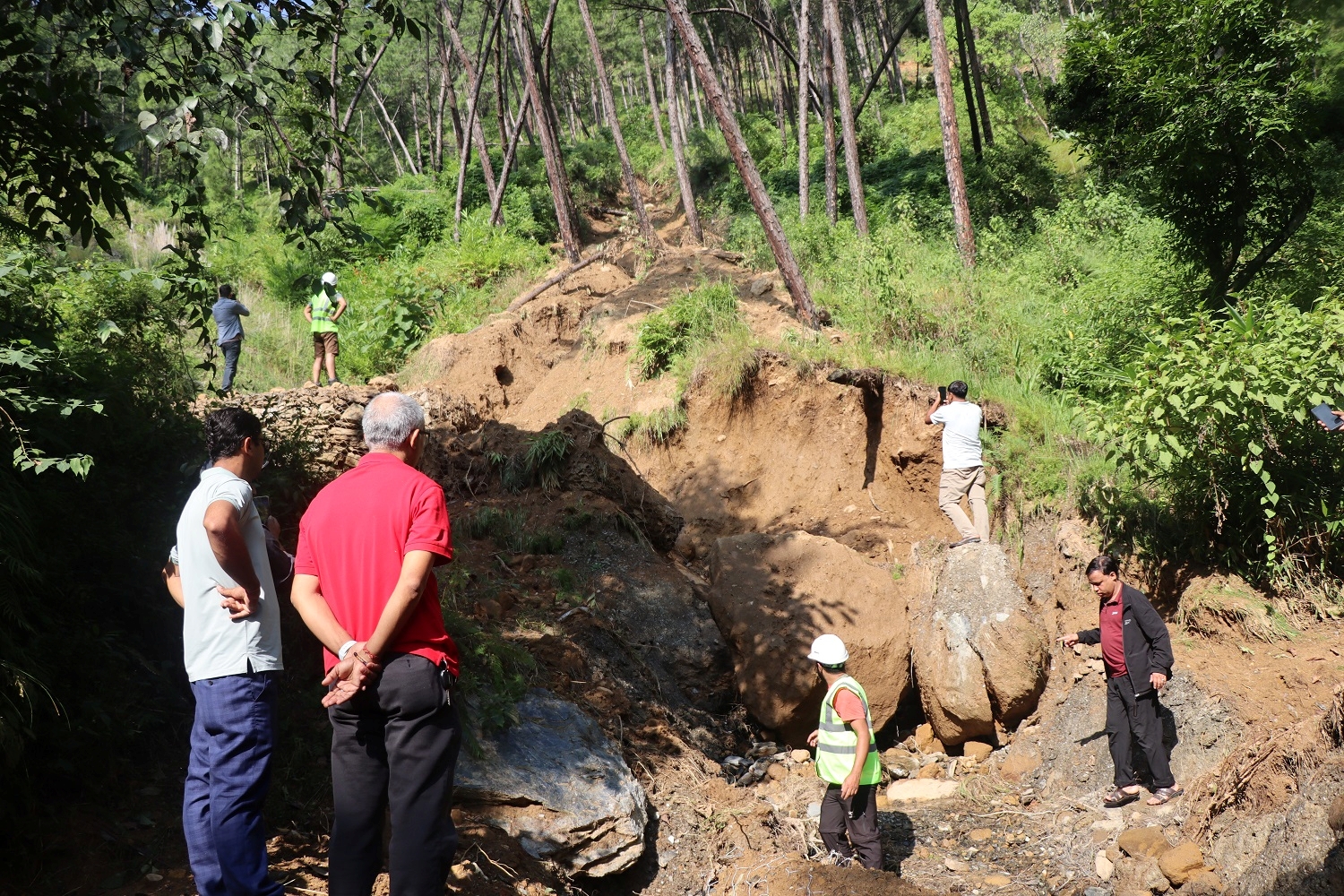
म्याग्दीका २६ पहिरोको स्थलगत अध्ययन
Myagdi, October 5.
A team of geologists has conducted an onsite study of 26 landslides in Myagdi, a district severely affected by monsoon-induced disasters.
In coordination with the National Disaster Risk Reduction and Management Authority (NDRRMA), the team of geologists affiliated with the Nepal Geological Society visited the landslide-affected areas of Beni Municipality and Raghuganga Rural Municipality.
Surat KC, Mayor of Beni Municipality, informed that the geologists’ team led by Bhaskar Khatiwada, President of the Nepal Geological Society, inspected 22 landslide sites in Beni and four in Raghuganga Rural Municipality. On Saturday and Sunday, six geologists divided into three groups carried out the study in the presence of local representatives.
The study covered several landslide-affected areas in Beni Municipality, including Bhasbhase, Khabara, Lovelyhill, Hadebhir, Tallo Musung, Chinakhet, Bhukbhuke, Chepare, Singa Tatopani, Aagebagar, Arthunge, Andheri Gaira, Jamreni, Jamunakhark, Maharanithan, Bhyauni Khola, Barah Pakho, Prakash Secondary School hill, Khareni Pakho, Jaleshwar, Galeshwar, Toripani, and Mate Bisauna; as well as Harkhark, Barkhark, Majhkhark, and Kalleni in Raghuganga Rural Municipality.
The field study team comprised Society President Bhaskar Khatiwada, geologists Dr. Champak Babu Silwal, Deepak Gautam, Rupak Gyawali, Janaki Khatri, and Meera GC, alongside Beni Municipality engineers Madhav Devkota and Bijaya Narayan Mandal, and District Coordination Committee engineer Suman Subedi.
Dr. Champak Babu Silwal, a geologist and Assistant Professor at Tri-Chandra Multiple Campus, stated that drone imagery was captured to accurately assess the landslide conditions and soil structure, while rock and soil samples were collected from the affected sites for laboratory testing.
On Sunday, the team submitted its preliminary report to the District Administration Office regarding the study conducted on the landslide-prone areas above Khareni Kholsa, Khoriya Pakho, and Campus Chowk, which pose a major security challenge to Beni market.
Team coordinator Khatiwada advised adopting both short-term and long-term measures, warning that the recent landslide at New Road in Beni could become active again, as cracked land above it remains prone to sliding.
“We have recommended short-term measures such as regular monitoring and measurement of the landslides, maintaining records, ensuring safe management of underground water sources, and preventing water from seeping into cracked land,” Khatiwada said. “We will soon submit a comprehensive report detailing the necessary long-term landslide control measures.” The team also urged residents living in houses near New Road in Beni Market to exercise heightened caution.
The study team concluded that four days of continuous heavy rainfall from September 24 to 27 weakened the steep sloped land, combined with poor surface water drainage, haphazard infrastructure development, and unmanaged underground water flow, ultimately triggering the landslides.
The recent torrential rains and subsequent landslides and floods in Myagdi have left seven people dead, two missing, and over 200 homes and sheds completely destroyed. Residents across dozens of villages have been displaced.
Assistant Chief District Officer Kul Prasad Acharya informed that 111 houses suffered complete damage, 93 sustained partial damage, and 342 homes remain at high risk. He noted that these numbers could rise further. Disrupted main roads, power supply, and telecommunication services continue to impact daily life across the district.