मौलिक भजन
BANEPA (KAVRE), October 6.
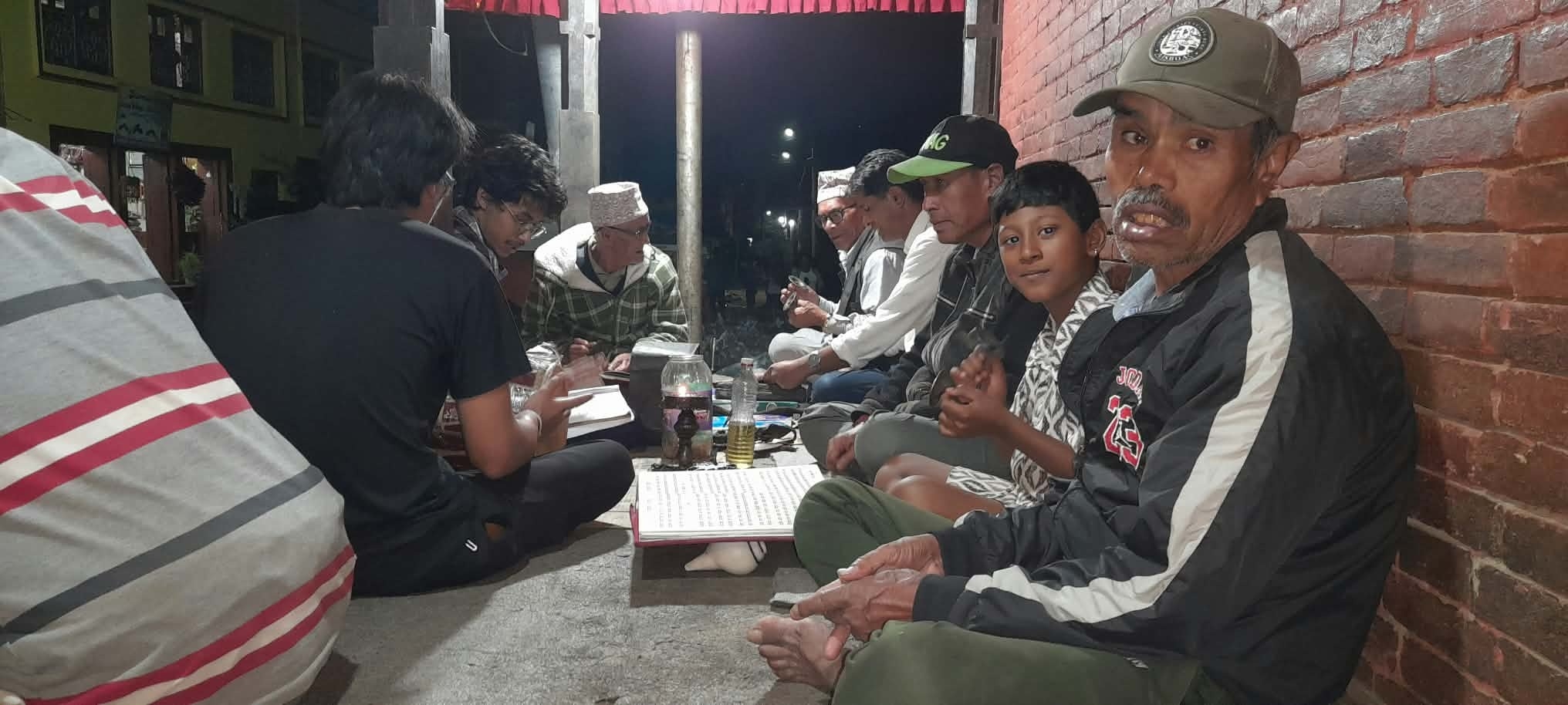
As dusk falls, traditional musical instruments begin to resonate through the historic alleys of Panauti in Kavrepalanchok. During the four-month period of Chaturmas—stretching from Harishayani Ekadashi to Haribodhini Ekadashi—local neighborhoods display vibrant religious and cultural fervor. Gathered in the evenings with traditional music, residents bring life to the ancient settlements through generations-old bhajan (devotional hymn) melodies. However, just adjacent to Panauti in Ward No. 5 of Dhulikhel Municipality, Shrikhandapur presents a starkly different picture, where traditional bhajan gatherings in courtyards have largely disappeared.
While ancient temple walls remain intact and Guthi traditions persist, the traditional bhajan chants that once echoed in these sacred spaces are gradually fading. The indigenous bhajan heritage of Kavrepalanchok currently reflects two contrasting realities: in some areas, youth participation offers hope for sustaining the heritage, while in others, the lack of intergenerational transfer threatens the tradition with extinction.
Hope for Intergenerational Continuity: ‘Dhalcha Halegu’ in Panauti
In Panauti’s historic neighborhoods such as Balachhetole, Pamaditole, and Kolachhen, cultural life remains deeply linked to tradition. Throughout Chaturmas, local residents gather in groups of 10 to 15 to perform devotional hymns accompanied by traditional instruments. In the local Newari language, this tradition is known as ‘Dhalcha Halegu’.
Beyond its religious significance, ‘Dhalcha Halegu’ serves as a platform for community engagement. As senior members play instruments and sing bhajans, children and youth actively participate, learning the lyrics, melodies, rhythms, and instrumental techniques. “The involvement of the younger generation provides them a direct opportunity to learn lyrics, tunes, playing techniques, religious rituals, and local traditions from their elders,” says Ram Bhuju, Ward Member of Panauti Municipality–7.
Local resident Pramesh Ghulnu notes that such cultural activities preserve religious faith while strengthening Panauti’s unique identity and community solidarity. “If we can foster youth participation in these traditions, our culture will remain alive for generations,” he adds.
This practice demonstrates that physical structures alone are insufficient for preserving indigenous heritage; continuous community participation and youth engagement are vital. When elders pass down their knowledge of hymns, instruments, and rituals to the youth, traditional practices naturally endure.
Fading Traditions in Shrikhandapur
While bhajan melodies continue to echo across Panauti, the situation in neighboring Shrikhandapur (Dhulikhel-5) is vastly different. The ‘Chaturmas Bhajan’ and ‘Lalmohar Bhajan’, which are central to Shrikhandapur’s identity, are now on the verge of extinction.
The ‘Lalmohar Bhajan’ in particular holds historic and cultural significance. According to locals, during the Malla or early Shah period, the royal court granted land or special authority—sealed with a Lalmohar (red seal royal edict)—to support temple rituals, cultural continuity, and the operation of bhajan groups. Because it received royal recognition and was managed through Guthis for generations, it came to be known as the ‘Lalmohar Bhajan’.
Despite its historical importance, this tradition faces a severe crisis due to a lack of vocalists and performers. “I used to sing the Lalmohar Bhajan myself. A tradition that continued for generations has now virtually disappeared,” recalls Purna Karmacharya, Advisor to the Shree Shwet Bhairav Bhajan Mandal. “Although a bhajan mandal has been formed and rituals are conducted using interest from Guthi Sansthan funds, the Lalmohar Bhajan itself no longer exists because there is no one left to sing it.” He notes that while physical structures remain, the underlying cultural practices are eroding.
The Challenge of Intergenerational Transfer
Locals in Shrikhandapur observe that although the older generation possesses deep knowledge of bhajans and heritage, transferring this knowledge to younger generations has weakened. Many youth leave for employment and higher education, leading to changing daily routines and lifestyles.
Increased technology use, migration for work, and shifting social habits have led to declining participation in traditional community activities. “I fear our culture may soon be confined only to textbook pages, and that Chaturmas Bhajan and Lalmohar Bhajan will become mere stories of the past for our children,” says local resident Bhab Sagar Ranjit. He emphasizes that if the younger generation does not learn and practice what elders preserved, the authentic form of these traditions could disappear within years.
Need for Intergenerational Transfer in Cultural Preservation
Lifestyles naturally evolve over time, and technological advancements alongside changing youth interests are inevitable. However, a critical question remains: how can indigenous culture and heritage be sustained alongside modern change?
A bhajan tradition is more than just music or religious practice; it embodies local history, language, traditional instruments, rituals, social cohesion, and ancestral knowledge. The loss of a bhajan tradition represents not merely the loss of a song, but the erosion of a cultural practice and a fragment of collective memory.
Panauti’s ‘Dhalcha Halegu’ and Shrikhandapur’s ‘Lalmohar Bhajan’ illustrate two distinct paths in cultural preservation. While Panauti has established a foundation for continuity through youth involvement, Shrikhandapur faces a crisis as the performing generation declines.
Initiatives by local governments, communities, Guthis, and cultural organizations to document lyrics, tunes, instruments, and history—combined with actively involving youth—can play a pivotal role in heritage preservation. Integrating local culture into school curricula, facilitating skill transfers from elders to youth, and organizing regular cultural events will be key to keeping these living traditions alive.