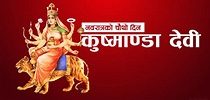
कुष्माण्डा देवी
Kathmandu, October 14:
On the fourth day of Navaratra, Goddess Kushmanda, the fourth among the nine Durgas, is being worshipped with full rituals at Dashain Ghar or prayer rooms.
According to classical traditions, the fourth day of Ashwin Shukla Chaturthi, or the fourth day of the Durga fortnight, is dedicated to the formal worship of Goddess Kushmanda. The three afflictions—spiritual, physical, and divine—are collectively known as Kushma.
The fourth goddess among the Navdurgas is named Kushmanda because she relieves her devotees who seek refuge from all three of these afflictions. Various Puranas mention that Kushmanda holds vessels filled with divine wine and blood-filled pots.
The Devi Kavach of the Sri Durga Saptashati (Chandi) states: “Kutsitah ushma kushma-trividhtapayutah samsarah, sa andhe mamsapeshyamudarrupayam yasyah sah kushmanda,” meaning the Goddess Kushmanda is recognized as the one in whose womb rests the entire universe afflicted by the threefold miseries.
On the first day of Navaratra, Sunday, Ashwin 25, barley shoots (jamara) were sown following Vedic rituals after performing Ghatasthapana in Dashain Ghar or the prayer room. On the same day, the first goddess among the Navdurgas, Shailputri, was invoked and worshipped with formal rituals at the site of Ghatasthapana.
On the second day, Monday, the second goddess, Brahmacharini, was invoked and worshipped at the prayer site, while on the third day, Tuesday, Goddess Chandraghanta was worshipped with unwavering devotion.
Today, on the fourth day of Bada Dashain, Goddess Kushmanda is being worshipped with proper rituals. Throughout the nine days of Navaratra, sacred texts such as Durga Saptashati (Chandi) and Srimad Devi Bhagavata are also recited at the Ghatasthapana site. It is a religious belief that worshipping the Goddess during Navaratra bestows strength, prosperity, and knowledge. Based on this belief, Vedic Sanatan followers specially worship Goddess Durga from Ashwin Shukla Pratipada to Navami. The holy offerings (prasad) collected during the nine days of worship are worn from Vijayadashami until Kojagrat Purnima, marking a 15-day celebration of the Bada Dashain festival for Nepalis.
According to classical rules, the forms of the nine Durgas worshipped during the fortnight known as Durga Paksha are: Shailputri on the first day, Brahmacharini on the second, Chandraghanta on the third, Kushmanda on the fourth, Skandamata on the fifth, Katyayani on the sixth, Kalaratri on the seventh, Mahagauri on the eighth, and Siddhidatri on the ninth. These nine forms of Durga are collectively called Navdurga.
During Navaratra, crowds of devotees gather to offer prayers and catch a glimpse of the deities at various Shaktipeeths across the country. Since early morning, devotees have been flocking to temples inside the Kathmandu Valley, including Guhyeshwari, Jayabageshwari, Maitidevi, Kalikasthan, Naksal Bhagwati, Bhadrakali, Shobha Bhagwati, Rakta Kali, Sweta Kali, Bijeshwari, Kankeshwari, Kalankimai, Chamunda Devi, Sundarimai, Bajrayogini, and Indrayani.
Similarly, crowds of devotees have been gathering at prominent Shaktipeeths outside the Valley, such as Palanchowk Bhagwati, Nala Bhagwati, Chandeshwori, Palchowk Bhagwati, Kamlamai, Ichchhakamana, Manakamana, Gardhimai, Chhinnamasta, Gahwamai, Baglung Kalika, Bindhyabasini, Taalbarahi, Shaileshwari, and Ugratara.
RSS / Unified Nepal