याङवरक पोखरी पर्यटकको आकर्षण
Panchthar, October 15:
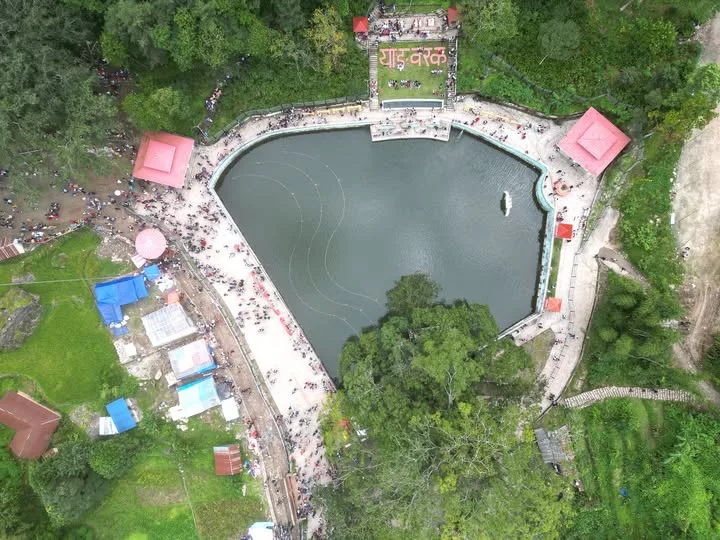
Infrastructure development works at the Yangwarak Pond, located in Yangwarak Rural Municipality-4, Jhordhara, have been successfully completed over a five-year period. Following these developments, the pond has rapidly captured the interest of domestic tourists.
Carrying deep religious and historical significance, the pond underwent infrastructural enhancements totaling NPR 64,424,000. Once choked by wild vegetation, water hyacinths, and debris, this natural body of water has been transformed into a modern tourist destination featuring water fountains, designated selfie spots, and structured railings. Measuring 7 meters in depth, 50 meters in length, and 50 meters in width, the construction was executed by SM Joshi Ashu JV, Kathmandu.
According to Bhimbahadur Yongya (Subas), Chairperson of the Yangwarak Rural Municipality, the conservation project encompasses traditional stone spouts, a children’s park, resting areas, various religious statues, gardens, an entrance gate, a Yangwarak pillar, and water fountains. Although the primary structures were finalized two years ago, peripheral tasks such as fencing and painting have recently reached completion, paving the way for the formal inauguration. Chairperson Yongya and former Chairperson Lekhnath Ghimire jointly inaugurated the site by unveiling the inscription stone and activating the water fountain.
The local government undertook these developments with the strategic vision of drawing travelers heading toward prominent destinations such as the sacred Pathibhara Temple in Taplejung, Timbung Pond, and Chiva Bhanjyang—the origin point of the Mid-Hill Highway. Presently, hundreds of domestic tourists visit the site daily, and the rural municipality is conducting a feasibility study to harness the location as a sustainable revenue stream.
The Yangwarak Pond holds profound cultural and spiritual resonance for the Limbu community. The name originates from “Yang,” meaning money, and “Warak,” meaning pond, derived from historical accounts of gleaming coins discovered within its waters. Local historian Mahendra Seling notes that the site is believed to have been used for bathing by the supreme deity (Tagera Ningwaphumang). Prior to the 12th century, it was known as Hang Warak (the King’s bathing pond) and Mang Warak (the pond where gods are encountered).
Another prominent feature within the precinct is the Nishan Kalika Dham. Situated beneath the roots of a giant tree, worship has been performed at this shrine since the inception of the pond, according to Shaharanand Yonghang, priest and former ward chair of Yangwarak-4. Protection walls and fencing for the Dham were previously completed through joint funding from the rural municipality and the family of local resident Asmin Idingo. Additional infrastructure, including vehicle parking, restrooms, and sacrificial areas, is now fully established.
A core tradition at the Nishan Kalika Dham is the public exhibition of historical military insignia (Nishan) every year on Maha Nawami during Bada Dashain. The rituals involve displaying and worshiping two sacred banners, Shree Kamfu and Shree Jhangi, alongside historical khukuris, swords, and weaponry. According to researcher Mahendra Seling, these items were gifted by the Gorkhali forces as a token of accord following a stalemate in battles fought against the troops of the then-Yangwarak Thum under the ten Limbuwans during the unification of Nepal. Because the 52 distinct clans of Limbuwans historically gathered here to draft collective community policies, the site is also widely referred to as 52 Maulo. Dedicated structures have now been constructed within the Kalika Dham complex to safely house both sacred banners.
RSS/Unified Nepal.