भोटेकोशी बाढी
Kathmandu, October 15:
The Nepal Red Cross Society has advanced various relief and response programs, including financial assistance, for families affected by the Bhote Koshi flood. Following search and rescue operations, the Society has rolled out extended recovery initiatives encompassing direct financial support.
This announcement was recently made by Jagan Chapagain, Secretary General and Chief Executive Officer of the International Federation of Red Cross and Red Crescent Societies (IFRC), during his visit to inspect the flood-affected areas.
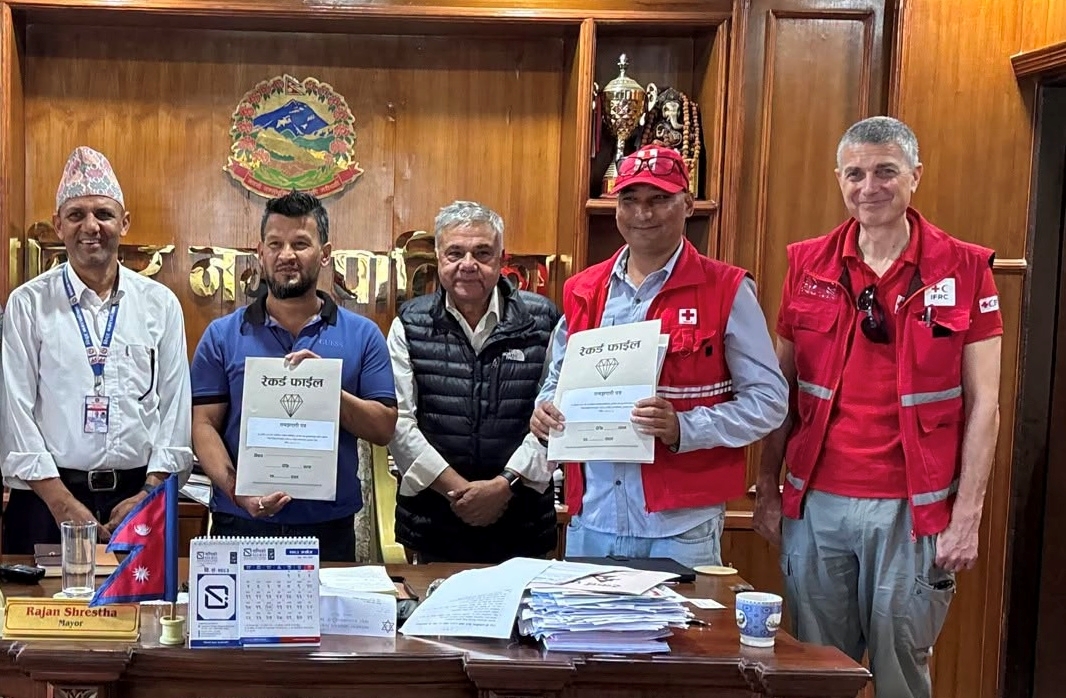
To facilitate this, a partnership agreement has been signed between the Nepal Red Cross Society and Bidur Municipality for flood response, recovery, and rehabilitation. The pact aims to address the immediate humanitarian needs of flood-impacted communities while bolstering recovery, long-term rehabilitation, and resilience against future disasters and climate-related risks.
The agreement was formalized on Wednesday at the Bidur Municipal Office through signatures from Bidur Mayor Rajan Shrestha, Nepal Red Cross Society General Secretary Rishi Raman Khanal, IFRC Head of Delegation in Nepal David Fisher, and Nepal Red Cross Nuwakot President Hari Shrestha.
According to a press release issued by the Red Cross, the collaborative efforts will span healthcare assistance, water, sanitation, and hygiene (WASH), shelter support, repair and reconstruction, livelihood and economic recovery, needs-based cash assistance, and disaster risk reduction, preparedness, and community resilience building.
Under the terms of the agreement, the Red Cross will provide NPR 100,000 per family to households led by single women who are missing family members, children who have lost guardians, or senior citizens. Additionally, 2,000 households will receive multipurpose cash grants of NPR 15,000 each.
Furthermore, the Red Cross will extend livelihood restoration assistance to 1,000 families, fund house rent payments for 2,000 households until permanent housing is arranged, and manage transitional shelters for 600 households.
The understanding also includes the repair of a 7.5-kilometer pipeline for the flood-impacted Bidur Drinking Water Project, alongside the restoration of water supply systems across the Bidur, Budhsinghat, Sirkhali, and Maharanidihi regions—benefiting a population of 30,000.
Additional areas of intervention encompass the reconstruction and rehabilitation of health and social infrastructure, basic and emergency healthcare services, restoration of school and educational facilities, camp management, and support for affected individuals.
To coordinate, guide, monitor, and review the programs and activities under this partnership, a joint coordination and program implementation committee will be formed under the leadership of the Mayor or a representative designated by the Mayor.
Speaking on the occasion, Red Cross General Secretary Khanal emphasized the organization’s ongoing commitment to multi-dimensional support for citizens in the flood-hit zones, stressing effective coordination between local bodies and Red Cross structures for successful implementation.
IFRC Nepal Head David Fisher expressed confidence that humanitarian aid will continue seamlessly, noting that this collaboration will significantly reinforce the unprecedented flood response. Bidur Mayor Rajan Shrestha voiced strong optimism that the Red Cross’s readiness and active engagement will greatly contribute to local rehabilitation and help citizens resume normal lives, committing his administration to working hand-in-hand through effective partnership to alleviate the suffering caused by the disaster.
RSS/Unified Nepal