Photo: Taken from X handle of MOF Nepal
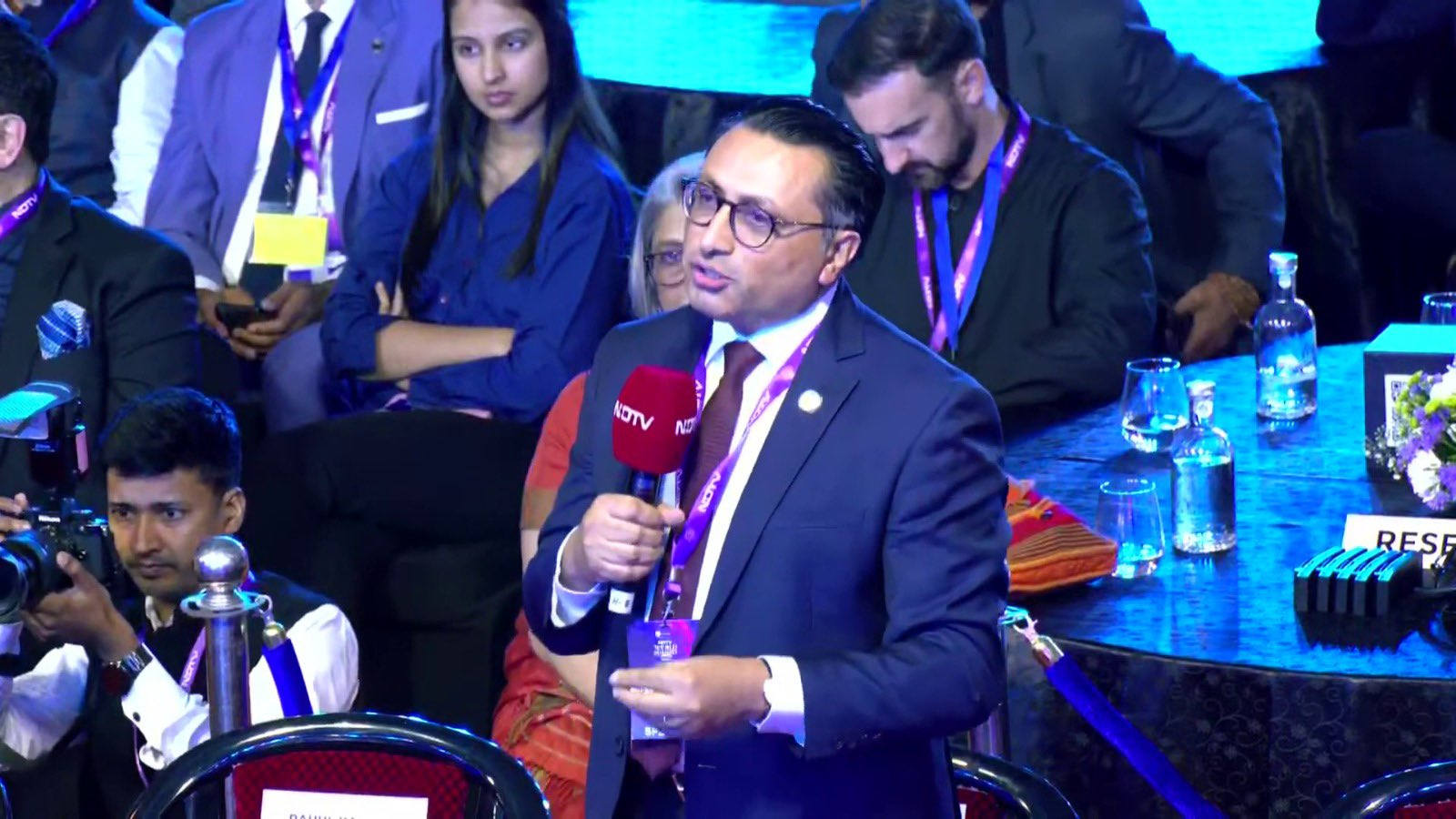
Kathmandu, October 23 — Finance Minister Dr. Swarnim Wagle’s participation in a discussion with Indian External Affairs Minister Dr. S. Jaishankar at the NDTV World Summit 2026 has raised questions about Nepal’s diplomatic positioning, the protocol accorded to its representative, and the language used to describe Nepal’s nationalism and relations with India.
The official account presents the discussion as an exercise in strengthening regional cooperation and adapting international partnerships to a changing global order.
However, the optics of the event and the reported remarks attributed to Wagle have prompted a broader question whether Nepal can pursue closer relations with India without appearing to compromise its sovereign equality or delegitimise legitimate nationalist voices at home.
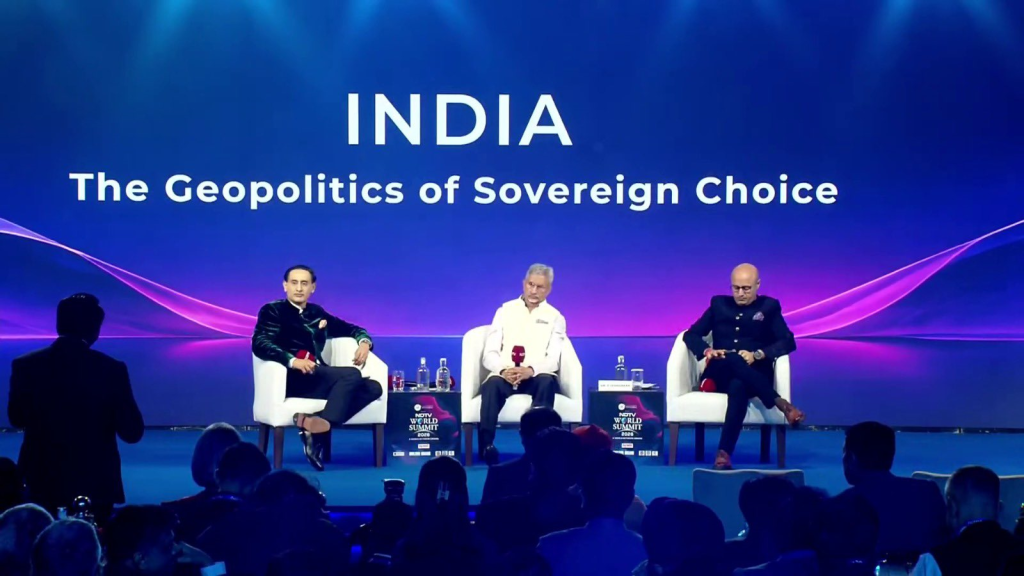
Diplomatic Protocol: Why Was Nepal’s Minister Not on the Dias?
Reports and criticism surrounding the event have drawn attention to the apparent difference in the positioning of the two ministers. While Jaishankar was the keynote speaker, Wagle participated as a guest speaker and was reportedly seated in the audience rather than alongside his Indian counterpart on the main dais.
The distinction between a keynote speaker and a guest speaker may reflect the organisers’ programme, and participation in a foreign media event does not automatically carry the same protocol obligations as an official bilateral meeting.
Nevertheless, the optics matter. When a serving minister from a sovereign neighbouring country participates in a high-profile international discussion with a senior Indian minister, the arrangements inevitably invite scrutiny over how Nepal’s representative is positioned.
The concern is not that Nepal’s Finance Minister must automatically receive identical billing to India’s External Affairs Minister. Rather, it is whether the format adequately recognised Nepal as an independent sovereign state whose representative was contributing to a substantive discussion on geopolitics and regional cooperation.
For a country that consistently emphasises sovereign equality in its foreign policy, such distinctions deserve a clear and measured assessment.
Has Nationalism Been Mistaken for Anti-Indian Sentiment?
More consequential is the reported remark attributed to Wagle that the era of “anti-Indian nationalism” in Nepal has ended. If accurately quoted and understood in its broader context, the statement raises questions that go beyond diplomatic courtesy.
Nepal’s nationalism cannot be reduced to hostility towards India. It encompasses the country’s sovereignty, territorial integrity, independent decision-making, constitutional identity and the right to conduct foreign relations on the basis of equality and mutual respect. These principles are not inherently anti-Indian. They are legitimate foundations of Nepal’s national interest.
There is an important distinction between anti-Indian hostility and a principled demand for balanced relations with India. Criticism of a particular Indian policy, disagreement over bilateral issues, concerns about unequal power relations, or advocacy of strategic autonomy should not automatically be categorised as anti-Indian sentiment.
Nor should the pursuit of equidistance understood as maintaining independent judgement and constructive relations with neighbouring and other powers be confused with antagonism towards any particular country. For Nepal, the objective should be to preserve freedom of choice, not to replace one form of dependency with another.
Consequently, if the Finance Minister intended to suggest that Nepal has moved beyond antagonistic nationalism towards mature and cooperative diplomacy, that argument deserved a more precise formulation.
If, however, the statement implies that nationalist voices demanding sovereign equality are relics of an anti-Indian political culture, it risks unfairly discrediting legitimate public concerns.
A government minister should exercise particular care in using politically charged terminology.
Such language can blur the distinction between hostility towards a neighbouring country and the democratic right to question whether bilateral relations are sufficiently balanced.
Friendship Without Subordination
Nepal has substantial reasons to maintain constructive relations with India. Geography, trade, transit, employment, energy, cultural ties, connectivity and people-to-people relations make the relationship indispensable to both countries. Cooperation during natural disasters and other emergencies is also valuable and should be acknowledged.
At the summit, Wagle reportedly expressed gratitude for India’s rapid assistance following the August 26 floods affecting the Bhotekoshi–Trishuli river systems, as well as for its support after Nepal’s devastating 2015 earthquake. Such assistance merits genuine appreciation. Timely humanitarian support can save lives and strengthen public trust between neighbouring countries.
Yet gratitude for assistance should not be confused with political alignment, just as cooperation should not require silence on contentious issues. Diplomatic goodwill is strongest when it rests on mutual respect rather than rhetorical demonstrations of loyalty.
Nepal’s relationship with India should therefore be guided by sovereign equality, reciprocal interests, non-interference, mutual respect and the freedom to disagree where national interests diverge. A close relationship does not require Nepal to abandon an independent voice, and an independent voice does not make Nepal an adversary of India.
Regional Cooperation Must Deliver Equal Benefits
The summit discussion also addressed the weakening foundations of multilateralism and the growing preference for bilateral, trilateral and flexible regional arrangements. Jaishankar reportedly argued that countries are increasingly favouring practical cooperation over formal institutional commitments, citing groupings such as BRICS and the International Solar Alliance in discussing different models of collaboration.
Wagle, meanwhile, raised questions about strengthening cooperation in disaster response, nutrition, energy and clean energy, including whether formal institutional frameworks or more flexible arrangements would be more effective.
These are important policy questions. Flexible partnerships can produce practical results, but they can also leave smaller states with fewer safeguards when bargaining power is unequal. Formal frameworks, transparency and clearly defined responsibilities can be particularly important when cooperation involves cross-border infrastructure, water resources, energy trade, disaster management and long-term economic commitments.
For Nepal, the test of regional collaboration should not simply be whether agreements can be reached quickly or administrative costs reduced. It should also be whether the arrangements respect Nepal’s decision-making autonomy, distribute benefits fairly and provide mechanisms for resolving disagreements.
Pragmatism is useful, but it should not become a substitute for institutional accountability where the interests of a smaller neighbouring country are at stake.
Nepal Needs an Independent Foreign Policy, Not a Politics of Labels
The government’s account portrays the summit as an opportunity to deepen cooperation amid global fragmentation and changing power relations. That objective is legitimate. What remains equally important, however, is ensuring that Nepal’s diplomatic engagement is not interpreted as an endorsement of any particular external power’s strategic preferences at the expense of Nepal’s own national priorities.
Nepal needs a Nepal-centred foreign policy which shall be capable of maintaining friendship with India, productive engagement with China and constructive relations with other countries without allowing any relationship to define the limits of its sovereign choices.
Equidistance should not be treated as a mechanical obligation to maintain identical distances from neighbouring powers. Its more defensible meaning is strategic independence, evaluating each issue on its merits and making decisions according to Nepal’s interests rather than external pressure or political sentiment.
Likewise, nationalism should not be used as a blanket justification for hostility, but neither should it be dismissed through the sweeping label of anti-Indianism. Democratic debate about sovereignty and foreign policy is a normal feature of an independent state, not evidence of diplomatic immaturity.
Ultimately, the significance of Wagle’s participation at the NDTV World Summit will depend less on the language of friendship alone than on the principles that guide Nepal’s actual diplomacy.
The country can welcome Indian cooperation, appreciate humanitarian assistance and pursue regional integration while insisting on equal treatment, reciprocal respect and independent judgement.
Nepal’s national interest demands neither hostility towards India nor unquestioning deference to it. It demands a relationship in which friendship and sovereignty reinforce each other—and in which defending Nepal’s equality is never mistaken for opposing its neighbour.