शिखका पहिरो प्रभावित
MYAGDI, Oct 25.
Bhumidevi Sherpunja Pun of Kindu Tole, Annapurna Rural Municipality-5, Myagdi, was forced to leave her home due to a landslide, spending a few days at a temporary shelter in Shikh. She has now begun living in an empty house provided by her elder sister, Sunmaya Tilija.
The house had remained vacant after Sunmaya’s family migrated elsewhere. In the wake of the disaster that left her homeless, the house has now become a reliable shelter for Bhumidevi’s family. “After spending about 15 to 20 days at the temporary shelter in Shikh, we consulted with family and decided to move into my sister’s vacant house,” said Bhumidevi. “We realized that the government cannot possibly accommodate us in shelters indefinitely. So, we decided to stay in my sister’s empty house until we build one of our own.”
While Bhumidevi’s family has found refuge in a time of crisis, Sunmaya’s unused house has also served a useful purpose. Like Bhumidevi, many displaced families in Kindu Tole have started moving into the vacant houses of their relatives, while others have found accommodation in Shikh Deorali, Lower Shikh, and Upper Shikh.
Moving from Shelters to Self-Management
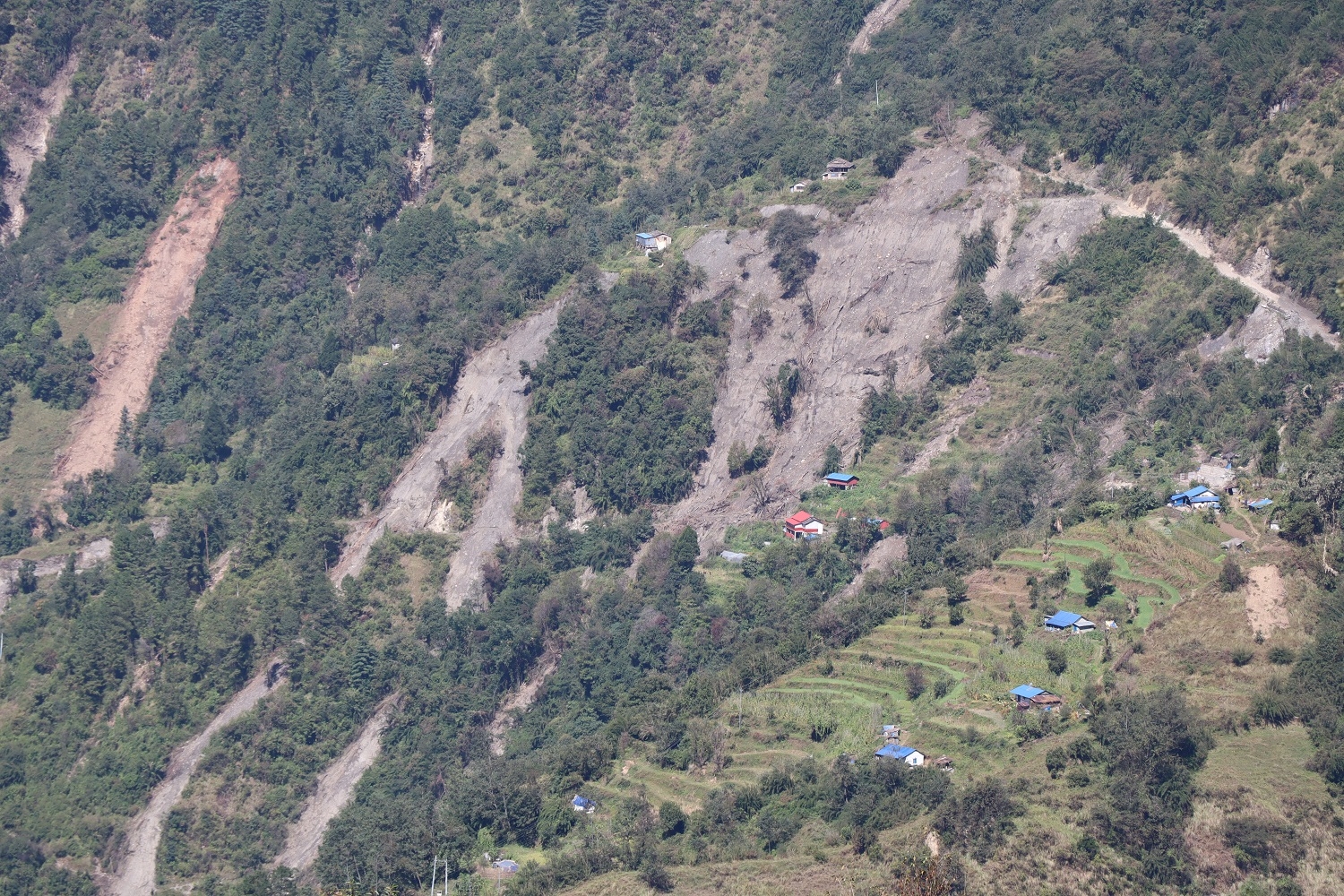
There are 45 houses across Dhoskekhor, Kindu, Jharwang, and Ghirwang in Annapurna-5. Excluding families who have migrated to cities like Pokhara and Kathmandu, 35 households traditionally resided in the village. Following incessant rainfall from October 8 to 11, these settlements were surrounded by landslides, severing their connection with the outside world.
Ninety-one people at high risk were airlifted to safety and brought to the playground of Kanchhibarahi Youth Club in Shikh Deorali, where a temporary shelter had been set up for them.
The landslide completely destroyed the homes of Narayan Sherpunja Pun, Ruk Bahadur Purja, Khem Bahadur Paija, Rek Bahadur Purja, Tam Bahadur Purja, and Jugman Chochangi. Many other houses, though uncollapsed, sustained severe cracks and are now uninhabitable.
Most families who had been staying in the huts and tents of the temporary shelter managed their own housing arrangements ahead of Dashain. According to Tole Coordinator Dipak Tilija, the displaced individuals have relocated to empty houses belonging to relatives and other safe locations.
Narayan Sherpunja Pun, who was met at the temporary shelter on Saturday afternoon, also confirmed that displaced people have begun managing their living arrangements independently. However, his own family remains in a state of uncertainty.
Houses, Cattle Sheds, and Farmland Washed Away
The landslide swept away Narayan’s house, cattle shed, and agricultural land. He did not even get the opportunity to salvage food grains and other belongings from his house.
“I could not retrieve anything from home, including 21 muri of potatoes and two muri of maize; everything was swept away by the landslide,” he shared. “The buffalo we released from the shed toward the forest on the day of the landslide cannot be brought back yet because the paths are destroyed.”
His wife has gone to stay with their children in Pokhara, and Narayan plans to work on his own farmland while staying in someone’s empty house. However, because his home and farmlands are located far away, he has been unable to make a final decision, prompting him to stay back at the temporary shelter. His previous house was destroyed by a landslide four years ago, and the newly built home—constructed using government housing reconstruction grants of 500,000 rupees before the full amount could even be disbursed—has now been destroyed as well.
With the cessation of rainfall, displaced residents have started returning to daily labor. Throughout the day, they visit the village to work on farmlands and handle household chores, while some are transporting remaining goods to safer locations. By evening, they return to the holding center to eat and sleep.
“Before Dashain, there were many people at the shelter, but the numbers have steadily decreased,” said Rek Bahadur Purja. “Realizing that constantly relying on the government during a disaster brings only hardship, those who were able and in a position to do so have managed things on their own.”
Establishing temporary housing has not resolved all problems. Families whose homes were destroyed without allowing them a chance to retrieve belongings are still facing shortages of food items, cooking utensils, and clothing, and continue to require relief and support. According to Shikh community leader Ganesh Gurung (Suren), efforts are ongoing to coordinate with government agencies and donors to facilitate better living conditions for the affected families.
Challenges Involving Electricity, Drinking Water, and Trails
Rehabilitation remains a major challenge in Annapurna-5, the ward hardest hit by the disaster. According to Ward Chairperson Rajesh Tilija Pun, electricity, drinking water, and trails require urgent restoration.
“Road connectivity is still a distant matter at this point,” he stated. “After a lot of effort, electricity service has begun to be restored. We are constructing walking trails through voluntary labor and are actively trying to arrange a regular drinking water supply.”
Ward Chairperson Pun added that delays in sending an expert team to study the geological condition of the landslide-affected settlements have made it difficult to make definitive decisions regarding rehabilitation. The affected families remain in limbo because it is still unclear which settlements are safe for habitation and which ones require complete relocation.
Shelters in Other Areas Also Emptying Out
The temporary shelter set up in Ghar (Ward No. 6) for displaced residents of Pawdwar in Annapurna-5 was also closed starting November 1.
According to Ghar Ward Chairperson Ram Bahadur Khadka, the displaced people left their belongings at the shelter and returned to their relatives and villages, with the understanding that they can reoccupy the shelter if heavy rains resume. At its peak, the Ghar shelter had accommodated up to 115 people from Pawdwar.
Similarly, the temporary shelter in Siruawari, which housed 30 families displaced from Mahabhir in Annapurna-8, has also been vacated. According to Ward Chairperson Kham Bahadur Garbuja, the affected families from Mahabhir are striving to arrange their own accommodation by finding vacant houses, while the local administration is facilitating arrangements for those yet to secure a place.
Monsoon-related disasters this year have claimed six lives in Annapurna Rural Municipality. According to the rural municipality, 60 houses have been completely destroyed and 129 partially damaged. Life, which initially began inside temporary shelters following the disaster, is now slowly transitioning toward self-management.
While empty houses of relatives, safe village clusters, and available resources have served as immediate lifelines for the displaced, their struggle will persist until safe rehabilitation and basic public services are fully restored for families who lost their homes.
RSS/Unified Nepal