भौगर्भिक अध्ययन
MYAGDI, October 30:
A preliminary geological study has been conducted on the landslides in Pauddwar, Annapurna Rural Municipality-5, which was the hardest-hit area by this year’s monsoon-induced disasters in Myagdi.
The study covered landslides in Pauddwar as well as Nepane, Giwang, Jharwang, Kindu, Dhaskekhore, Sobitta, Bhuwanthan, Birauta, Shikha, and Hallekharka located in Wards 5 and 6 of Annapurna Rural Municipality.
Lekhprasad Bhatta, a geologist from the consulting firm ‘People in Need’ deployed by the National Disaster Risk Reduction and Management Authority (NDRRMA), stated that the study was carried out through site inspections, discussions with affected people, sample collection, and the use of drones.
“Based on the request of Annapurna Rural Municipality and the decision and recommendation of the District Disaster Management Committee, the Disaster Risk Reduction and Management Authority sent us to conduct a preliminary geological study of the landslide in Pauddwar village,” he said.
“Our study focused on providing recommendations regarding whether it is suitable to continue settling the village in Pauddwar.”
A team comprising Annapurna Rural Municipality Vice-Chairperson Diva Tilija Pun, Ward No. 5 Chairman Rajesh Tilija Pun, the head of the rural municipality’s technical branch, and geologists studied around 30 landslides spanning lengths of over 100 meters.
Geologist Bhatta noted that additional risks have emerged due to landslides above Pauddwar village, severely cracked ground, and tilted trees. According to him, initial assessments indicate that 15 houses are at high risk from the landslides.
Bhatta mentioned that a detailed report containing recommendations regarding the risks posed to the settlement by the landslides originating from above the village and other areas will be submitted to the rural municipality.
Ward Chairman Rajesh Tilija stated that on September 27 (Ashoj 11), two people lost their lives when they were buried by a landslide in Giwang, Annapurna Rural Municipality-5, while 28 houses were completely destroyed.
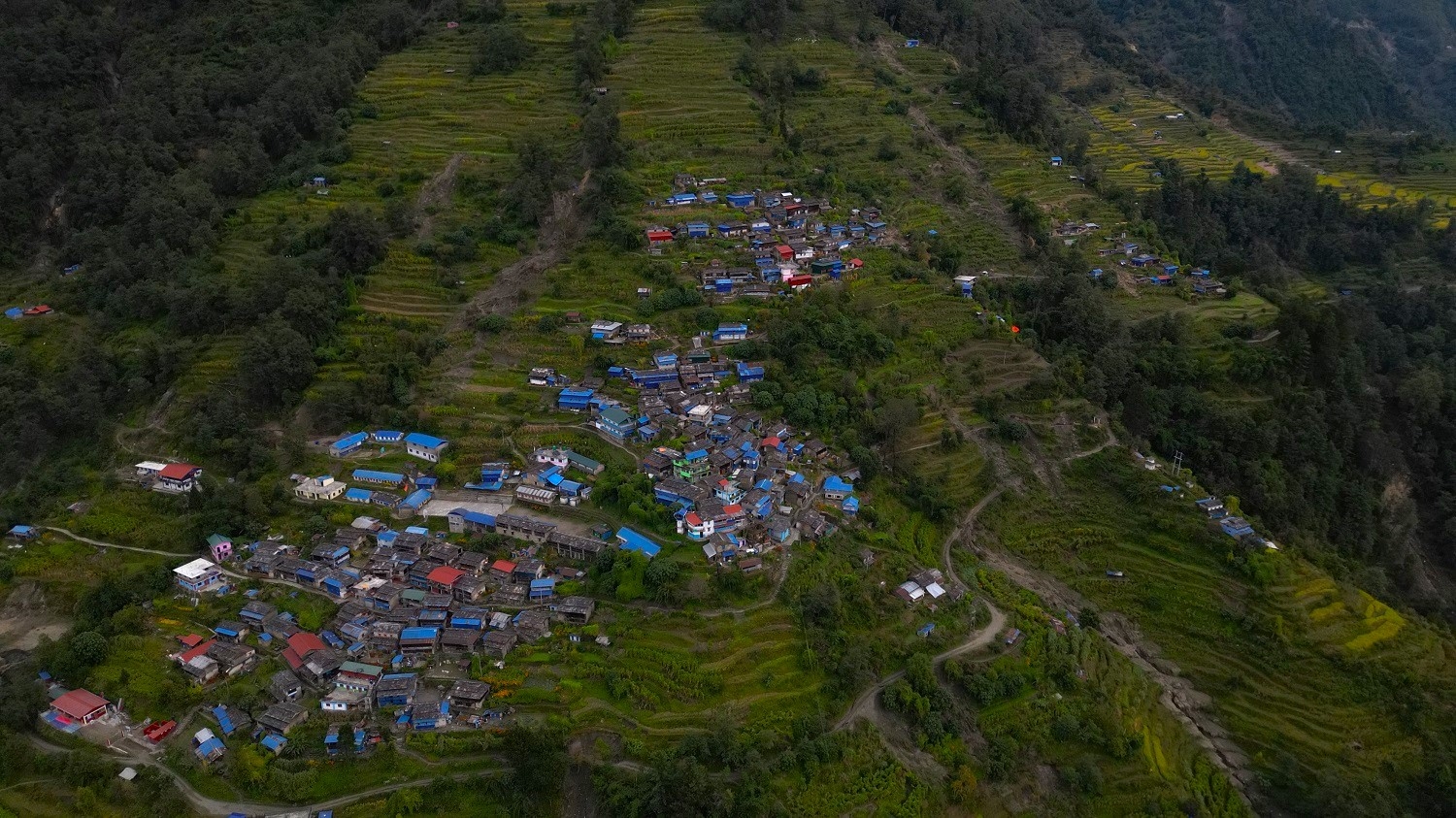
Pauddwar village, home to over 200 houses, is surrounded by landslides on all sides, and other settlements face similar risks.
The road connecting Pauddwar remains blocked, though local residents have voluntarily cleared a footpath through collective labor (shramdan).
Temporary electricity supplies have been restored, and a voluntary campaign has been initiated to repair drinking water systems.
The 115 residents of Pauddwar who were rescued by helicopter on September 27 and sheltered at the relief camp in Ghar, Annapurna Rural Municipality-6, have recently started moving into the empty houses of relatives and neighbors or building temporary huts in safe locations.
Most of the 35 households previously sheltered in Shikha have also moved into relatives’ homes.
Annapurna Rural Municipality Vice-Chairperson Diva Tilija Pun stated that reconstruction work will be advanced based on the recommendations and study report provided by the geologists.
She added that initiatives are also underway to conduct geological studies for landslides in other areas of the rural municipality.
—RSS