
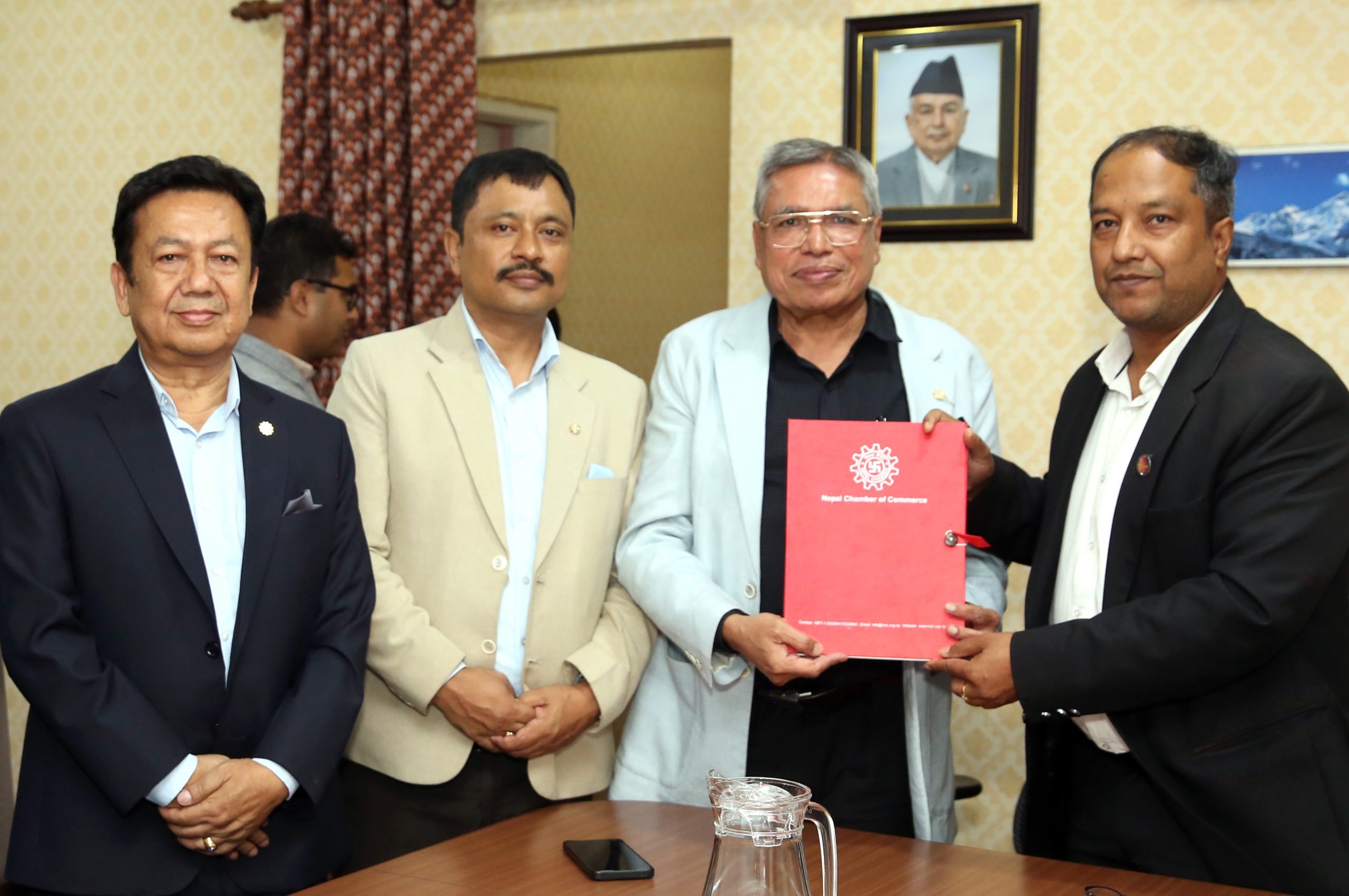
Kathmandu, Sept. 23: The Nepal Chamber of Commerce has submitted a preliminary draft of the proposed Commercial Credit Recovery Bill, 2083 to Minister for Industry, Commerce and Supplies Dipak Kumar Shah, seeking a legal mechanism to address the long-standing problem of unpaid trade credit.
A Chamber delegation led by President Kamlesh Kumar Agrawal handed over the draft to Minister Shah on Wednesday.
The proposed legislation seeks to provide businesses with a faster mechanism to recover payments for goods and services sold on credit. The Chamber said prolonged delays in payment have put pressure on working capital, disrupted cash flow and affected business expansion.
Under the draft, an invoice issued for the sale of goods or services would serve as evidence of the transaction. Written or electronic purchase requests, the seller’s acceptance and the issued invoice could also be recognized as proof of the transaction.
If a payment deadline is specified on the invoice, the buyer would have to pay within that period. If no deadline is specified, payment would generally have to be made within seven days of delivery.
The draft also proposes the formation of Commercial Credit Transaction Recovery Committees at both federal and provincial levels. The committees would investigate complaints and attempt to recover unpaid amounts within 30 days.
The proposed committees could also coordinate with tax authorities to restrict certain tax adjustments and with relevant agencies to suspend dividend payments in cases involving unpaid commercial debts.
Court proceedings after committee intervention
The draft proposes that parties first seek remedy through the relevant committee before initiating court proceedings. If the committee fails to resolve the matter within 30 days, or either party is dissatisfied with its decision, the case could be taken to the district court.
Sellers would be allowed to seek recovery of principal, interest and penalty interest. The draft proposes that no court fee be charged on such claims and that cases be decided through a summary procedure within 30 days.
Courts could also issue interim orders to freeze bank accounts or property of buyers when the claim appears prima facie valid. Restrictions could be placed on the transfer, sale or registration of relevant movable and immovable property while the case is pending.
The draft gives priority to settlement between buyers and sellers. Where the parties agree to installment-based payment, any discount or waiver granted under the settlement would automatically lapse if an installment is not paid on time.
Proposed VAT and bad-debt provisions
The draft also addresses the tax consequences of unpaid commercial credit.
If a seller has already paid VAT on an invoice but does not receive payment from the buyer, the unpaid amount could be adjusted as a tax credit in a subsequent tax period, subject to the proposed law.
Similarly, unpaid or waived credit amounts could be treated as bad debts or business losses for income-tax purposes, subject to the Income Tax Act, 2058 and certification by the relevant committee or court.
Chamber President Agrawal said the proposed law aims to institutionalize the recovery of commercial debts and reduce the financial and administrative burden businesses face because of lengthy legal procedures.
The Chamber said it expects the government to consider the proposal as part of efforts to improve the business environment and strengthen cash flow in the private sector.