


Kathmandu, November 20:
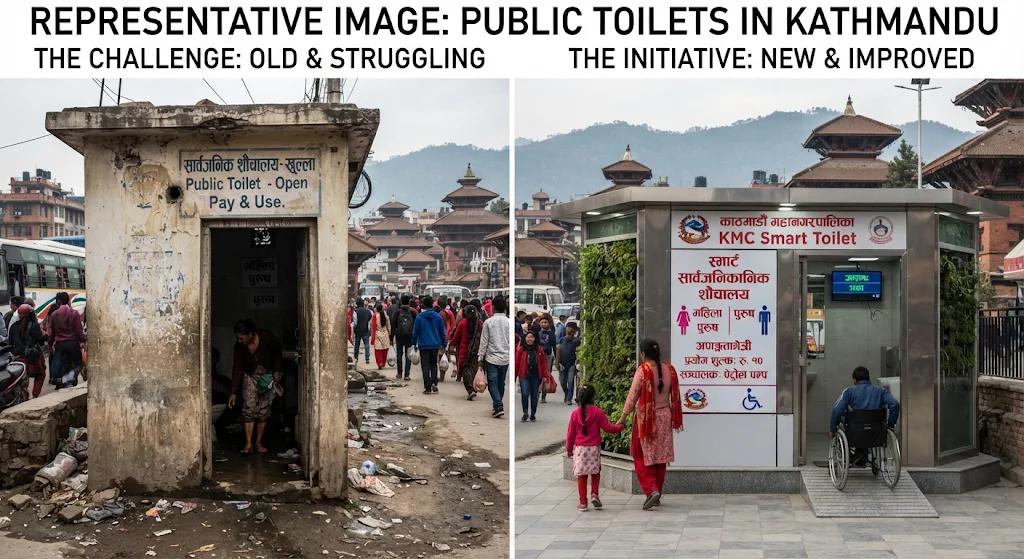
For many people in Kathmandu, finding a public toilet is not simply a matter of convenience—it is a daily struggle for dignity. Dirty facilities, a lack of water, poor maintenance, inaccessible structures, and closed toilets leave pedestrians, women, children, elderly people, and persons with disabilities struggling to meet one of their most basic needs while navigating the city.
A recent study by the Kathmandu Metropolitan City’s Urban Planning Commission has laid bare the sorry state of public toilets across the capital, revealing that many facilities are poorly managed, inadequately maintained, or simply unusable.
Of the 169 public toilets surveyed, only 113 were operating regularly. Nine were partially operational, 10 were still under construction, 14 were closed or out of service, and two were deemed unusable. The status of 21 others remained unclear.
The figures paint a troubling picture of a city where public toilet infrastructure exists on paper, but access to clean, safe, and functional facilities remains far from guaranteed.
The study, which examined cleanliness, water supply, physical infrastructure, accessibility, and management, concluded that Kathmandu’s problem is not necessarily a shortage of toilets, but the failure to properly maintain and manage the ones already built. It recommended prioritizing repairs, upgrades, and reconstruction over simply adding new structures.
Responding to the findings, Acting Mayor Sunita Dangol has directed concerned authorities to treat public toilets as an essential and mandatory public service, with a focus on making them clean, safe, inclusive, and accessible. She also stressed the need for women-friendly, child-friendly, and disability-accessible facilities.
The study further highlights the need to carefully assess access, water supply, drainage, foot traffic, public demand, land ownership, and long-term operational feasibility before constructing new toilets.
The Metropolitan City says it has begun implementing an action plan, dividing proposed improvements into immediate, medium-term, and long-term measures. It has also acknowledged petrol stations operating public toilets for improving cleanliness and making their facilities more user-friendly.
But for the thousands of people who move through Kathmandu every day, the real test will not be in directives, reports, or plans—it will be whether they can find a clean, safe, accessible toilet when they need one.
Because a public toilet is not a luxury. It is a basic service, and access to it is a matter of health, dignity, and human rights.