


Kathmandu, Nov 25:
Darji did not inquire about her husband’s ancestral home when she got married. Tailoring skills and her husband’s support were enough to make a living. However, after her husband’s death, questions of identity and citizenship arose in her life.
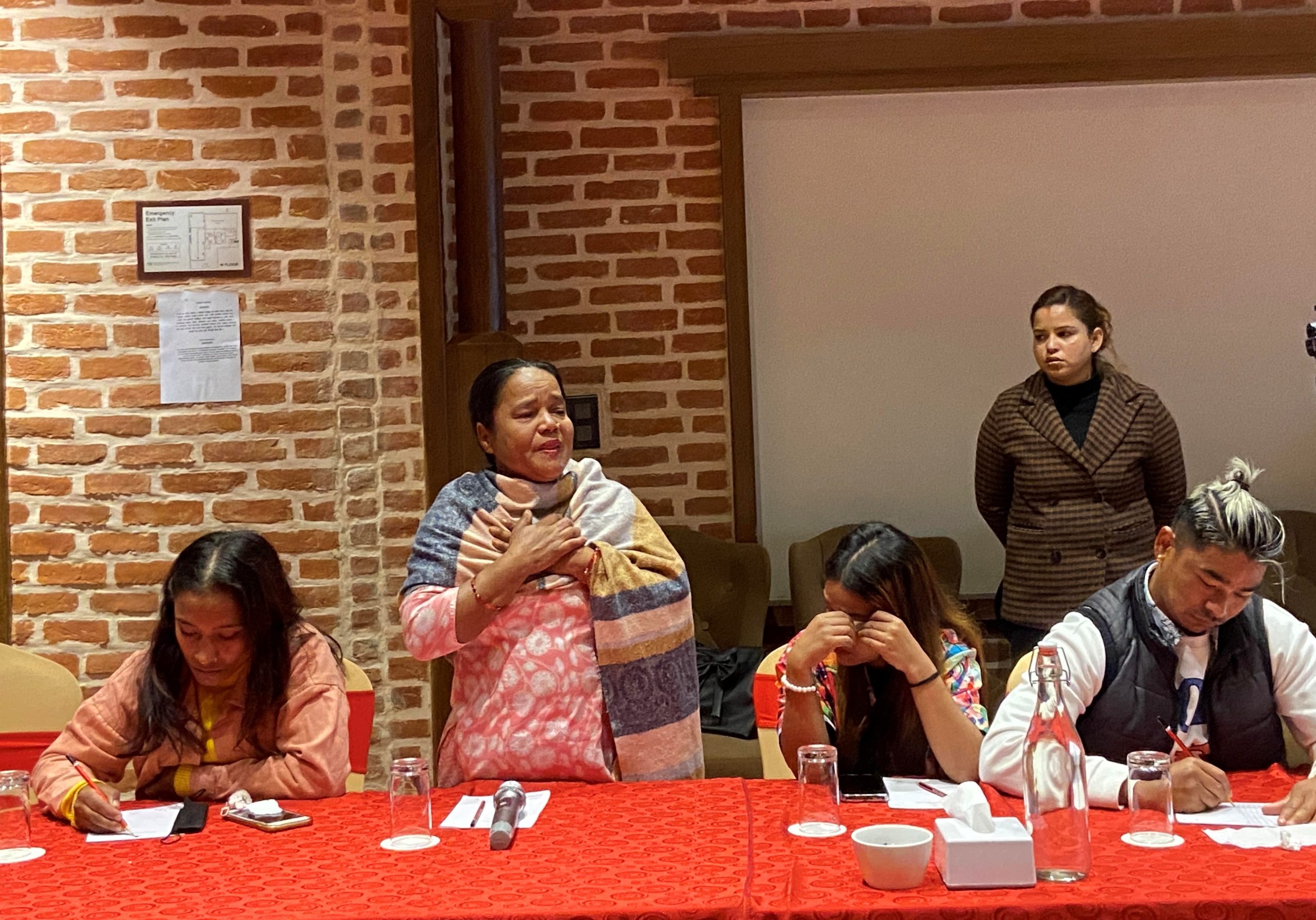
Born in Nepal, Pampha has been struggling with the pain of remaining stateless in her own country. Her distress is not limited to herself alone. She is even more worried after a situation arose in which her children and grandchildren may also remain without citizenship. She says, “We fear that three generations of us will become stateless.”
According to Pampha, she married a young man who had come visiting her maternal village. The eldest among 10 children, her family was in the grip of poverty. Her parents arranged her marriage thinking the young man, skilled in sewing clothes, could support the family. “They married me off thinking the boy is skilled at sewing and will provide,” Pampha said. “Neither my maternal family asked where his home was, nor did I ask.” After that, her married life passed doing tailoring and wage labor.
More than two decades have passed since the death of Pampha’s husband, who had come to Kathmandu for employment 35 years ago. She faced the problem of not having citizenship even more severely when it became impossible to obtain citizenship and birth registration for her children. Now, without birth registration, her grandchildren are also deprived of going to school.
“After all, I am also a citizen of this country. My birthplace is this country. Why isn’t my citizenship made? I couldn’t understand at all,” she said emotionally.
The worry that even her grandchildren might end up without citizenship has been tormenting Pampha. Therefore, she is pleading for civic identity for her children and grandchildren. According to her, she was born in 2025 BS. She wants the next generation not to suffer the hardships she endured due to lacking citizenship.
“Without citizenship, my two sons have neither found employment nor been able to study. We are even deprived of the opportunity to open a bank account,” she said. She stated that her sons, who earn a living through daily labor, even had to lose that work simply because they lacked citizenship. She said that without citizenship, the family’s livelihood has been taken away, along with being deprived of various facilities provided by the state.
She did not refrain from trying to get citizenship through her maternal side either. However, she returned to Kathmandu disappointed after local authorities turned her away, saying citizenship for a married daughter could not be issued from her maternal home.
“I went to my maternal home saying I needed to get citizenship after my husband passed away. But there they sent me back telling me to get it from my husband’s side. I don’t know my husband’s ancestral home. Where should I go now?” she asked.
When Will We Get Our Citizenship?
Sanjay Rai, who spent his life as a street child, remains without citizenship even after reaching adolescence. He has been unable to obtain citizenship because his relatives are unidentified. Having somehow become a taekwondo player, he also got a job coaching at a school. However, he said he faces trouble collecting his pay because he does not have citizenship.
The TikTok account he has been operating is also in someone else’s name. He complained that Rs. 500,000 earned in that account was also kept by someone else. He said he was forced to get the mobile SIM card he uses in someone else’s name as well.
“What greater irony can there be than not even being able to open a bank account because of not having citizenship?” he asked.
With the help of the organization Saath Saath, he asked members of the House of Representatives, “Honorable MPs, when will we get our citizenship?”
Anju Guru is without citizenship just like Sanjay. She spent her childhood on the streets in the Pashupati area. Anju, who married in adolescence, also has a husband who is a street person. Neither the husband nor the wife has citizenship.
“If I had citizenship, I would get employment. Our future would be bright. Right now we are living in darkness. We have neither identity nor respect,” she said.
According to a recent survey on street children conducted by Saath Saath, 93 percent of the 150 street children surveyed are unaware of birth registration. The survey concludes that most view birth registration as a means to obtain citizenship and employment rather than a fundamental right.
The survey notes that 65 percent lacked parents’ documents, while 35 percent involved cases linked to unidentified or missing fathers and marital status. Likewise, the survey showed that 45 percent do not have any identification card or document, leaving them deprived of access to formal employment and government services.
The organization also categorized cases where birth registration could not be done. Accordingly, there are three cases involving cohabiting couples, 25 involving polygamy, 45 where neither parent had documents, 65 where the father lacked documents, 27 where the mother lacked documents, 45 where the father is missing, and five cases involving identification of a foreign citizen father.
Lawmaker Madhusudan Chaulagain of the Law, Justice and Human Rights Committee said that since the right to citizenship is a fundamental right, no citizen should be deprived of it. He expressed the view that temporary identity cards should be arranged for citizens to live smoothly when documents are not verified and parents’ identities are not established.
For this, he expressed a commitment to hold necessary discussions in the committee and take initiatives to prepare working procedures to make the citizenship distribution process easier.
“People must get a natural right like citizenship. The law exists. We will take initiatives in the committee to make it even simpler,” lawmaker Chaulagain said.
Rights activist and Saath Saath resource executive Kavita Shah said that although legal provisions exist to obtain citizenship and birth registration, complex practical implementation prevents ordinary people from receiving services easily.
“Good laws have been made, yet because the practical side is weak, many in the younger generation are forced to become stateless,” she said.
RSS