


Kaski, Nov 29 :
The festive atmosphere of traditional dain (paddy threshing) prevailed from early Saturday morning at Naubisetole in Pokhara Metropolitan City-29.
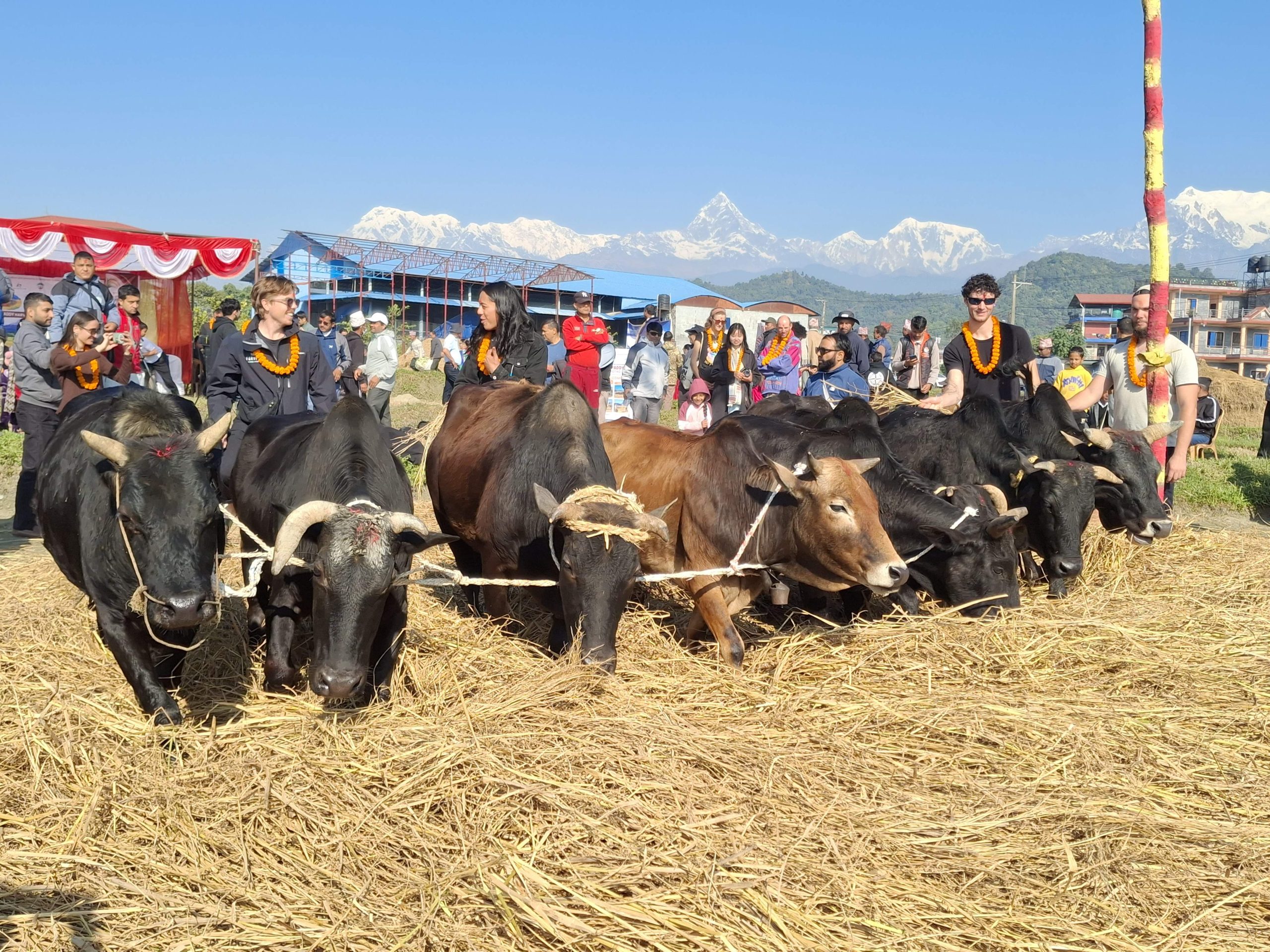
In the harvested paddy fields, some people were busy taking sheaves from stacks and threshing the grain, while others were driving yoked oxen to thresh the harvest. Women were sorting straw used for weaving gundri (traditional straw mats).
Sitting along the earthen field ridges, foreign tourists watched with delight the Nepalese agricultural practice of gathering the rice harvest in the traditional manner. The third edition of the Dain Festival was organized at Naubisetole under the slogan “Pokhara for All Seasons,” hosted jointly by Pokhara Metropolitan City and the Pokhara Tourism Council with promotion by the Nepal Tourism Board.
At the festival held to preserve culture and promote tourism, foreign tourists had the opportunity to observe Nepalese paddy-harvesting traditions up close. The sight of threshing paddy and driving oxen against the backdrop of the mountains proved to be a novel experience for them, and several tourists joined in the threshing activity themselves and enjoyed it.
Tourists from England, led by Mark, began driving the oxen, with other tourists joining in alongside him. Mark, who has come to Nepal for trekking, expressed happiness at being able to take part in the Dain Festival.
“I have come to Nepal for two weeks. I plan to go trekking. Participating in a paddy festival with the mountains in the background and driving oxen is a first-time experience for me. I am happy. I will tell my friends about this when I return home,” he said.
Japanese tourist Hitomi, who has arrived to trek in the Annapurna region for two months, also expressed excitement at participating in the Dain Festival. While she found driving the oxen enjoyable, she remarked that the method of threshing paddy seemed difficult to her. “I drove the oxen and felt good. However, I could not thresh the paddy; it seemed tall. Nepal’s way of farming seems fun,” she said.
Chinese tourist Sandesh noted that farming is carried out traditionally in a similar manner in China as well. Pointing out that paddy planting and harvesting methods are alike in Nepal and China, he stated that as the use of modern technology continues to grow, the younger generation should be informed about traditional agricultural systems.
“Nowadays there has been much development; tractors and machines have arrived. We must teach today’s children how rice comes about,” he said.
The festival was organized with the objective of passing on the traditional agricultural system—which is gradually disappearing in Pokhara amid growing urbanization and changing lifestyles—to the younger generation. Local residents, students from various schools, children, and others were present at the event.
Festival Coordinator and First Vice President of the Pokhara Tourism Council, Hariram Adhikari, stated that the festival has helped preserve traditional farming systems, promote local produce, protect arable land, and encourage farmers toward their profession.
“We believe this will increase domestic and foreign tourist activity while also contributing to the development of agro-tourism,” Adhikari said.
Pokhara Metropolitan Mayor Dhanraj Acharya stated that tourism promotion is not limited merely to bringing domestic and foreign tourists and housing them in hotels. He remarked that presenting Pokhara’s nature, culture, and indigenous traditions to tourists is also an important aspect of tourism development.
“Pokhara is a city rich in nature, culture, and adventure activities. We have our own indigenous culture and traditions. For a long time, we have been organizing various festivals with the view that we must present our culture to the younger generation, Nepali brothers and sisters coming from different parts of the country, and foreign guests,” he said.
He added that a few days earlier, activities related to Gai Puja (Cow Worship) and Kukur Puja (Dog Worship) in Lakeside had also acquainted foreign tourists with Nepali culture and its connection to nature.
Chairperson of the Pokhara Tourism Council, Hari Bhujel, stated that the festival was organized to promote Pokhara’s tourism by linking traditional agricultural culture, rural lifestyle, and local products with tourism.
“We started the Dain Festival after tourists who participated in the Ropain (paddy planting) Festival in Asar began showing interest in how paddy is brought in. At a time when agricultural modernization is increasing, we have tried to keep the old agricultural system alive and attract tourists by finding pairs of oxen and threshing in the traditional way,” he said.
Chief of the Metropolitan Economic Development Division, Manahar Kadariya, stated that the festival has helped preserve the traditional agricultural system—which has been falling into shadow due to urbanization and changing lifestyles—and pass it on to the younger generation.
He remarked that the festival contributes to the development of agro-tourism by promoting local products, protecting arable land, and encouraging farmers in their occupation.
Competitions in paddy threshing, danderi (a traditional threshing/harvesting activity), gundri weaving, and tug-of-war were held during the festival. In addition, outstanding farmers producing high yields of paddy were honored.
RSS