


Myagdi, Nov 24:
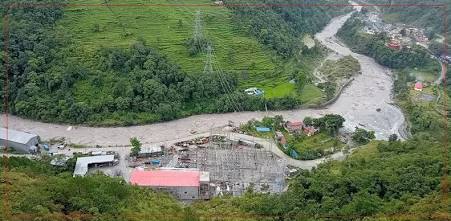
This year’s monsoon-induced disaster has severely impacted power generation, transmission, and construction across hydropower projects in Myagdi. Floods and landslides in the Kaligandaki and Myagdi rivers as well as their tributaries have damaged dams, powerhouses, tunnels, transmission lines, and access roads of both completed and under-construction projects.
Several projects have been completely shut down due to floods and landslides, while power generation and testing at others have been affected. Construction pace has slowed at under-construction projects due to disruptions in transporting construction materials and mobilizing equipment, creating risks of longer completion timelines and higher construction costs. While dozens of projects are under construction and operation in the Kaligandaki and Myagdi Khola basins, the latest impacts on hydropower generation structures and construction raise questions about how vital physical infrastructure protection and disaster management are for energy development.
Power Supply via Temporary Towers
Riverbank erosion by the Kaligandaki River damaged the Dana–Khurkot transmission line under the 220 kV Kaligandaki Corridor. Floods swept away two towers at Aula in Annapurna Rural Municipality-1 and one tower at Ratopani, while partially damaging a tower at Dhirchyang. Another tower in the Tiplyang area has also come under threat of river erosion.
With the transmission line disrupted, connecting electricity generated by hydropower projects in northern Myagdi to the national grid became difficult. According to Roshan Khadka, chief of the Nepal Electricity Authority’s (NEA) grid office in Pokhara, power supply resumed from Ashoj 31 after erecting temporary towers in the Bhirkate area and stringing roughly two kilometers of wire. The authority stated that reconstruction of the flood-damaged transmission line and towers has also moved forward. Power generated from Ghar Khola (5 MW? — reported as Ghlemdikhola 5 MW, Mistrikhola 42 MW, Nilgiri-1 38 MW, Nilgiri-2 71 MW, Relekhola 6 MW at Narchyang in Annapurna Rural Municipality-4, and Thapakhola 14 MW in Mustang has been feeding into the national grid via this transmission line.
Two Projects Shut Down, Billions in Losses
Two hydropower projects operating in Annapurna Rural Municipality have been affected by floods and landslides. Project representative Homnath Pandey stated that the 6 MW Relekhola Hydropower Project shut down after floods from the Relekhark area of Narchyang deposited sediment in the dam.
Similarly, the dam of the 14 MW Gharkhola Hydropower Project—which had earlier been hit when a dry landslide on Shrawan 26 buried its powerhouse—suffered further damage from floods and landslides in the second week of Ashoj. One person died and another was injured when the landslide buried the powerhouse, with all powerhouse equipment buried under debris. Anil Tiwari, staff member at promoter Myagdi Hydro Power, said preparations are underway to rebuild the project, with preliminary estimates putting disaster damage at more than NPR 1 billion.
Construction Affected in Kaligandaki Basin
Construction work at the under-construction 180 MW Kaligandaki Gorge and 66.3 MW Madhya Kaligandaki hydropower projects in the Kaligandaki basin has also been disrupted for a month. According to Senior Manager Krishnadas Shrestha of Kaligandaki Gorge Hydropower Project, construction was affected after floods and landslides deposited debris at the dam construction site at Thapla in Ghasa, Mustang. The project had recently begun excavating two adit tunnels.
According to Chandra Prasad Dhakal, chair of the IME Group, an investor in promoter Hydro Support Pvt. Ltd. for Madhya Kaligandaki Hydropower Project, floods in the Kaligandaki River caused major damage to the dam, tunnel, housing, machinery and equipment, construction materials, diesel tanks, and workshop. Floodwaters breached the diversion and deposited debris at the dam construction site at Sukebagar on the border of Annapurna Rural Municipality-3 and 4, and also entered inside the tunnel adit. Residential buildings at Nagdhunga and Ratopani in Annapurna Rural Municipality-2 collapsed, and materials stored there were swept away.
The river also washed away the Pokhrebagar-side approach road to the motorable bridge on the Beni–Jomsom–Korala road in front of the under-construction underground powerhouse at Naulibagar. Dipendra Sharma, an employee of civil contractor Rasuwa–Multi JV, said construction halted after flood and landslide damage, noting that project timelines are likely to extend due to the disaster.
Rahughat Testing Period Extended
The testing period for the 40 MW Rahughat Hydropower Project has been extended after Kaligandaki River erosion damaged the powerhouse area at Tilkenichaur in Raghuganga Rural Municipality-3. Floods damaged the tailrace gate of the project, promoted by NEA subsidiary Rahughat Hydro Power. Alongside damage to the structure that discharges water back into the river after generation, the river shifted its course and eroded close to the switchyard, while water entered the powerhouse through the tailrace and caused inundation.
The project, which had started test generation in early Ashoj, had completely shut down due to the flood. Ganesh KC, managing director of Rahughat Hydro Power, said re-testing is underway after repairing damaged structures and equipment, with two 20 MW units currently operating alternately for test generation. In addition to repairing the approach road connecting to the dam, accumulated debris has been cleared from the dam area on the border of Jhin and Dagnam. Floods also eroded roughly 150 meters of the Beni–Jomsom–Korala road alongside the Rahughat powerhouse area, leaving the switchyard at high risk and sweeping away vehicles and equipment belonging to civil contractor Jayaprakash Associates.
Transport Challenges in Myagdi Khola Basin
Under-construction hydropower projects in the Myagdi Khola basin have also been hit by floods and landslides. Jyoti Kumar KC, project chief of Upper Myagdi Khola-1, said transporting construction materials and equipment has been difficult due to landslides at Ghumaune (Phaparkhet), Balaute, Bangepahiro, and Ilpu, as well as flooding in Shivaratri Khola. Since Ashar, vehicles carrying cement, rebar, and other construction materials and equipment have been unable to reach project sites. Although work has continued using existing materials and equipment, construction has not progressed at the expected pace.
Because a motorable bridge being built over Shivaratri Khola through the Infrastructure Development Office was not completed on time, crossing vehicles face trouble during the monsoon. Buddhiraj Adhikari, public relations officer for Myagdi Khola Hydropower Project, said rising river water levels and landslides along access roads have disrupted construction, forcing crews to pull cargo trucks across with bulldozers and clear landslides to pass vehicles.
Construction has also been affected at Upper Myagdi Hydropower Project, which has achieved about 60 percent physical progress. Project chief Ramesh Subedi said construction materials have had to be transferred between vehicles at multiple points along the route. Resham Bhandari, chair of Darkhola Hydropower, said construction materials could not be hauled due to landslides on cliffs at Thapachaur, Gautali, and Dachaur along the Beni–Darwang and Darwang–Dharapani–Takam–Muna roads.
Infrastructure Safety and Disaster Management Challenges
Floods and landslides have not damaged all hydropower projects in Myagdi. Apart from Rahughat, power generation at other projects in the Rahughat corridor has remained regular. Generation has also continued normally at Tundi Power Company’s 84 MW Upper Rahughat and Mangale–Chimkhola–Rahughat projects, as well as the 22.5 MW Upper Thulokhola and 23 MW Thulokhola hydropower projects.
The recent disaster has shown that not only core structures like dams, powerhouses, and tunnels, but also access roads, transmission lines, construction material storage sites, and residential structures are at risk. River course shifts, sediment accumulation, and landslides can affect everything from regular operation to construction work. Since hydropower projects require large investments and long timelines, minimizing losses from natural disasters should be made an integral part of construction planning.
Beyond halting generation, floods and landslides can increase costs and timelines for under-construction projects, affecting overall energy development goals and raising investment risks. Special attention is needed toward river erosion control, safe embankments, alternative access roads in high-risk areas, protection of transmission towers, and disaster preparedness. As hydropower generation potential and investment grow in Myagdi, safeguarding related infrastructure against natural disasters has become equally important.
RSS