


Nawalpur, Nov 24:
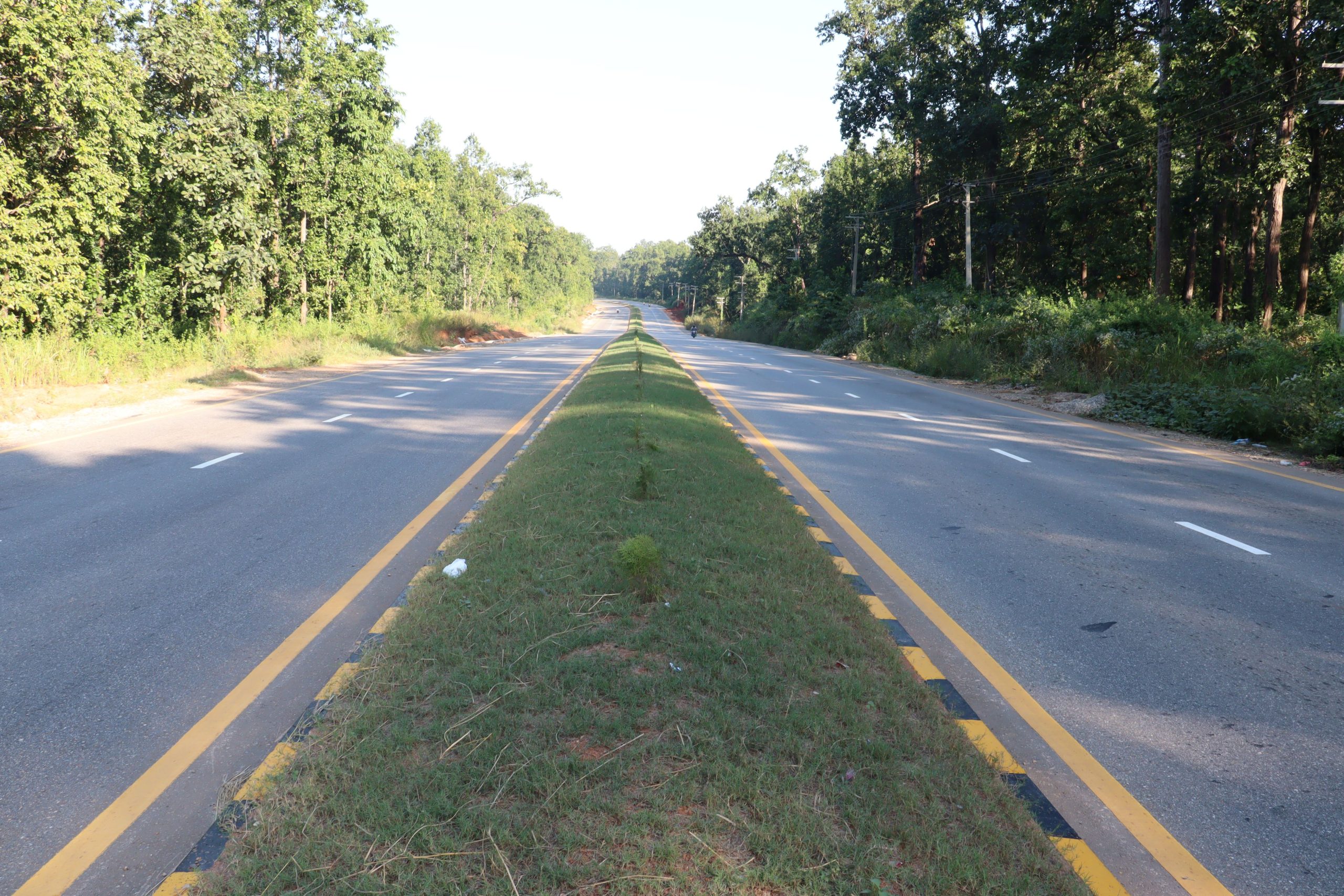
Planting turf (dubo) has begun on the central divider of the Narayanghat–Butwal road, which has completed expansion into four lanes.
Work to plant turf on the three-meter-wide divider along the roughly 113-kilometer stretch is progressing rapidly.
According to Engineer Shiva Khanal, information officer for the eastern section of the Narayanghat–Butwal Road Expansion Project, turf planting is underway on central dividers in various locations including Gaindakot, Devchuli, and Kawasoti.
Stating that blacktopping work under the road expansion project is nearly finished, he informed that work is now underway on side service lanes, painting roadside dividers, planting turf on the center divider, and planting ornamental plants to make the road look attractive.
The East–West Highway, whose foundation was laid in 2018 BS (1961 AD) by the late King Mahendra Shah in Gaindakot, Nawalpur, has been expanded to four lanes after roughly 65 years.
Following a contract for the Narayanghat–Butwal road expansion, an agreement to expand it was signed in Magh 2075 BS (January/February 2019). Expansion work began after the road’s foundation was laid in Chaitra of the same year.
Information officer Khanal said the road expansion work—originally started with a target to finish within 42 months of the agreement date—was completed last Saun (July/August) after extending the deadline four times over roughly eight years.
“After almost all road work was completed, we took over the road in Saun; the road has only been taken over, not yet handed over. After the takeover, the construction company will fix defects for five years. Only after that will it be handed over,” information officer Khanal said.
He noted that there will be a five-year testing period during which the construction company must carry out repairs, as various defects may appear on the road during construction.
With the main blacktopping and concreting works completed, work is now underway to fix defects, prepare pedestrian walkways, install roadside railings, and do concreting.
Both sections of the contract—divided into two parts—were carried out through global tender by the Chinese construction company China State Construction Engineering Corporation.
Around NPR 17 billion has been spent on expanding the road, which was tendered in two sections: the eastern section from Gaindakot to Daunne (65 kilometers) and the western section from Daunne to Butwal (48 kilometers).
The Asian Development Bank (ADB) provided 85 percent of the total budget as a loan at a 1.5 percent interest rate.
Under the 113-kilometer expansion of Narayanghat–Butwal, 70 kilometers have been built as four lanes, 29 kilometers as six lanes (four lanes plus additional service lanes on both sides), and 14 kilometers in the Daunne area as three lanes.
The project stated that road designs were differentiated according to geographical and transport needs across market areas, plains, and hilly terrain.
While sections in rural and forest areas were expanded to four lanes, urban stretches were expanded to six lanes, and geographically challenging parts of Daunne were expanded to three lanes.
In addition, arrangements have been made for lane markings, traffic signs, speed limit signs, and the use of speed guns for monitoring.
Information officer Khanal stated that speed limits have been set to reduce accidents as vehicle speeds increase after road expansion.
According to him, the maximum speed limit has been set at 80 km/h on straight and open roads, around 60 km/h in market and crossing areas, and 40 km/h in forest areas and the hilly Daunne section.
After repeated problems of blacktopped roads getting damaged and sinking on the Daunne mountain stretch, cement concrete has been laid over roughly 11 kilometers.
A total of 49,830 trees were cut for the expansion of the roughly 113-kilometer road from Gaindakot to Butwal.
With the four-lane road expansion, 21 large bridges, 43 small bridges, and 46 culverts (drains) for road drainage have been constructed in the area.
During expansion, small bridges and culverts were built to four lanes, while large bridges were prepared as two lanes to the south of the old bridges.
Information officer Khanal said older bridges were upgraded or replaced according to need and technical condition.
RSS