हुकाहुकी पर्व
BHADRAPUR (JHAPA), Nov 6 :
Indigenous communities in Jhapa are facing severe difficulties in procuring santhi (dry jute stalks), which is an essential requirement for celebrating the Hukahuki festival observed on the day of Laxmi Puja during Tihar. Santhi, which was once easily available in villages, is now hard to find and requires extensive searching. The problem in celebrating the festival has arisen as traditional jute (pata) cultivation continues to decline.
For the collective Hukahuki program scheduled for November 7 in Birtamod-9, Garamani, the organizers had to transport a tractor-load of santhi all the way from Gauriganj. Vishwadeep Rajvanshi, Chairman of the Rajvanshi Youth Committee, shared that they had to source it from Gauriganj after failing to find it in the surrounding areas of Birtamod, Kankai, and Bhadrapur.
Sakun Rajvanshi of Birtamod-9 also had to purchase a bundle of santhi for Rs 100. Since santhi is mandatory for playing Hukahuki on Laxmi Puja, she managed to buy it on a market day (Hatiya) in Birtabazaar after a long search. “Santhi, which used to be found everywhere in villages previously, is now very hard to find even when searching,” she expressed.
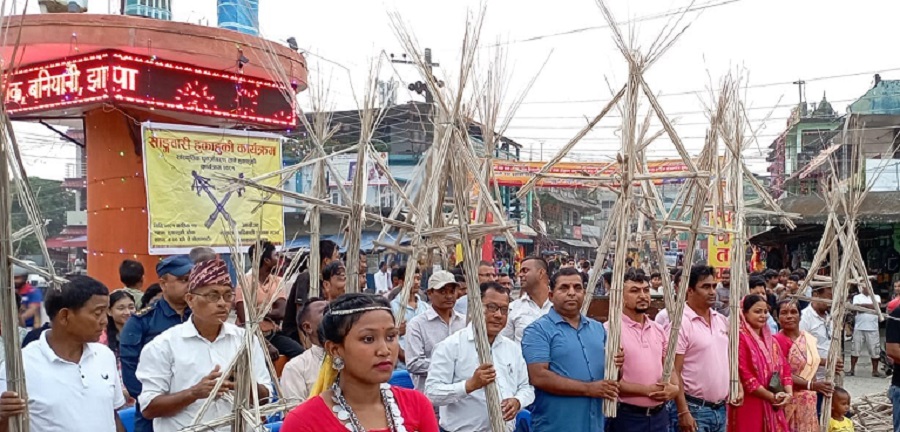
Indigenous communities including Rajvanshi, Tajpuriya, Gangai, and Majhi have a tradition of making bundles of santhi, worshipping them, and playing Hukahuki by lighting them on fire on Laxmi Puja. The availability of santhi has dropped as jute cultivation—its primary source—has steadily declined.
Jute cultivation, once a major cash crop in Jhapa, is now limited to very few areas. According to Sagar Vista, Chief of the Krishi Gyan Kendra, Jhapa, jute has been cultivated in approximately 525 hectares of land in the district this year. Former Ward Chair Shambhu Singh Rajvanshi stated that five bighas of land were used for jute farming in Barhadashi Rural Municipality-1 this year. According to him, farmers are abandoning jute farming because it lacks fair pricing and involves cumbersome processes.
“Retting jute plants requires rivers or ponds, but water bodies are disappearing,” he said. “Since it requires a lot of hard work from sowing seeds to drying the harvested plants, farmers are giving up this farming.” He noted that farmers who previously cultivated jute on bighas of land now grow it only in small patches for domestic purposes. Ruplal Rajvanshi, a farmer from Barhadashi-1, cultivated jute on one kattha of land last year. “I cultivate it more for santhi than for the fiber,” he said.
Domestic Uses of Santhi
The indigenous community uses santhi not only for the Hukahuki festival, but also for lighting fires, making cowdung cakes (gaita), and various other household chores. Although people used to make ropes at home from jute in the past, local Ruplal mentioned that they now buy ropes directly from the market. “Santhi is indispensable, which is why we still cultivate a small amount of jute,” he said.
The Krishi Gyan Kendra reported that jute farming is currently practiced in limited areas of Kachanakawal, Barhadashi, Jhapa, and Gauriganj rural municipalities. As the cultivation area shrinks, traditional practices and cultures dependent on it are also beginning to be impacted.
RSS